Cosmic Megastructure Quipu: The Largest Mystery in the Universe
Cosmic Architecture Beyond Imagination
No matter how vast we imagine the cosmos to be, its grandest structures routinely defy comprehension. Modern extragalactic astrophysics has revealed an unprecedented structure spanning cosmic spacetime: the cosmic megastructure Quipu.
Astronomers named this structure after the ancient Incan mnemonic device—a complex assembly of knotted cords used to store historical and numerical records—because its colossal network of galaxy filaments and gravitational knots visually mirrors an ancient Incan quipu.
Dimensions and Geometry of the Cosmic Giant
Viewed on cosmological scales, Quipu resembles an immense braided rope of luminous galactic clusters. Extending across approximately $1.3$ billion light-years, Quipu stands among the longest coherent cosmic structures ever identified in the observable universe.
A beam of light traveling at $300,000$ kilometers per second would require $1.3$ billion years to traverse its main backbone. Dozens of auxiliary filaments branch outward from its central spine, weaving a cosmic tapestry where each node harbors dense galaxy clusters illuminating the void with hundreds of billions of stars.
Discovery and Observational Analysis
This astronomical breakthrough emerged from extensive archival analyses of extragalactic X-ray data gathered by the ROSAT satellite, led by German astrophysicist Hans Böhringer and an international team of researchers.
Mapping diffuse hot gas emissions revealed that multiple prominent galaxy clusters were arranged in an unmistakable linear orientation across cosmological red-shifts:
- The main filamental axis spans roughly $1.3$ billion light-years ($400$ megaparsecs).
- The total gravitational mass of the megastructure is estimated at an astounding $20$ trillion ($2 \times 10^{13}$) solar masses.
The Cosmic Web and Dark Matter Scaffolding
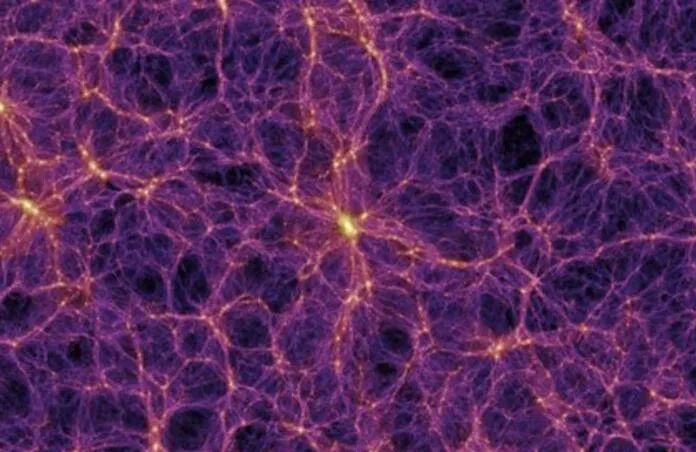
Astrophysicists recognize that the cosmic megastructure Quipu constitutes a primary arterial highway within the larger cosmic web—the primordial scaffolding of the universe. In standard $\Lambda\text{CDM}$ cosmology, invisible dark matter forms massive filamental channels along which baryonic gas flows, feeding supermassive black holes and birthing galaxy clusters.
The vast voids separating Quipu’s branching filaments are not truly empty; they are permeated by rarefied Warm-Hot Intergalactic Medium (WHIM) and dark matter filaments, maintaining the structural coherence of this galactic megastructure.
Conclusion
The discovery of the cosmic megastructure Quipu reminds us that our universe is not an accidental scatter of isolated island universes, but a deeply connected cosmic web. Through its luminous filaments and dark matter foundations, Quipu reveals the grand architectural tapestry of cosmic evolution.