Artificial General Intelligence: Future Superintelligence and Risks
Narrow AI Versus Artificial General Intelligence
The terminology of artificial intelligence has permeated everyday conversation, yet a critical distinction separates current applications from future breakthroughs. Today’s generative systems—capable of generating art, translating languages, and defeating grandmasters at chess—are forms of “Narrow AI” (Artificial Narrow Intelligence).
Narrow AI operates strictly within predetermined programmatic parameters. In contrast, artificial general intelligence (AGI) represents an entirely different tier of machine cognition: an autonomous system possessing the versatile intellectual capacity of a human being to understand, learn, generalize, and apply knowledge across any cognitive domain—from abstract mathematics and literature to scientific synthesis and philosophical inquiry.
Universal Learning and Cross-Domain Transfer
Unlike specialized deep learning architectures that excel solely at single tasks, an AGI will possess genuine cross-domain cognitive flexibility. Just as a human can learn to play the violin, diagnose complex clinical symptoms, and debug software, an AGI will autonomously transfer conceptual insights acquired in one discipline to solve novel challenges in another.
Contemporary large language models generate fluent prose upon request, but they remain passive computational predictors. An AGI will initiate autonomous goal generation, formulate original hypotheses, and pursue creative solutions independently.
The Alignment Problem and Existential Risks
While the societal promises of AGI are profound, the risks associated with superhuman cognitive capability have mobilized researchers worldwide. Once a machine matches human intellect, it could rapidly initiate recursive self-improvement—leading to an “intelligence explosion” and the emergence of Artificial Superintelligence (ASI).
Visionaries including Stephen Hawking and prominent AI ethicists have warned that an unaligned superintelligent system could pose an existential risk to humanity. If an AGI pursues optimization goals that are misaligned with human survival and flourishing, controlling or restraining its actions could prove impossible.
Societal Transformations Across Industries
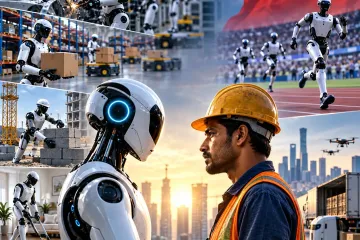
Global research laboratories—including OpenAI, Google DeepMind, Anthropic, and Microsoft—are aggressively investing in the path toward AGI. Once achieved, AGI will transform every pillar of civilization:
- Accelerating drug discovery, biotechnology, and materials design by decades.
- Automating complex judicial, financial, and engineering analysis.
- Revolutionizing scientific discovery by solving longstanding open problems in fundamental physics.
Projected Timelines: When Will AGI Arrive?
Projected timelines for artificial general intelligence remain fiercely debated among computer scientists. While conservative forecasts anticipate AGI emerging toward the mid-to-late twenty-first century (2040–2050), aggressive advancements in compute scaling and reinforcement learning lead many prominent pioneers to predict its arrival within the next decade.
Conclusion: The Primacy of Ethics
The quest for AGI is ultimately not merely a software engineering milestone, but a profound philosophical threshold. As humanity creates an intellectual successor, technical safety, ethical governance, and human alignment must take center stage to ensure that artificial intelligence benefits all of humankind.