Earth and the Moon: Creation, Distance, and Cosmic Influence
A Four-and-a-Half-Billion-Year Partnership
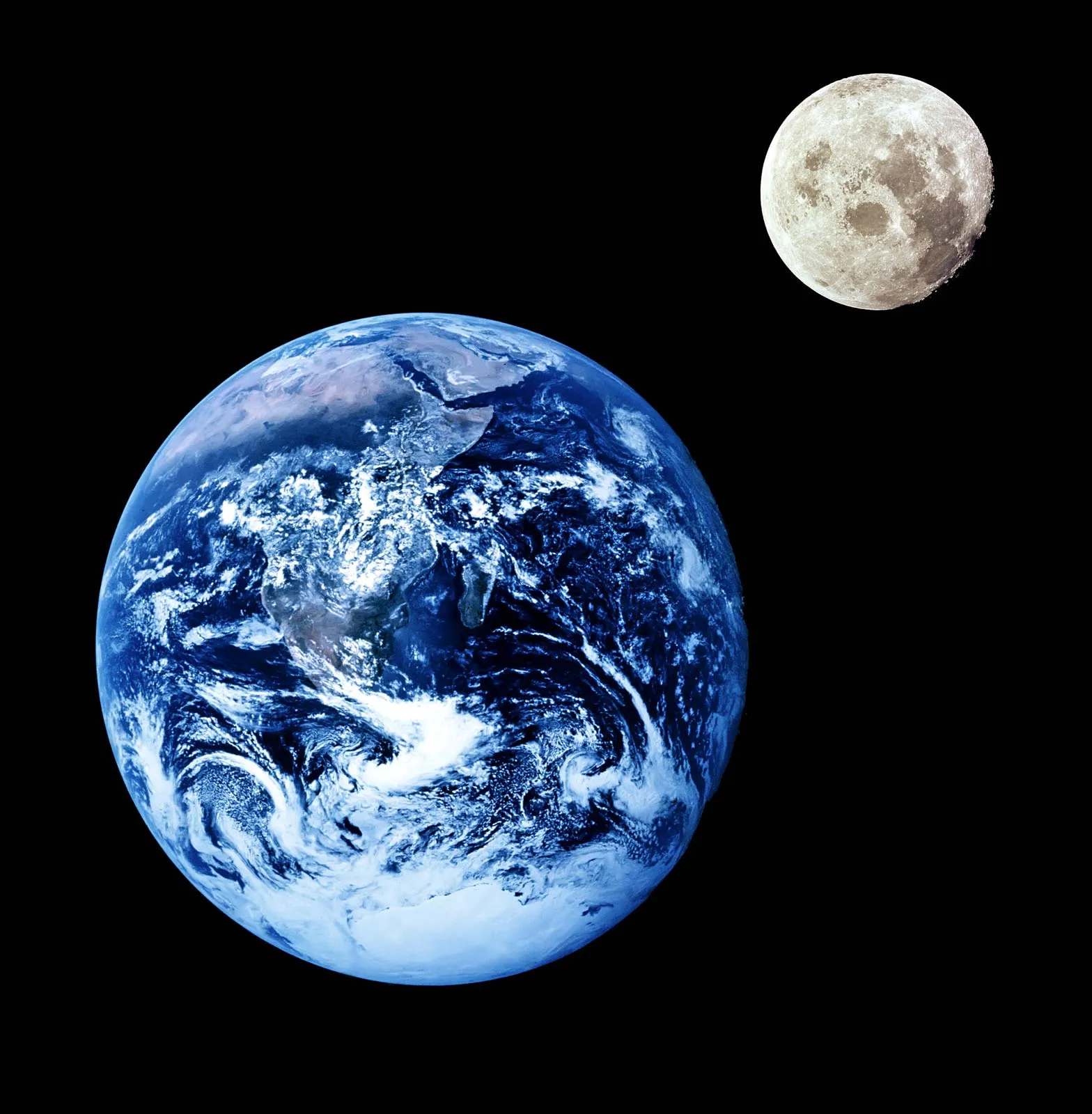
Orbiting the Sun as the third terrestrial planet, our world is accompanied by a faithful celestial companion: the Moon. Formed approximately 4.5 billion years ago—likely through a colossal collision between the proto-Earth and a Mars-sized planetesimal named Theia—the partnership between Earth and the Moon has endured across geological eons, tethered by mutual gravitation.
On an astronomical scale, the Moon is our closest planetary neighbor, situated at an average orbital distance of 384,400 kilometers. Reflected sunlight from the lunar surface traverses this intervening vacuum in a mere 1.3 seconds.
Viewing the System Across Deep Space
To grasp the true scale of the Earth-Moon system, one must observe it from interplanetary distances. In May 2010, NASA’s robotic spacecraft MESSENGER, en route to Mercury, turned its wide-angle camera toward its distant home from a distance of 183 million kilometers. The resulting photograph captured Earth and the Moon as a singular celestial couple: a brilliant beacon of light paired with a tiny, faithful companion.
Despite this cosmic proximity, bridging the Earth-Moon distance remains an immense technological feat. To date, only five nations—the United States, the former Soviet Union, China, India, and Japan—have achieved successful soft landings on the lunar terrain.
Tidal Locking and the “Far Side” of the Moon
The Moon completes one orbital revolution around Earth in 27.3 days. Crucially, its axial rotation takes the exact same amount of time. This synchronized state, known as tidal locking, was produced by gravitational friction slowing the Moon’s rotation over billions of years.
Because of tidal locking, the same lunar hemisphere always faces Earth. Popular culture often mislabels the hidden hemisphere as the “dark side of the Moon,” but in reality, both hemispheres receive equal amounts of sunlight as the Moon orbits our planet. Astronomers correctly designate this hidden surface the “far side of the Moon.”
How the Moon Stabilizes Life on Earth
Relative to host planet size, the Moon is disproportionately large, ranking as the fifth largest natural satellite in the solar system. The gravitational interaction between Earth and the Moon plays a crucial role in maintaining terrestrial habitability:
- Oceanic Tides: Lunar gravitational gradients generate ocean tidal bulges, circulating marine nutrients and establishing coastal intertidal ecosystems vital to early evolutionary life.
- Axial Tilt Stability: The Moon’s gravitational torque stabilizes Earth’s axial tilt at approximately 23.5 degrees, preventing erratic wobbles that would otherwise trigger catastrophic, destabilizing climate extremes.
- Planetary Rotation Braking: Tidal friction gradually transfers rotational momentum, slowing Earth’s rotation from primordial six-hour days to our stable 24-hour cycle.
The Moon’s Gradual Departure
Laser ranging measurements using retroreflectors left on the lunar surface by Apollo astronauts reveal that the Moon is steadily receding from Earth at a rate of approximately 3.8 centimeters per year—roughly the rate at which human fingernails grow.
While this gradual drift will eventually alter tidal patterns millions of years in the future, Earth and the Moon will remain cosmic partners for billions of years to come.