The Momentum of Light: How Massless Photons Propel Spacecraft
Can Massless Particles Deliver a Mechanical Push?
Classical mechanics teaches that momentum is the product of mass and velocity ($p = mv$). A stationary stone requires mass and speed to deliver an impact. How, then, can something entirely devoid of rest mass exert a mechanical push? Modern physics provides an astounding answer: although photons possess zero rest mass, they carry relativistic momentum ($p = E/c$), meaning the momentum of light can exert real, measurable mechanical force.
Radiation Pressure: From Tiny Shoves to Gigantic Thrust
The recoil produced by an individual photon is imperceptible. However, when sextillions of photons strike a surface simultaneously, their collective impacts accumulate into a continuous mechanical force known as “radiation pressure.”
On Earth, atmospheric air resistance and gravitational friction completely overwhelm this delicate force. But in the frictionless vacuum of space, radiation pressure becomes an extraordinarily efficient propulsion mechanism.
Solar Sails and Propellant-Free Spaceflight
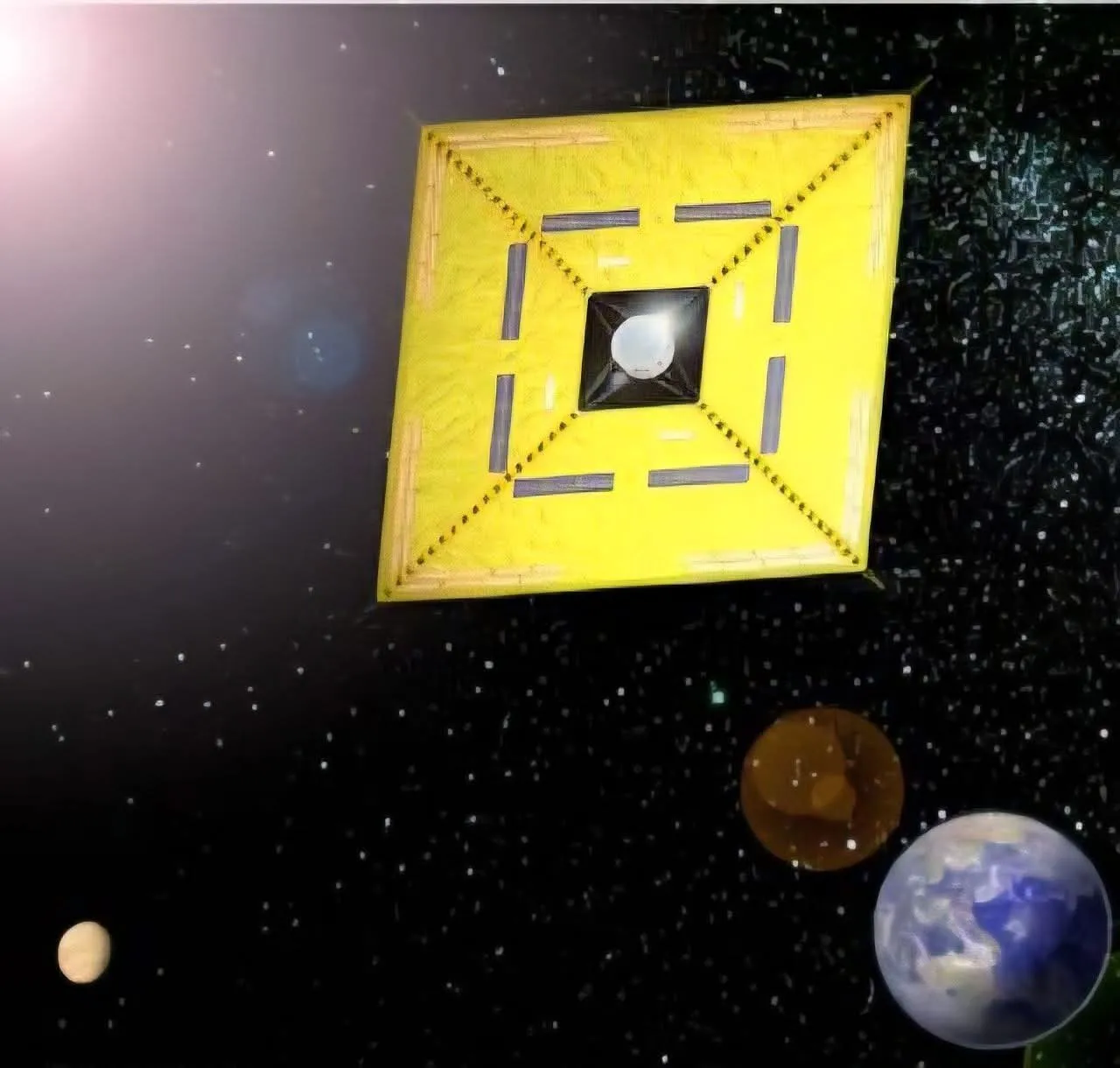
Solar sail technology harnesses the momentum of light by unfurling massive, ultra-thin, highly reflective membranes made of aluminized polymers. When sunlight strikes the reflective sail, photons bounce off, transferring twice their incident momentum to the craft.
In 2010, the Japan Aerospace Exploration Agency (JAXA) successfully demonstrated this principle with IKAROS (Interplanetary Kite-craft Accelerated by Radiation of the Sun), cruising through interplanetary space propelled entirely by solar radiation pressure. Subsequently, The Planetary Society’s LightSail 2 mission proved that sunlight pressure alone could actively raise a satellite’s orbit around Earth without using a single drop of chemical fuel.
Breakthrough Starshot: Reaching Interstellar Space
While sunlight dims rapidly beyond the inner solar system, directed laser propulsion offers a pathway to interstellar transit. The ambitious Breakthrough Starshot project proposes constructing an array of phased high-power ground-based lasers delivering gigawatts of coherent light to miniature micro-probes equipped with ultra-reflective sails.
By concentrating photon pressure onto lightweight sails, these interstellar probes could accelerate to 20 percent the speed of light within minutes, crossing the four-light-year gulf to Alpha Centauri in just over two decades.
Optical Tweezers: Manipulating the Microscopic Realm
The application of photon momentum extends into the microscopic domain. In 2018, American physicist Arthur Ashkin received the Nobel Prize in Physics for inventing “optical tweezers”—focused laser beams that trap, manipulate, and hold living cells, bacteria, and DNA strands using the gentle gradient forces of light without damaging delicate biological structures.
Conclusion
From shaping the sweeping dust tails of comets to steering propellantless solar sails across deep space, the momentum of light proves that radiation is not merely an illuminating phenomenon, but a dynamic mechanical force capable of propelling humanity to the stars.