Kaprekar's Constant 6174: The Enigmatic Math of Number Theory
An Uncanny Mathematical Black Hole
Choose any four-digit number where at least two digits are different. Arrange the digits in descending order to form the largest possible number, then reverse them into ascending order to form the smallest. Subtract the smaller number from the larger. Now repeat the exact same procedure with the resulting difference.
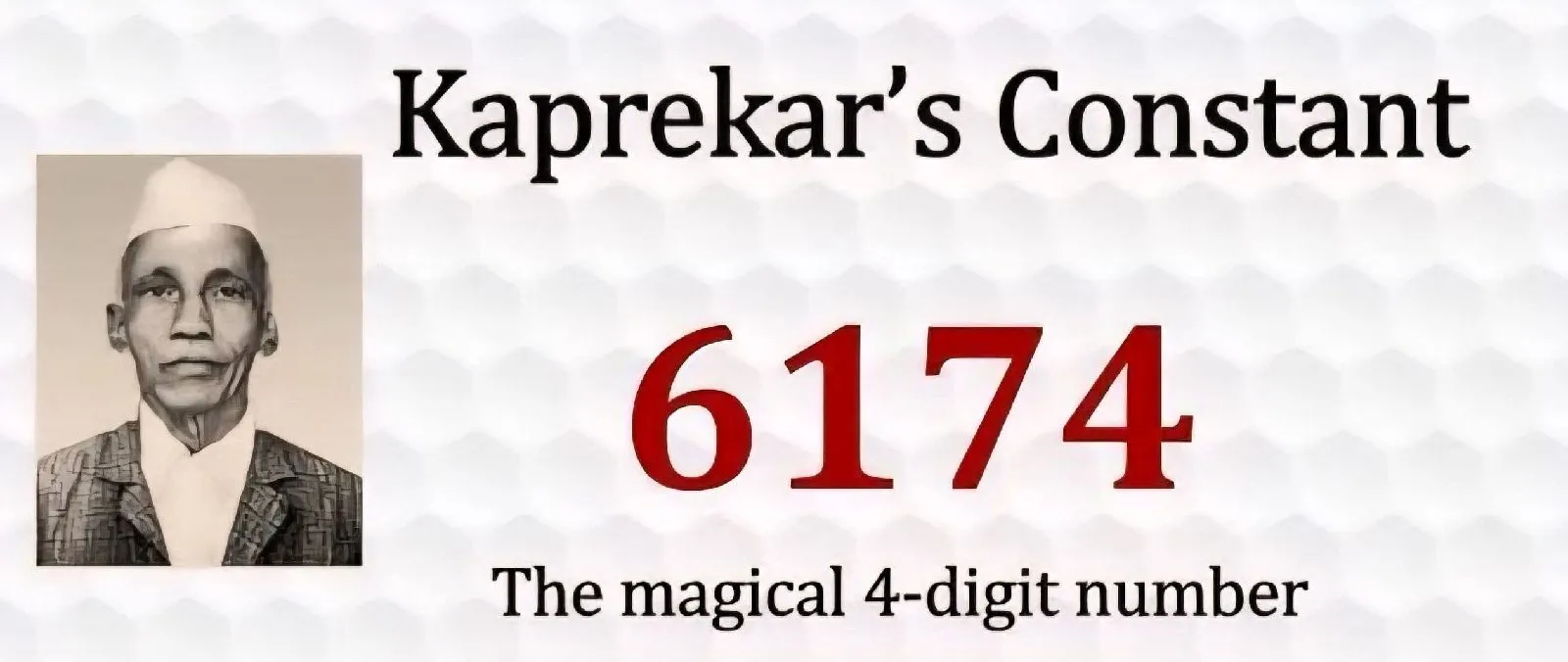
No matter which valid four-digit combination you start with, you will always arrive at the exact same number within at most seven iterations: 6174. Once you reach 6174, the process loops endlessly on itself. In mathematics, this celebrated number is known as Kaprekar’s constant.
The Humble Genius of D. R. Kaprekar
This remarkable property was discovered in 1949 by Dattatreya Ramachandra Kaprekar, an unassuming schoolteacher and recreational mathematician from Devlali, India. Lacking formal university professorships, Kaprekar spent decades exploring the playful aesthetics of numbers, unveiling properties that initially seemed like mathematical curiosities but subsequently attracted worldwide attention among number theorists.
Step-by-Step Walkthrough: The Kaprekar Routine
To see the routine in action, let us trace an arbitrary starting number: 3524.
- Step 1:
- Descending order: 5432
- Ascending order: 2345
- Difference: $5432 – 2345 = 3087$
- Step 2:
- Descending order: 8730
- Ascending order: 0378
- Difference: $8730 – 0378 = 8352$
- Step 3:
- Descending order: 8532
- Ascending order: 2358
- Difference: $8532 – 2358 = 6174$
- Step 4 (The Fixed Point):
- Descending order: 7641
- Ascending order: 1467
- Difference: $7641 – 1467 = 6174$
The calculation reaches 6174 and remains permanently fixed! The number acts as an attractor, pulling every four-digit integer (except repdigits like 1111, 2222, etc., which yield 0000) into its orbit in a maximum of seven operations.
Why Does Kaprekar’s Constant Work?
When four digits $a ge b ge c ge d$ are arranged into descending order ($1000a + 100b + 10c + d$) and ascending order ($1000d + 100c + 10b + a$), their difference simplifies to:
$$Delta = 999(a – d) + 90(b – c)$$
Because the differences $(a – d)$ and $(b – c)$ can only take a restricted set of values, the operation dramatically constrains the universe of possible outputs. Through iterative mapping, all valid paths inexorably terminate at the unique fixed kernel 6174.
Conclusion
The elegance of Kaprekar’s constant highlights the hidden symmetry and beauty embedded in arithmetic, demonstrating that profound patterns often conceal themselves within the simplest elementary operations.