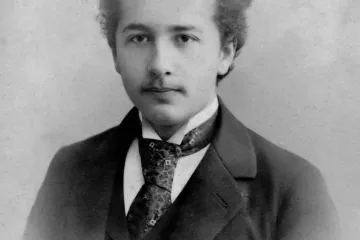
Oskar Klein: Pioneer of the Unseen Dimension
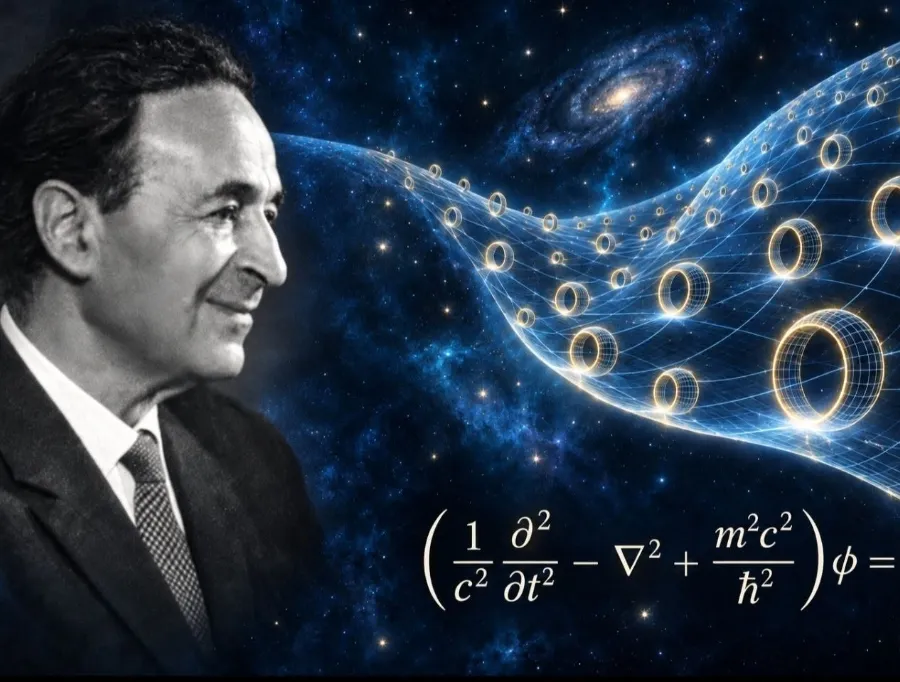
Is there a direction in the universe that we cannot see? Another dimension beyond length, breadth, and height? What if it is curled up in so tiny a space that it completely escapes our sight?
Nearly a century ago, the Swedish physicist Oskar Klein gave mathematical form to just such an astonishing idea. In trying to bind gravity and electromagnetism into a single thread, he searched for an extra dimension hidden behind our familiar world.
From Curiosity to the Quantum
Oskar Benjamin Klein was born in Sweden on 15 September 1894. From childhood, he possessed an intense fascination with science. He would gaze at the night sky through his mother’s small telescope. While still in his teens, he had the opportunity to learn and work in the laboratory of the Nobel laureate Svante Arrhenius.
In 1918, Klein moved to Copenhagen. There, in close contact with Niels Bohr and Hendrik Kramers, the brand-new world of quantum physics opened up before him. In the years that followed, Klein became one of Bohr’s closest collaborators.
The Fifth Dimension?
In Einstein’s relativity, three dimensions of space and one of time combine to make four-dimensional spacetime. The German scientist Theodor Kaluza tried to bring gravity and electromagnetism into the same mathematical framework by adding a further dimension of space.
Klein carried the idea forward. In 1926, he proposed that this extra dimension could be curled up into an exceedingly tiny circle. On macroscopic scales, therefore, it remains completely beyond our detection.
To grasp the intuition, consider a thin wire. From a distance, it looks like nothing more than a long line. But come close enough, and an ant can also walk around its circumference. From afar, that extra direction was invisible. Klein’s extra dimension is not, of course, the physical space around a wire; it is an analogy to illustrate the concept.
This line of inquiry became known as Kaluza-Klein theory. It did not turn out to be a complete description of nature. Yet the concept of an extra dimension curled up on a subatomic scale later found a central place in string theory. Even today, however, the physical existence of extra dimensions has not been experimentally established.
Quantum Meets Relativity
Another celebrated contribution from Klein is the Klein-Gordon equation. Quantum mechanics explains the behaviour of microscopic particles. But when particles travel at speeds approaching the speed of light, the principles of special relativity must also be satisfied. This equation was an early, pivotal milestone in uniting the two domains.
In 1926, Klein and Walter Gordon contributed independently to its formulation. In modern physics, it remains particularly vital for describing spin-zero particles and fields. Spin is an intrinsic quantum characteristic of a particle; imagining it as the mechanical spinning of a child’s toy top would be entirely misleading.
Collisions of Light and Electrons
When a photon—a particle of light—collides with an electron, it can alter both its direction and its energy. This phenomenon is called Compton scattering.
Together with Japanese physicist Yoshio Nishina, Klein formulated an essential equation to calculate the dynamics of this scattering. In 1928, they completed the work using Paul Dirac’s relativistic quantum theory.
The Klein-Nishina formula determines the probability of a photon scattering in any given direction after colliding with an electron. It was a major leap forward in our understanding of how light interacts with matter.
A Way Beyond the Barrier
Klein’s name is also attached to another astonishing phenomenon: the Klein paradox.
Everyday experience tells us that the higher a barrier is, the harder it should be to overcome. But within relativistic quantum mechanics, Klein revealed that under specific conditions, even an extraordinarily high barrier cannot hold a particle back as expected.
This is not a tale of passing through a physical wall. Here, the barrier refers to a strong potential field exerting force upon the particle. Understanding the bizarre behaviour of particles in such fields demands that we step well beyond classical intuition. This puzzle proved crucial in revealing the deeper structures of relativistic quantum theory.
A Century-Spanning Bridge
Oskar Klein died on 5 February 1977. In his memory, Stockholm University and the Royal Swedish Academy of Sciences have jointly organised the Oskar Klein Memorial Lecture and awarded the Oskar Klein Medal since 1988. In 2026, that distinguished honor was bestowed upon the Bengali physicist Ashoke Sen.
The connection is resonant. Klein sought to unify the distinct forces of nature through the geometry of extra dimensions. Decades later, Ashoke Sen is working on a framework of string theory where extra dimensions and quantum gravity have once again become paramount.
Not every grand idea ends up as nature’s ultimate description. But some ideas forever alter the questions we ask. Oskar Klein left us with just such a question: Is the universe only as vast as what our eyes can see? We are still searching for the answer.