A Flower Named After Lionel Messi: Salvia messii
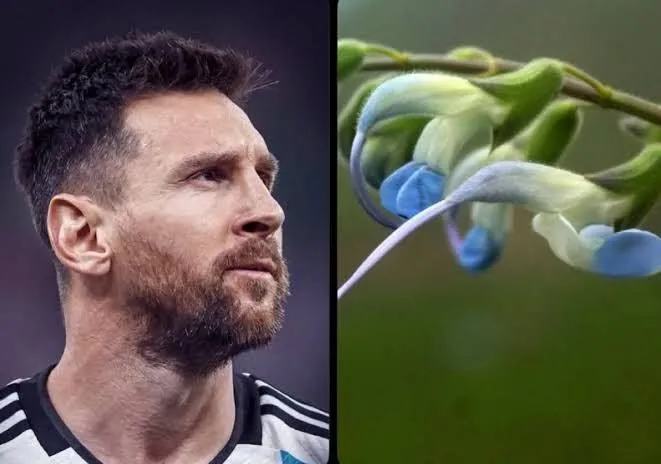
Stepping beyond the boundaries of football, Lionel Messi has now entered the botanical world. Scientists in the Peruvian Andes recently discovered a new flowering shrub named Salvia messii, bearing delicate sky-blue and white blossoms that mirror the iconic colors of Argentina’s national jersey.
Botanists bestowed the name Salvia messii—literally Messi’s salvia—in tribute to the Argentine football icon.
This aromatic shrub thrives high in the Andes mountains of Peru, at elevations between 2,000 and 2,400 meters above sea level, growing up to 1.5 meters tall. It belongs to the mint family, Lamiaceae, making it a botanical relative of familiar culinary herbs such as mint, basil, and rosemary.
The formal scientific description of this newly discovered species appeared on 2 October 2026 in the international botanical journal Phytotaxa, documented through joint research by Peruvian and Argentine botanists.
How Plants Get Their Names
Plants receive their scientific names through a globally standardized system known as binomial nomenclature. In the eighteenth century, Swedish naturalist Carl Linnaeus established this two-part naming tradition.
Under this convention, every species name consists of two Latinized words. The first denotes the genus, while the second is the specific epithet identifying the unique species within that group.
In this case, Salvia represents the genus, and the species epithet messii was chosen in honor of Lionel Messi.
A curious question naturally follows: Messi’s surname ends with a single ‘i’, so why does the botanical name end with a double ‘i’ as messii?
Under the International Code of Nomenclature for algae, fungi, and plants, when a species is named to honor a person, the name must be Latinized. For a man’s surname, the standard Latin genitive singular suffix ‘-i’ is added. Since Messi already ends in an ‘i’, adding the Latin suffix results in messii.
However, botanists cannot bestow names at will. Researchers must first provide rigorous scientific evidence that the plant is genuinely distinct from all previously catalogued species, preserve type specimens in recognized herbaria, and publish comprehensive morphological descriptions in peer-reviewed journals.
An Endangered Beauty
Despite bearing the name of one of history’s greatest football legends, the future of Salvia messii remains precarious. To date, researchers have recorded it in only six localized areas of Peru.
Wildfires, road infrastructure projects, and prolonged regional droughts pose severe threats to its specialized mountain habitat. Consequently, researchers have evaluated the plant as an Endangered species under IUCN criteria.
Lionel Messi’s legacy in football is undisputed and eternal. Now, his name is firmly planted in botanical history. Yet this discovery carries a vital conservation message: Earth still harbors countless unknown plant species, many quietly slipping away before they are ever found. Discovering them is essential, but safeguarding their survival is even more urgent.
References
- Gonzáles, P., Uría, R., & Capcha-Ramos, J. (2026). A remarkable new Salvia (Lamiaceae) from the ecotonal vegetation surrounding the western Andean relict forests of Peru. Phytotaxa, 777(3), 272–282.