Japan Launches MMX Mission to the Moons of Mars
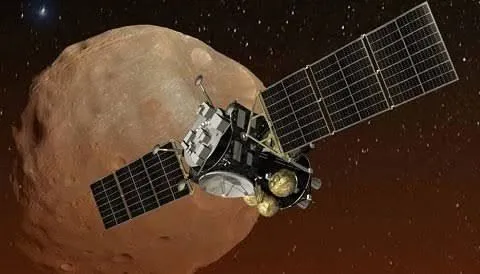
Setting its sights not on Mars itself but on its enigmatic moons, Japan has embarked on an ambitious new interplanetary voyage. On 20 October 2026, the landmark MMX mission officially got underway with the flawless launch of an H3 rocket from Tanegashima Space Center, sending the Martian Moons eXploration (MMX) spacecraft on its journey toward Mars.
The Japan Aerospace Exploration Agency (JAXA) confirmed that approximately 71 minutes after liftoff, the spacecraft successfully separated from the launch vehicle and entered its planned trans-Mars trajectory.
Destination: The Moons of Mars
Mars is orbited by two tiny moons, Phobos and Deimos. Unlike Earth’s spherical moon, they resemble jagged, crater-pocked potatoes. Scientists remain divided on how they formed: were they rogue asteroids captured by the gravitational pull of Mars, or are they ancient debris blasted into orbit during a colossal impact on the Red Planet? Resolving this longstanding cosmic puzzle is the central objective of Japan’s new expedition.
What Will the Spacecraft Do?
According to the mission roadmap, the spacecraft will arrive in the vicinity of Mars in August 2027. It will enter orbit around Phobos to study its surface topography, mineralogy, and internal structure from close range.
Riding along is a compact French-German rover named Idefix. The rover will touch down on Phobos, roving across its rugged terrain to gather high-resolution imagery and vital scientific data.
Even more remarkably, the main spacecraft will itself descend onto Phobos’ surface. Using a robotic sampling mechanism, it plans to gather at least 10 grams of regolith and pebble samples.
While 10 grams may seem modest, its scientific value is priceless. Analyzing pristine Martian moon material will unlock chemical and isotopic secrets regarding the formation and evolution of the Martian system.
Sample Return in Australia
If all progresses as planned, the spacecraft will depart Mars in 2030, setting course back toward Earth. By 2031, a specialized reentry capsule carrying the precious samples will parachute down into the remote desert near Woomera in South Australia.
If successful, the MMX mission will deliver humanity’s very first samples from a Martian moon straight into terrestrial laboratories. Locked inside those few grams of primordial dust could be vital clues to the 4.5-billion-year history of our solar system.