The Space Elevator
No rockets. No massive explosions. Just step into an elevator and ride straight from Earth into space!
As much as it sounds like science fiction, Japan’s construction giant Obayashi Corporation has been working on exactly this idea — a space elevator. The company published its detailed concept in 2012, with the goal of making it a reality around 2050, provided the necessary technology could be developed.
A Colossal Cable
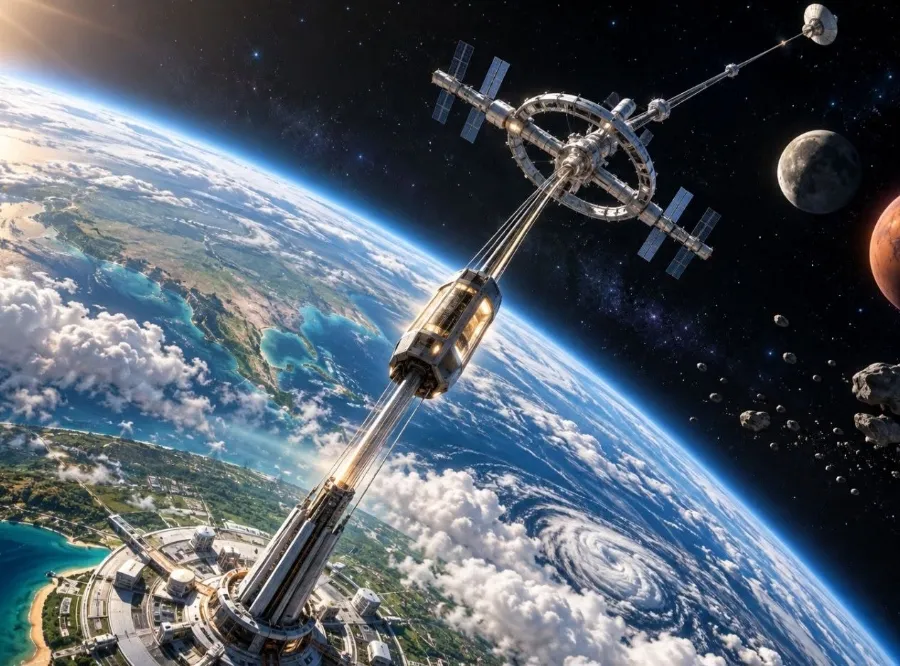
This is no ordinary skyscraper lift. According to the plan, a cable approximately 96,000 kilometres long would extend from a base station near the equator out into space. A space station would sit in geostationary orbit, about 36,000 kilometres above the Earth. The cable would not end there either — it would stretch much farther, with a counterweight at its far end.
A special electric vehicle, the climber, would travel along this cable, carrying people and cargo slowly up into space.
The Toughest Challenge
But what material could possibly make a cable this long?
Steel is out of the question. A steel cable that long could not even support its own weight. That is why carbon nanotubes — extraordinarily light yet strong — sit at the heart of Obayashi’s plan.
And this is where the biggest technological barrier lies. Although carbon nanotubes are incredibly strong in the laboratory, no one has yet managed to produce a defect-free cable thousands of kilometres long with the required strength.
Obayashi Corporation even tested carbon nanotube samples in the space environment aboard Kibo, the Japanese module of the International Space Station. Signs of damage from atomic oxygen were found there.
Testing in Space
Still, the research has not stopped.
In 2018, the STARS-Me mission from Japan’s Shizuoka University used two tiny CubeSats and a climber to test the orbital elevator concept. It was not a full-scale space elevator, but rather a small experimental step toward the technology of the future.
More Obstacles
There are further problems. The cable must be protected from space debris. It must withstand strong winds, lightning strikes, and vibrations. The power supply for the climber must also be extremely reliable.
So there is no reason to treat 2050 as a confirmed launch date. It is a long-term goal Obayashi announced many years ago. With current technology, building a fully functional space elevator is still not possible.
A New Era
But what if it becomes possible one day?
It could transform the very idea of space travel. Instead of using enormous rockets and vast amounts of fuel each time, people and cargo could be lifted into space along a cable.
Taken even higher, the rotation of the Earth itself could be harnessed to fling spacecraft toward the Moon, Mars, or even asteroids.
There was a time when travelling to the Moon was the stuff of fiction. Could the space elevator, too, one day become reality?