Starship Reaches New Heights
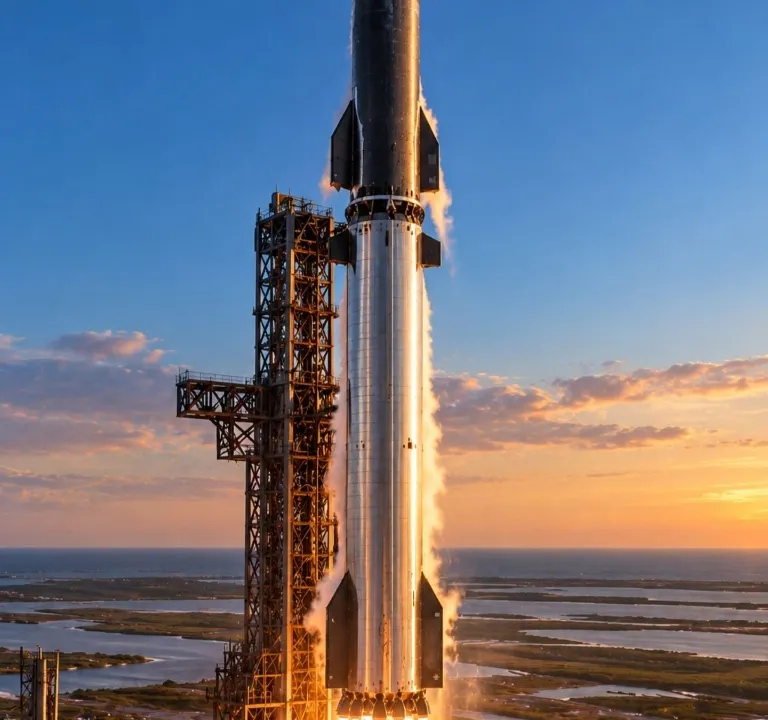
The colossal SpaceX Starship has done more than just test its wings this time—it has completed its first real job. Reaching orbit with 26 next-generation Starlink satellites aboard, it successfully deployed them into space.
Built by SpaceX, Starship is the most powerful rocket system on Earth. It consists of two stages: the massive booster at the bottom, called Super Heavy, and the spacecraft on top, named Starship. Both are being developed to be fully and rapidly reusable.
The entire rocket stands nearly 124 metres tall—equivalent to a 40-storey building. Starship is capable of carrying more than 100 tonnes of payload into orbit. And most intriguingly, it is designed to be completely reusable.
What Makes Starship Special
For most conventional rockets, launching large payloads into space remains extraordinarily expensive. SpaceX aims to slash launch costs by flying the same Starship and Super Heavy booster again and again. If successful, this could fundamentally change how massive satellites, space stations, and heavy cargo bound for the Moon and Mars are transported. NASA is also planning to use a specialised version of Starship as a lunar lander for its upcoming Artemis missions.
The 28 September flight was therefore of special importance. During ascent, one of Starship’s six Raptor engines shut down earlier than scheduled. Even so, the spacecraft remained under control. Another engine was subsequently fired to complete orbital insertion, and at an altitude of roughly 269 kilometres, it deployed 26 Starlink V3 satellites one by one.
The original flight plan called for an approximately 10-hour mission. Because of the engine anomaly, that was trimmed to around three hours. Having completed its primary objectives, Starship was deorbited and brought down in a controlled splashdown in the Pacific Ocean.
Starship’s earlier suborbital test flights were primarily about validating technology. What set this flight apart was that, for the first time, it reached orbit and deployed commercial satellites. In other words, Starship took a major leap from experimental rocket to operational space transportation system.
SpaceX’s ambitions stretch much further—first the Moon, then Mars. That journey is still long, with many technical milestones yet to be proven. But this flight made one thing abundantly clear: Starship is no longer merely a future blueprint. Step by step, it is turning into a working space transportation system.