Chrysalis: Designing a 400-Year Starship
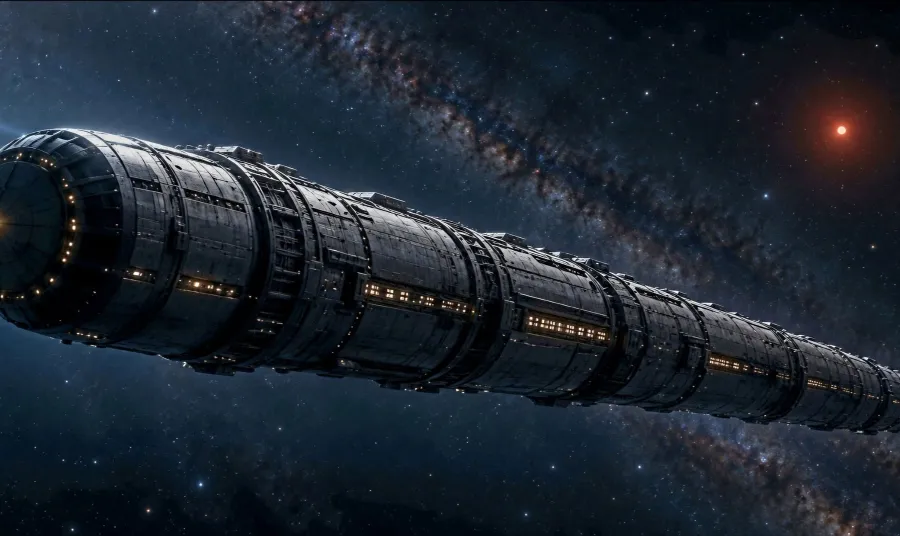
A colossal spacecraft sets out from Earth. The Chrysalis generation ship is designed to journey toward Proxima Centauri b, a planet orbiting the closest star to our Sun.
Yet getting there will take nearly 400 years. None of the people who depart Earth will ever reach that world; their lives will conclude along the way.
A new generation will be born aboard the starship. Then another. Centuries later, it will be their distant descendants who arrive in the realm of another star.
This is not an ongoing mission, however. It is a proposed design for a hypothetical interstellar ark: ‘Chrysalis’.
A Name of Transformation
‘Chrysalis’ refers to the pupal stage of a caterpillar before it emerges as a butterfly—a deeply fitting name.
Inside the vessel, an entirely self-sustaining human society would grow over centuries, utterly isolated from Earth. One day, their descendants will emerge from that enclosed habitat to build a new life on an alien world, just as a fully formed butterfly breaks free from its chrysalis.
In 2025, Chrysalis claimed first place in the Project Hyperion generation-ship design competition. Designed by a five-member Italian team, the plan addresses far more than engineering alone: architecture, ecology, social structure, and human psychology are all integral to the concept. Judges praised its holistic integration, in-space construction framework, and the proposal to train crews in the isolation of Antarctica.
A Giant of the Cosmos
The proposed Chrysalis spans roughly 58 kilometres in length, with a maximum capacity of around 2,400 people. To balance food production, living quarters, population dynamics, and genetic diversity, the steady-state crew would be kept to around 1,500.
Inside the cylindrical super-structure are rotating concentric habitats. This rotation generates artificial gravity, enabling residents to stand and walk naturally on the floor. Whether this perfectly replicates Earth’s gravity, however, depends on the diameter and rotational speed of each cylinder.
A Floating Settlement in Space
Chrysalis is far more than a spaceship—it is a self-contained floating civilisation. Nested inside are five concentric layers. Certain levels are dedicated to farming and food production. Others house homes, schools, hospitals, libraries, parks, and recreational centres. Still others are reserved for manufacturing plants, warehouses, and maintenance facilities.
Plans call for taking along plants, fungi, microorganisms, insects, and select animal species essential for preserving biodiversity. Water, air, nutrients, and waste must be continuously recycled and purified, since once the journey begins, there is no possibility of resupply from Earth.
A Four-Hundred-Year Journey
The intended destination of Chrysalis is Proxima Centauri b. Located approximately 4.24 light-years from Earth, it is our nearest known exoplanet.
The planet orbits within its star’s habitable zone, meaning that with a suitable atmosphere, temperatures could permit liquid surface water. Yet whether the planet actually possesses an atmosphere, liquid water, or conditions hospitable to life remains entirely unknown.
Proxima Centauri is an active red dwarf star. Its intense radiation and frequent stellar flares could make the planetary environment severely hostile.
To propel the craft, designers proposed a fusion drive powered by deuterium and helium-3. But fusion engines powerful and durable enough to sustain such a voyage do not yet exist. The 400-year travel time remains contingent on technologies that have yet to be invented.
The Difficult Questions
The greatest hurdle facing this mission is not merely technological. How an enclosed human society can remain stable across centuries is arguably a far harder problem.
Who will be permitted to have children? How will population growth be regulated? What form will governance and law take? How will Earth’s history, science, and cultural heritage be passed down across generations? And why would people born aboard a starship choose to settle on a world they have never seen?
The Chrysalis blueprint therefore places immense weight on AI-assisted administration, education, culture, knowledge preservation, and mental health. Early crew members are also slated for extensive preparatory training in the isolation of Antarctica.
A Distant Dream
There is no immediate plan to construct Chrysalis. The requisite fusion propulsion, century-lasting machinery, and fully closed-loop life-support systems are all beyond our current reach.
Nor is Project Hyperion’s goal to launch humans toward another star today. Its true aim is to evaluate what multi-generational interstellar travel might look like with near-future technologies, and to identify the critical research avenues ahead.
This is where Chrysalis matters most. It reminds us that reaching another star requires far more than powerful engines. It demands taking along a sustainable human society, a living ecosystem, and the accumulated memory and wisdom of human civilisation.
Before venturing toward the stars, humanity must first learn how to keep a miniature, artificial Earth alive across hundreds of years in deep space. For now, Chrysalis stands as a grand blueprint for that distant dream.