Who Will Win the Physics Nobel?
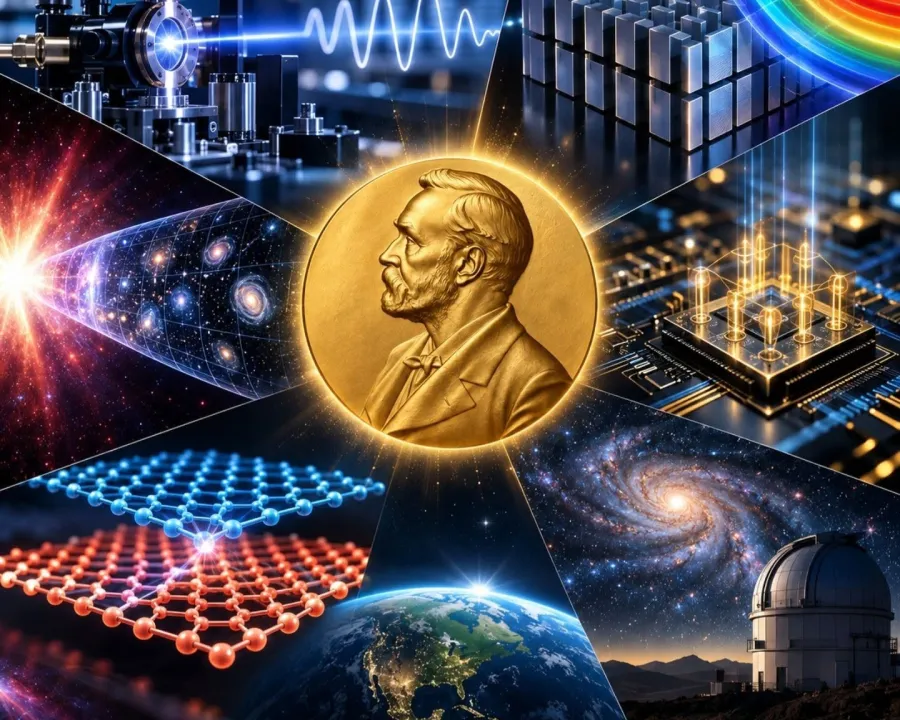
On 6 October, the Royal Swedish Academy of Sciences will unveil the laureates of the 2026 Nobel Prize in Physics. There is no official way to predict the outcome in advance, as nomination archives remain sealed for 50 years. Nevertheless, several groundbreaking discoveries and pioneering physicists are generating intense discussion across the scientific community.
The Most Precise Clocks in History
Hidetoshi Katori of Japan and Jun Ye of the United States developed optical atomic lattice clocks of staggering accuracy.
These optical clocks are so extraordinarily sensitive that they can detect the minute change in Earth’s gravitational potential caused by raising a clock by just a few millimeters, measured purely through gravitational time dilation. Their applications span relativistic geodesy, foundational physics, and deep-space navigation.
Manipulating Light in Impossible Ways
Another prominent field under consideration is metamaterials—artificially engineered structures tailored to steer light and electromagnetic radiation in ways never observed in natural substances.
Pioneered by John Pendry and David Smith, their work gave rise to the extraordinary concept of bending light around an object.
The First Microsecond of the Cosmos
Cosmic inflation remains a perennial heavyweight in Nobel discussions. According to this cosmological framework, the infant universe underwent an exponential expansion in the tiniest fraction of a second after the Big Bang.
Alan Guth, Andrei Linde, and Paul Steinhardt are the theoretical architects of this concept. Their names have featured prominently on Nobel shortlists for decades.
Foundations of Quantum Computing
Today’s burgeoning quantum processors did not emerge overnight; they rest upon decades of rigorous theoretical groundwork.
Theorists such as Peter Shor, David DiVincenzo, and Daniel Loss formulated the foundational algorithms, quantum error correction principles, and quantum dot architectures that made physical quantum computing plausible. The Nobel committee may well recognize these seminal milestones.
Twistronics: A New Angle on Graphene
Another fascinating candidate is twistronics. When two atom-thin sheets of graphene are stacked and rotated to a precise “magic angle” of approximately 1.1 degrees, their electronic and quantum properties transform dramatically, unlocking unconventional superconductivity.
Pablo Jarillo-Herrero, Rafi Bistritzer, and Allan MacDonald are widely celebrated for discovering and explaining this remarkable phenomenon.
Predicting the Nobel Prize is notoriously difficult. The committee has often waited decades before bestowing its ultimate accolade upon transformative discoveries.
Until the official announcement arrives on 6 October, nothing is certain. Yet it is precisely this suspense that makes the Nobel season so captivating.