Francis Halzen Wins the 2026 Nobel Prize in Physics
Every moment, countless invisible particles from the universe pass straight through our bodies. We feel nothing at all. These mysterious particles are called neutrinos.
By detecting these neutrinos, physicist Francis Halzen has opened an entirely new window for observing the universe. In recognition of this extraordinary achievement, he has been awarded the sole 2026 Nobel Prize in Physics.
Eyes Beneath the Ice
Catching a neutrino is extraordinarily difficult. They are electrically neutral and interact with ordinary matter only very rarely. They can even pass through the entire Earth almost without obstruction.
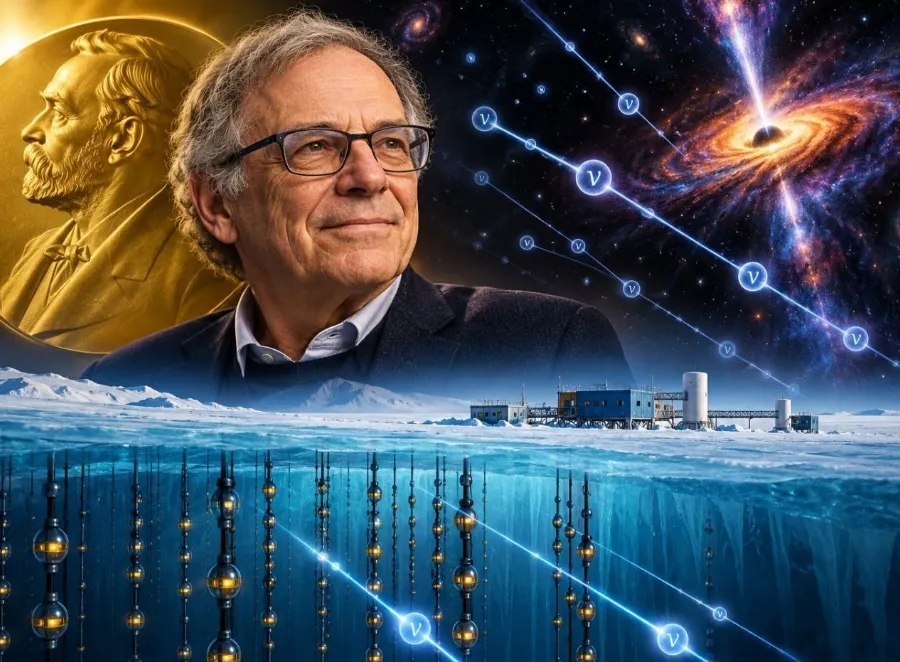
To capture these elusive particles, Halzen led an international team of scientists and engineers to build an ingenious system: the IceCube Neutrino Observatory.
This is no telescope mounted on a mountaintop. Its vast detector array is buried deep beneath the ice at the South Pole in Antarctica. Across roughly one cubic kilometre of ice, 5,160 light-sensitive detectors have been installed. They wait for the faint flashes of light produced when a neutrino finally interacts with the surrounding ice.
A Message Captured
In 2013, IceCube researchers analysed 28 ultra-high-energy events and found strong evidence that some of these neutrinos were not produced in Earth’s atmosphere but had arrived from distant sources in outer space.
For astronomy, this was an entirely new kind of message.
We observe the universe with visible light. We also study it with radio waves, X-rays, and gamma rays. But the special power of neutrinos is that they can carry information even from the densest regions of the cosmos — places from which light cannot easily escape.
A New Window
This is why Halzen’s work is so significant. Using neutrinos, scientists are now tracing the sources of the most powerful and mysterious events in the universe: the cores of active galaxies, the neighbourhoods of black holes, and the origins of ultra-high-energy cosmic rays.
A particle once thought nearly impossible to detect — the ‘ghost particle’ — has become a new messenger for uncovering the deep secrets of the cosmos.
A colossal eye buried deep beneath Antarctic ice is now showing us a face of the universe that light alone could never reveal.
This year’s Nobel Prize in Physics is therefore not merely recognition of a remarkable experiment. It is recognition of opening an entirely new path for seeing the universe.