Chemistry Nobel 2026: The Left and Right of Molecules
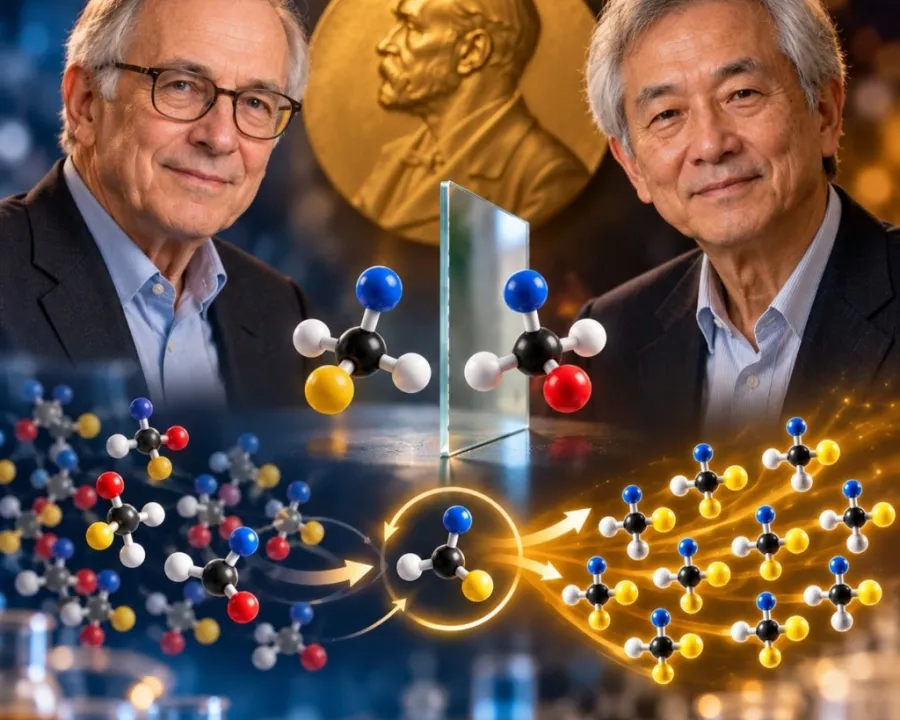
Two molecules can be made of the exact same atoms, yet their three-dimensional shapes can be non-superimposable mirror images of each other—just like our left and right hands. In chemistry, this remarkable property is known as chirality.
For pioneering ways to control these elusive mirror-image molecules, Henri B. Kagan and Kenso Soai have won the Chemistry Nobel 2026. Their work has played a transformative role in synthesizing desired chiral forms in large amounts.
Mirror of Molecules
Two forms of a chiral molecule look nearly identical, but their behavior inside living organisms can be completely different. When designing medicines, knowing which “hand” of a molecule is being produced is of vital importance.
Kagan demonstrated that even a slight imbalance in a chiral catalyst can sometimes give one molecular form a far greater advantage than expected. In other words, an almost imperceptible difference can amplify into a dramatic preference.
Self-Assisting Reactions
Kenso Soai uncovered an even more astonishing phenomenon: asymmetric autocatalysis.
Here, the chiral molecule produced in a reaction acts as a catalyst for its own creation, accelerating the production of identical molecules. As a result, even if there is only a minuscule initial difference between the two forms, one form rapidly multiplies to dominate the reaction. This groundbreaking process is now internationally renowned as the “Soai reaction.”
The Mystery of Life
The significance of this discovery extends far beyond the chemistry lab; it touches on a fundamental mystery of life itself. Many of life’s essential molecules are chiral. Yet why did nature select one specific “handedness” over the other? How did a slight asymmetry at life’s beginnings expand into such total uniformity?
The research of Kagan and Soai opens an important doorway toward unraveling that profound mystery.
Their work reveals that in the molecular world, a slight “left-right” distinction can sometimes alter the entirety of chemistry.