Up and Down on Earth: Is Australia Really at the Bottom?
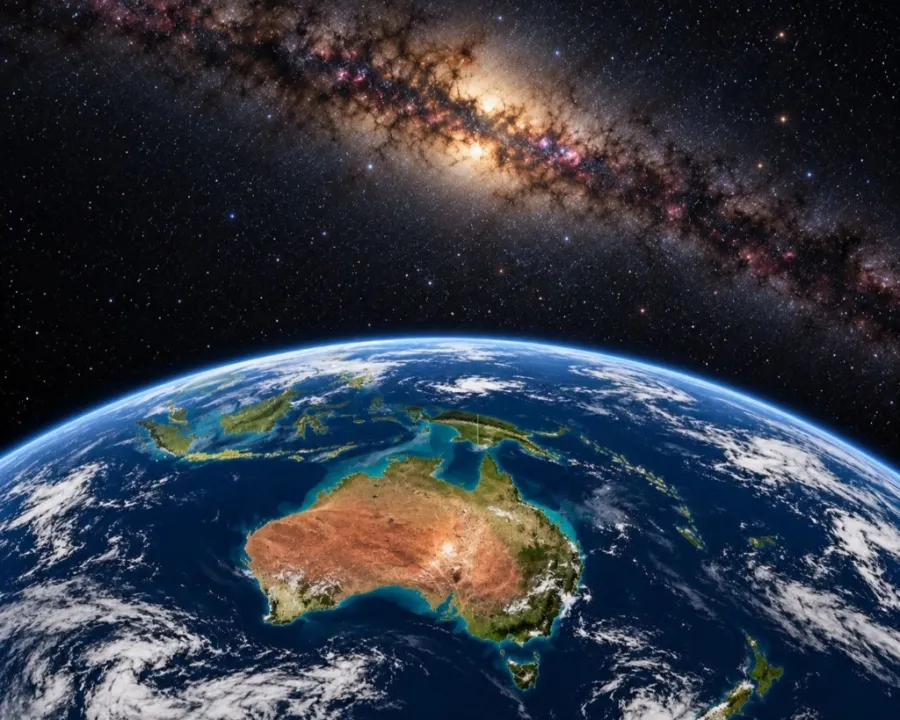
Maps and globes routinely position Australia toward the bottom of the Earth because the country sits in the Southern Hemisphere.
Yet when it comes to up and down in space, a floating planet has no fixed, universal orientation. Showing the North Pole at the top and the South Pole at the bottom is purely a human convention. Turning a terrestrial globe upside down breaks no law of physics whatsoever.
Earth’s Position in the Galaxy
Our home, the Milky Way, is a spiral galaxy. Nestled along the Orion Arm—a relatively minor spiral arm—lies our solar system, located roughly 26,000 light-years from the galactic center.
At the heart of the Milky Way lies a dense, swollen swarm of stars known as the galactic bulge. This central region is considerably thicker than the surrounding spiral arms. However, the galactic center does not tower above the arms; it resides right within the galaxy’s primary plane.
Now comes the intriguing twist: if we decide to define the direction toward the galactic center as “up,” Australia could actually be considered on the top of the Earth!
The Australian Sky
The galactic core occupies a celestial coordinate that, across much of Australia at certain times of the year, passes almost directly overhead.
From Canberra, for instance, the center of the galaxy climbs to a peak altitude of about 84 degrees—just six degrees shy of the true zenith directly overhead.
Because Earth continuously rotates on its axis, Australia does not face the galactic center at all hours. That cosmic orientation shifts steadily throughout the day and year.
Where Is Up, and Where Is Down?
Thus, the intuition that Australia sits at the bottom of the world has no basis in science. What we label “up” and “down” is entirely an artificial human convention.
That naturally raises the question: if Australia is not at the bottom of the Earth, which country is?
The scientific answer is simple: none of them!
In the vast expanse of the cosmos, absolute up and down do not exist. Everything depends entirely on which direction we choose as our reference point and the perspective from which we observe it.