Cosmic Scale vs Human Economy: Could We Have Money Equal to the Sun's Mass?
Most of us have daydreamed about possessing staggering wealth at some point in our lives. Some aspire to be billionaires; others imagine what it feels like to be a trillionaire. But what if your imagination stretched beyond all terrestrial limits and soared into astronomical scales? Imagine if you held a fortune whose numerical value equaled the Sun’s mass in kilograms! While that premise sounds like pure science fiction, let us examine through the lens of physics and economics whether such an absurd quantity of money could ever exist or be stored on Earth.
The brief answer is: absolutely not, in any possible reality. Why? Let us embark on an extraordinary journey comparing cosmic scale with earthly finance to find out.
1. A Monstrous Number: 2 Followed by 30 Zeros!
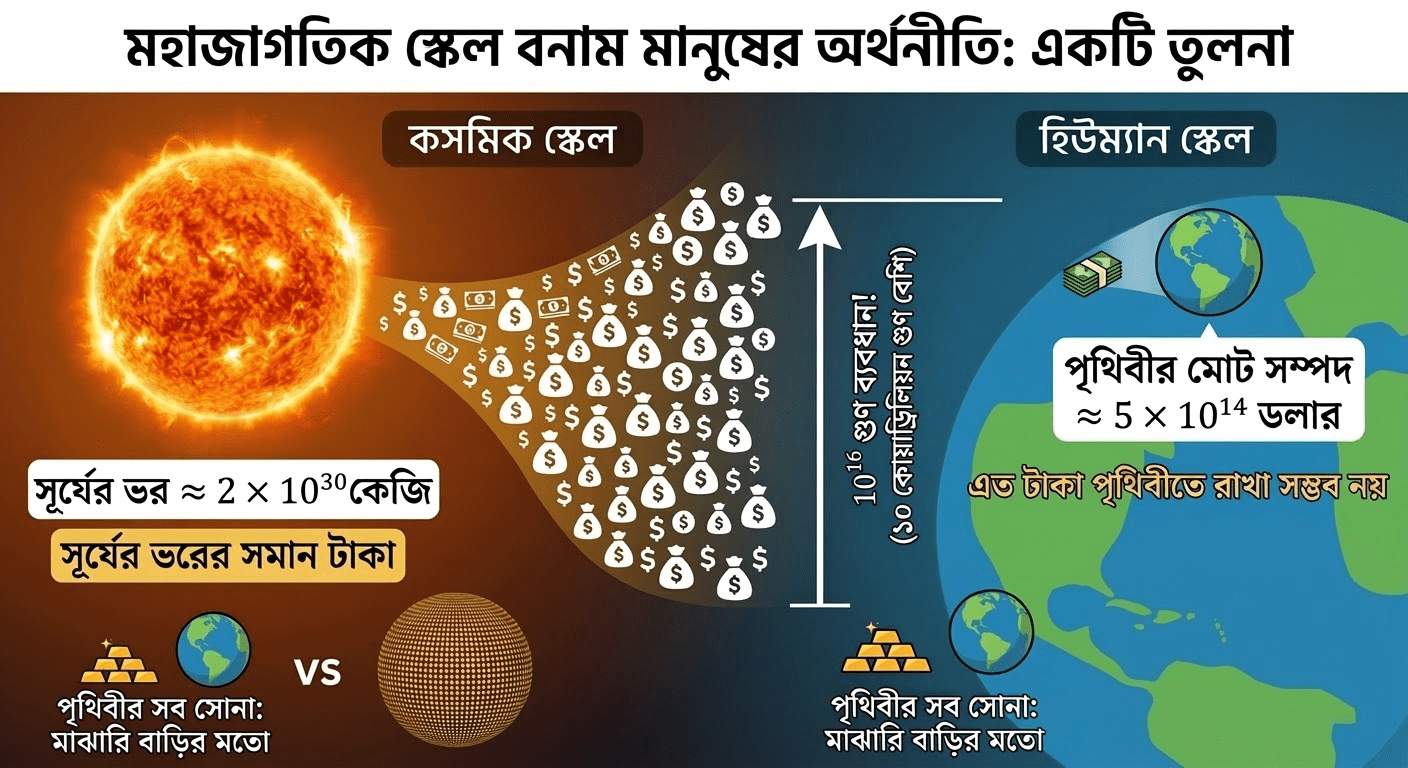
First, let us grasp just how immense this figure is. The mass of the Sun is approximately $2 \times 10^{30}$ kg. That is a 2 followed by thirty consecutive zeros!
If you converted this mass into units of currency—whether dollars, euros, or taka—the total dwarfs any economic scale ever devised by civilization. It is not millions, billions, or trillions; it is 2 nonillion! Written out in full, it looks like this: 2,000,000,000,000,000,000,000,000,000,000!
2. All Global Wealth vs. the “Wealth” of the Sun
Suppose we pooled all the money owned by every human on Earth: physical banknotes, bank deposits, stock markets, real estate, cryptocurrency, gold reserves, and diamonds. The total estimated global wealth stands at roughly 500 trillion dollars, or $5 \times 10^{14}$ dollars.
Now let us compare the two magnitudes:
-
Scale of the Sun’s mass: $10^{30}$
-
Scale of Earth’s total wealth: $10^{14}$
The difference between them is a factor of $10^{16}$ times (ten quadrillion times)! This gulf is so vast that if all the collective wealth on Earth were represented by a single grain of sand, the figure matching the Sun’s mass would represent the entire Sahara Desert!
3. Printing Paper Banknotes: A Cosmic Catastrophe!
Someone might playfully suggest: “If Earth lacks that much wealth, what if we just print the banknotes?”
Let us do the horrifying physics calculation. Suppose you wanted to print this fortune using single one-dollar bills. A standard paper bill weighs approximately 1 gram.
-
If you printed banknotes matching the Sun’s mass ($10^{30}$ bills), their collective mass would equal $10^{27}$ kg.
-
Yet our entire planet Earth has a total mass of only $6 \times 10^{24}$ kg!
What does that mean? Your printed paper currency would weigh roughly 166,000 times more than planet Earth itself! Far from finding warehouse space to store these notes, the sheer mass of this mountain of cash would produce a titanic gravitational field. It would instantly crush the Earth, and under its own crushing self-gravity, the pile of banknotes would collapse into a super-dense planetary body or even ignite nuclear fusion to become a star!
4. Economic Collapse: Money Reduced to Complete Worthlessness
What if we avoid paper notes and keep the entire balance digitally in computer databases? The outcome is equally disastrous.
Money carries value only because it represents tangible goods, services, productivity, and resources. If you magically created nonillions of dollars out of thin air, the purchasing power of each dollar would instantly collapse to absolute zero. In economics, this runaway devaluation is known as hyperinflation.
Because there are no corresponding goods or real assets in existence to match such infinite money, buying a simple cup of tea or a slice of bread would require trillions upon trillions of units. The currency would become nothing more than meaningless digital digits.
5. Melting All the Gold on Earth: How Big Would It Be?
To appreciate the sheer scale of the cosmos, consider gold. Across all human history—from the Pharaohs of ancient Egypt to modern mining—the total quantity of gold ever excavated is around 200,000 metric tons.
Gold is exceptionally dense. If you melted all the gold in existence—every wedding band, bullion bar in Fort Knox, and electronic component—into a single solid cube, each side of that cube would measure only about 21 to 22 meters. In other words:
-
It would stand roughly as tall as a modest 7-story residential building.
-
Its footprint would cover barely half of a standard tennis court.
Can you fathom that? All the gold accumulated throughout human civilization would fit inside the volume of a single townhouse! By contrast, the mass of the Sun exceeds all of Earth’s gold by roughly 10 trillion trillion times.
6. Visualizing the Scale: If the Sun Were a Football!
Astronomers often use an intuitive scale model to help us comprehend the mind-boggling scale of the universe.
Imagine shrinking the gigantic Sun down to the size of a standard football (soccer ball).
-
How big would our vast Earth be on that scale? Earth would shrink into a speck just 2.2 millimeters wide—the size of a tiny mustard seed or the head of a pin!
-
And what about distance? On this scale, you would have to place that mustard seed approximately 24 meters (about 78 feet) away from the football!
If you place the football at one goalpost of a soccer pitch, the tiny mustard seed representing Earth sits nearly a quarter of the way across the field. And all the space in between? Pure, empty vacuum! That is the true geometry of the cosmos.
All of human economics, fortunes, gold reserves, and currency represent an unimaginably tiny speck when weighed against the mass of stars and planets. That is why astrophysicists remark:
“Human scale numbers vs cosmic scale numbers are fundamentally different universes.”
The universe humbles us with our physical insignificance in this vast cosmic void, yet elevates us through our unique ability to comprehend its boundless grandeur.