Earth's Iron Heart: Mysteries of the Core and Geodynamo
When we gaze up at the night sky, we behold the infinite expanse of the cosmos. Planets, stars, galaxies, and comets make outer space seem like an endless vault of wonders. Yet another breathtaking world of mystery lies hidden right beneath our feet—deep inside our own planet. The world we inhabit is no inert, solid sphere of cold rock. Deep within, it is a dynamic, superheated, and profoundly complex realm. And the most enigmatic part of that hidden interior is Earth’s central core. This core is not just a geological foundation; it is the engine that generates Earth’s powerful magnetic field, which tirelessly shields our planet from cosmic destruction.
The Concentric Layers of the Earth
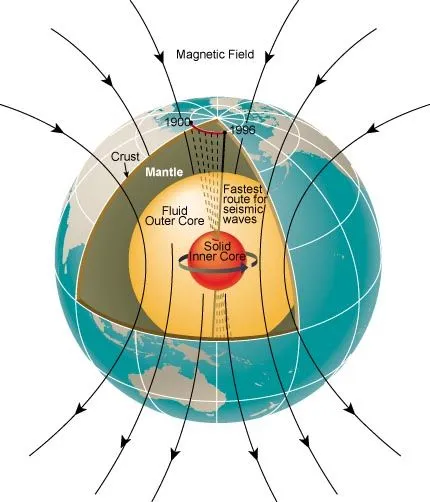
Earth spans a diameter of roughly 12,700 kilometers, structured into distinct concentric layers. The outermost shell is the crust, where all terrestrial life thrives. It is relatively paper-thin—measuring just a few kilometers under oceanic basins and up to roughly forty kilometers beneath towering mountain ranges. Beneath the crust lies the mantle, extending to a depth of nearly 2,900 kilometers. This vast layer is intensely hot and filled with churning, semi-solid silicate rock.
Directly beneath the mantle begins Earth’s core. The core is divided into two distinct regions: the outer core and the inner core. This is the hottest and densest region of our planet, where temperatures rival the blazing surface of the Sun.
A Center Forged in Iron and Nickel
Earth’s core consists predominantly of iron and nickel. Spanning a diameter of roughly 7,000 kilometers, the entire core region is nearly the size of Mars and significantly larger than the Moon. The outer core is composed of molten liquid metal, where temperatures rage between 4,000 and over 5,000 degrees Celsius.
Driven by the heat escaping from deep within and the planet’s rotation, this swirling liquid metal churns in relentless, violent convective currents.
Encased inside the molten outer core lies the inner core—a solid sphere of metallic iron and nickel. Remarkably, despite temperatures hot enough to vaporize metal at normal atmospheric conditions, this inner core remains solidly crystalline. The secret is incomprehensible pressure. Deep within Earth’s center, pressure is so extreme that iron atoms are forced together into an unyielding solid. Geophysicists estimate the inner core’s diameter to be approximately 2,400 kilometers.
The Birth of the Magnetic Shield
The churning, turbulent currents of molten metal in the outer core generate Earth’s magnetic field through a mechanism scientists term the geodynamo. As Earth spins on its axis, the fluid liquid iron convects vigorously. This swirling motion produces vast loops of electrical current, which in turn spawn an immense planetary magnetic field.
This magnetic field envelops our world in an invisible protective cocoon called the magnetosphere. The Sun continuously expels a torrent of high-energy charged particles known as the solar wind. If not for Earth’s magnetic field, these energetic solar particles would relentlessly strike our atmosphere, gradually stripping away gases into interplanetary space. Planetary scientists believe that Mars once possessed an ocean and thick atmosphere, but lost them when its internal magnetic dynamo died billions of years ago.
Reversals of the Magnetic Poles
Earth’s magnetic shield is far from static. Over geological epochs, Earth’s magnetic north and south poles have swapped places countless times—a phenomenon known as geomagnetic reversal or magnetic pole reversal.
The last major reversal occurred approximately 780,000 years ago, known as the Brunhes-Matuyama reversal. Scientists deciphered this dynamic history by analyzing iron-bearing minerals embedded in ancient volcanic basalt. When molten lava cools and solidifies into stone, tiny ferromagnetic particles freeze along the alignment of the Earth’s magnetic field at that moment. Consequently, layered ancient volcanic rocks serve as frozen magnetic tape recorders of Earth’s geomagnetic past.
The root trigger for pole reversals lies in the chaotic turbulence of the molten iron in the outer core. Internal convective heat, Coriolis forces from planetary rotation, and fluid metallic friction generate volatile, shifting eddies. Periodically, these chaotic flow patterns become so disrupted that the global dipole weakens, destabilizes, and eventually reconstitutes in reverse polarity. This change does not happen overnight; it is a gradual transition unfolding across thousands of years.
Dynamics and Mystery of the Inner Core
Earth’s deep interior remains full of fascinating puzzles. Because human instruments cannot physically drill more than a dozen kilometers into the crust, geophysicists probe the deep interior using seismic waves triggered by earthquakes. Recent seismic studies suggest that the solid inner core may periodically rotate at a slightly different rate than the crust and mantle above it—a phenomenon called super-rotation. This reveals that the deep interior is anything but dormant.
Final Thoughts
As we go about our daily lives on Earth’s tranquil crust, a tempestuous sea of liquid iron swirls thousands of kilometers beneath our feet. The ceaseless motion of that incandescent metallic ocean maintains the invisible shield that has preserved terrestrial life from deadly cosmic rays for billions of years.
How extraordinary that our planet’s greatest guardian originates from a blazing iron sphere at its very heart. Earth is far more than a silent ball of rock wandering through space; inside beats a colossal magnetic engine whose power protects every breath we take.