Navigating Unseen Paths: The Mystery of the Pigeon's Internal Compass
An Ancient Mystery: Imagine centuries past, during royal reigns or the trenches of world wars. With no telephone or internet, humanity relied on trusted avian messengers: homing pigeons. Through thick battle smoke, dense fog, and pitch-black nights, these remarkable birds crossed hundreds of unfamiliar miles to reach their exact destinations.
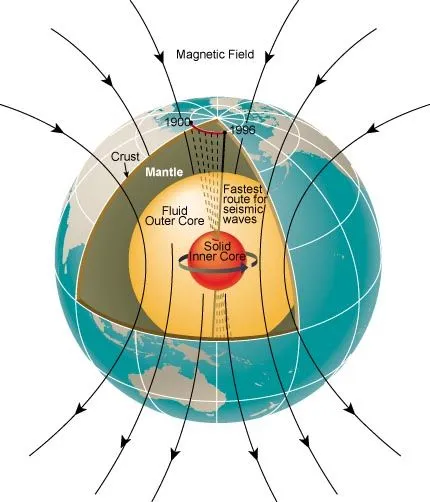
While human GPS relies on orbital satellites, a bird’s brain houses no satellite dish. How then do they navigate? For centuries, scientists knew pigeons could sense Earth’s magnetic field, yet locating their internal biological compass remained one of zoology’s greatest mysteries.
A Trail of Scientific Clues: Researchers initially suspected magnetite particles in the pigeon’s beak acted as compass needles. Years later, cellular analyses proved these iron-rich cells were immune macrophages rather than sensory receptors.
Focus then shifted to the eyes. Biologists discovered cryptochrome proteins in the retina that harness quantum mechanics in the presence of light to “visualize” magnetic inclinations. Yet this “light compass” required photons, leaving unexplained how pigeons navigate seamlessly on overcast days and in total darkness.
Clearly, the fundamental navigation sensor remained undiscovered, prompting researchers to peer inside the avian brain itself.
Mapping the Avian Brain: In a landmark study published in Science titled “A global screen for magnetically induced neuronal activity in the pigeon brain,” scientists developed an innovative experimental chamber to simulate Earth’s magnetic field while monitoring whole-brain neuronal activation.
They tracked which neural circuits lit up as magnetic vectors were systematically rotated.
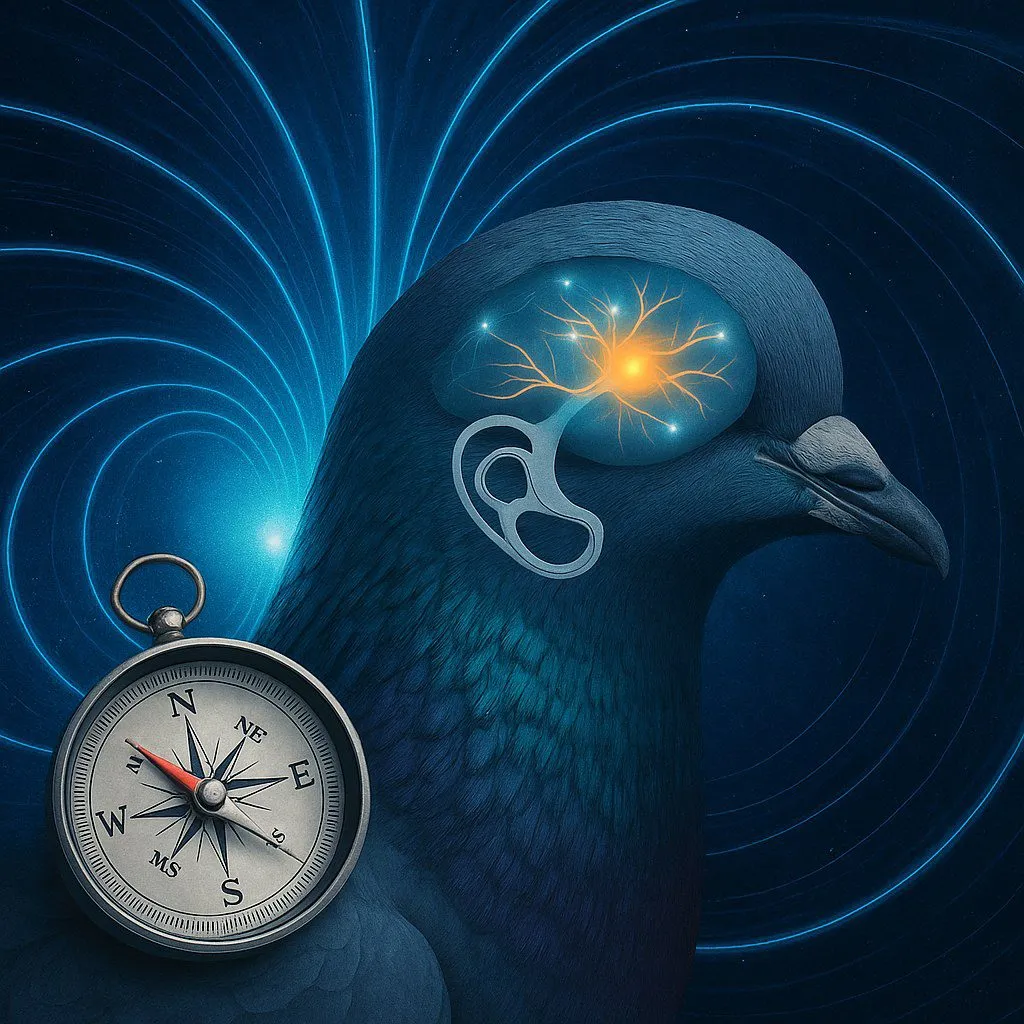
An Unexpected Discovery in the Inner Ear: The results stunned the scientific team. The primary magnetic signals originated neither in the beak nor the eyes, but from deep within the pigeon’s inner ear.
Pigeons possess semicircular canals for balance similar to humans. Researchers discovered that specialized Type II hair cells inside these fluid-filled canals act as biological radio antennas.
The underlying mechanism utilizes classical electromagnetic induction—analogous to wireless smartphone chargers. As the pigeon banks and turns in flight, Earth’s geomagnetic flux lines cut across the semicircular canals, generating subtle electric potentials within these specialized sensory cells.
The Brain’s Central Navigation Room: These sensory cells transmit signals directly to two principal neural hubs: 1. Medial vestibular nuclei: the primary relay station receiving raw vestibular signals; and 2. Caudal mesopallium: the high-order processing center functioning as the master navigational map room.
Upon receiving these geomagnetic inputs, the caudal mesopallium integrates the signals to determine spatial position and heading relative to Earth’s coordinates.
The Dark Compass: This breakthrough solved the longstanding riddle of nocturnal avian navigation. While retinal cryptochromes require sunlight, the inner ear’s induction mechanism operates independently of light. Dubbed the “Dark Compass,” it functions flawlessly during pitch-black nights, dense cloud cover, and heavy rain, as Earth’s magnetic field remains omnipresent.
Nature’s Masterpiece of Bioengineering: This discovery underscores that nature engineered a navigation system far more efficient than human-made electronics—functioning autonomously without batteries or orbital infrastructure. Beyond ornithology, deciphering this biological dark compass may inspire next-generation navigation systems for autonomous drones, underwater vehicles, and aerospace platforms.