The Universe's Tuning Seeker: Ashoke Sen and String Theory
A violin string produces so many different notes. Change the vibration, and the note changes. Could something similar be happening at the very deepest level of the universe? Are electrons, quarks and other fundamental particles really just different vibrations of something incredibly tiny?
At the heart of string theory lies exactly this astonishing idea. And one of the foremost researchers driving this theory forward is the Bengali physicist Professor Ashoke Sen.
He has recently been awarded the 2026 Oskar Klein Medal — one of the most prestigious international honours in theoretical physics. Previous recipients include Stephen Hawking, Steven Weinberg, Peter Higgs, Edward Witten and Kip Thorne. Ashoke Sen’s name now joins that distinguished list.
On 22 October, he delivered the Oskar Klein Memorial Lecture at Stockholm University. The title of his lecture translates to “From Strings to Gravity, from Gravity to Strings.”
Ashoke Sen was born in 1956. After attending Sailendra Sarkar Vidyalaya in Kolkata, he earned his bachelor’s degree in physics from Presidency College. He then completed a master’s at the Indian Institute of Technology Kanpur and, in 1982, his PhD from Stony Brook University in the United States.
After research abroad, he returned to India and worked for many years at the Harish-Chandra Research Institute in Allahabad. He is currently a professor at the International Centre for Theoretical Sciences in Bengaluru. His primary field of research is string theory.
A bridge between two worlds
Modern physics rests on two great pillars. Einstein’s general relativity explains gravity and the curvature of spacetime. Quantum theory, on the other hand, explains the behaviour of atoms and subatomic particles.
Each theory is extraordinarily successful in its own domain. But deep inside a black hole, or at the very earliest moments of the universe’s birth, quantum effects become just as important as gravity. That is where the need arises to bring the two theories into a single framework.
String theory is a theoretical attempt to bridge that gap. Instead of treating fundamental particles as point-like objects, it imagines them as incredibly tiny one-dimensional strings. Different vibrations of these strings can manifest as different particles. Within this framework lies the possibility of describing gravity in quantum terms.
Another door in the mathematics
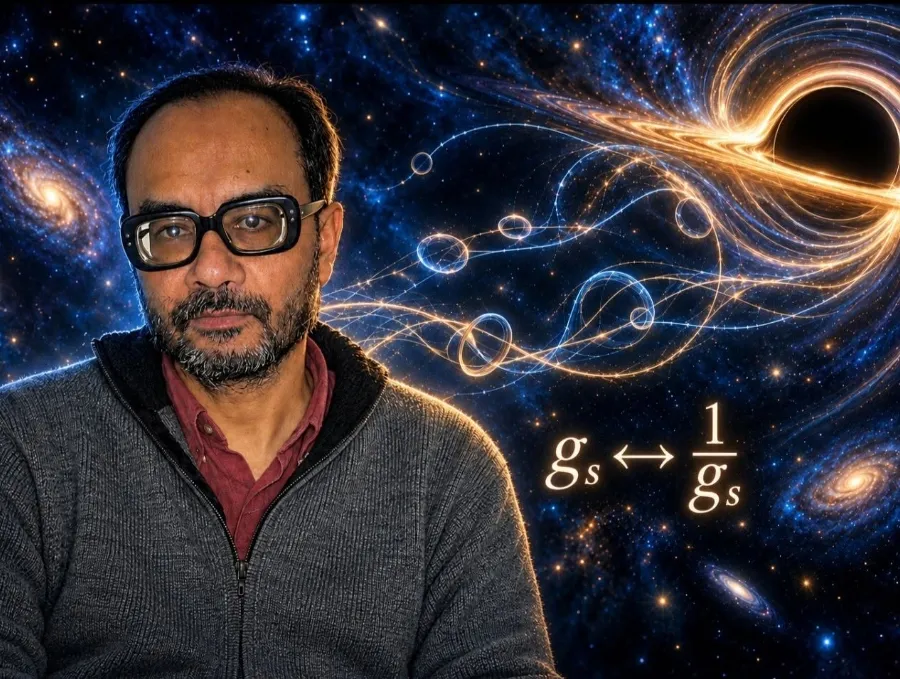
One of Ashoke Sen’s most important contributions is his work on S-duality.
When interactions between particles are very strong, their behaviour becomes extremely difficult to calculate. But here is the fascinating part: describe the same system in a different way, and those strong interactions can appear weak. The calculations then become manageable — and those easier calculations reveal the answer to the original, intractable problem.
This connection between strong and weak interactions is the core idea of S-duality. It is rather like finding an open door on the far side of an impenetrable fortress.
Ashoke Sen provided powerful mathematical evidence for this relationship in specific theories. His work opened the way to understanding deep connections between string theories that had seemed entirely separate.
The hidden ledger of black holes
Another major area of his research is black hole entropy. Here, thinking of entropy as merely “disorder” does not capture the full picture. Even when a system looks the same from the outside, its interior can be arranged in a vast number of microscopic configurations. The more such possible arrangements there are, the greater the entropy.
Black holes have entropy too. But what kind of microscopic states lie behind that entropy?
Ashoke Sen developed powerful methods for computing the entropy of certain types of black holes. His research helped match the large-scale properties of black holes with the count of their possible quantum states. This is a significant advance in understanding the relationship between the worlds of gravity and quantum mechanics.
Recognition and boundaries
In 2012, he was among the inaugural recipients of the Breakthrough Prize in Physics. In 2014, he received the Dirac Medal. Now the Oskar Klein Medal has been added to that list.
One thing, however, must be made clear. String theory has not yet been experimentally verified. Ashoke Sen’s mathematical achievements and the experimental detection of strings in nature are two separate matters.
Yet the importance of his work is immense. In the search for answers to the universe’s deepest mysteries, he has opened mathematical pathways that other researchers are now following.
We look up at the sky and see starlight. Ashoke Sen searches within his equations for that same light, those same stars, and the profound mysteries hidden behind the fabric of spacetime.