Einstein's Question: Chasing a Beam of Light
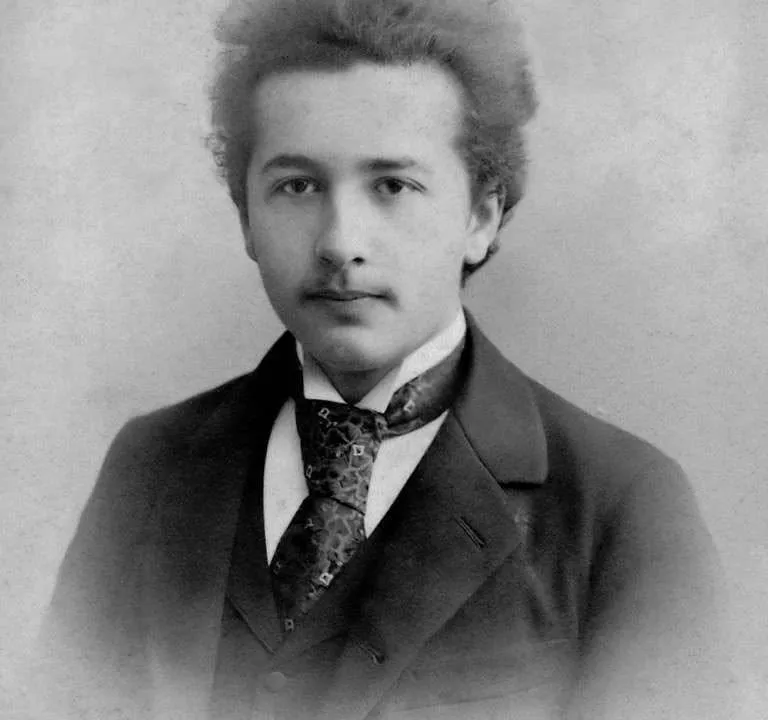
The year was 1895. Albert Einstein was only sixteen years old. A curious question took root in his mind: if you could run alongside a beam of light at the speed of light, what would you see? That thought—known to history as Einstein’s question—would change our entire view of the universe.
When two trains travel side by side in the same direction at equal speed, each seems stationary from the other. Would the same happen with light? If you ran at the speed of light, would the beam of light beside you appear frozen in place?
This teenage question would have a profound and lasting impact on his way of thinking.
The Strange Rule of Light
The problem is that light does not behave like any ordinary moving object. Whether you run toward the source of light or sprint away from it, the speed of light in a vacuum remains identical for every observer.
Suppose a car is moving at 100 kilometres per hour. You are travelling in another car in the same direction at 80 kilometres per hour. To you, the relative speed of the first car is only 20 kilometres per hour.
Yet with light, this everyday arithmetic fails completely.
No matter how fast you chase after a light beam, the light never slows down. In a vacuum, its speed remains constant at roughly 300,000 kilometres per second.
What Changes Instead?
This is where nature upends our common intuition. If the speed of light is the same for everyone, then our traditional assumptions about time and space must give way.
To a stationary observer, a rapidly moving clock appears to tick more slowly. The length of an object along its direction of motion appears shortened. Even whether two events occur simultaneously can depend on the motion of the person watching.
In other words, there is no universal cosmic clock or fixed cosmic ruler.
In 1905, at twenty-six, Einstein organised these revolutionary insights into a rigorous mathematical framework, publishing his special theory of relativity.
Energy Within Mass
Following this theory, Einstein arrived at another astonishing revelation: a fundamental equivalence between mass and energy. Even when an object sits entirely at rest, an immense amount of energy is locked within its mass.
He captured this relationship in his celebrated equation:
E = mc²
Here, E represents energy, m is mass, and c is the speed of light.
Because the speed of light squared is a staggering number, even a tiny amount of mass embodies colossal energy. If a single gram of matter were converted completely into energy, it would unleash roughly 90 trillion joules. This mass-energy equivalence became central to understanding atoms and nuclear reactions.
Travelling at the Speed of Light?
Here lies another surprise.
No object with mass can ever reach the speed of light in a vacuum. As an object accelerates, it demands ever greater energy to move any faster. The closer it draws to the speed of light, the steeper that energy cost becomes. Reaching the speed of light itself would demand infinite energy—an impossible feat in reality.
And so, the thought that captured the teenage Einstein—riding alongside a light beam at light speed—is physically impossible.
A New Vision of Gravity
Yet Einstein did not stop there. Special relativity explained the relationship between space and time for observers moving at uniform speeds. Soon, an even bigger challenge emerged: how could gravity be brought into this picture?
After nearly a decade of intense thought, in 1915 he unveiled the general theory of relativity. Where Isaac Newton described gravity as an attractive force pulling two masses together, Einstein revealed a far deeper mechanism: gravity is the curvature of spacetime itself.
A massive body like the Sun warps the fabric of spacetime around it. Earth simply follows the natural contour of that curved spacetime, which we observe as an orbit around the Sun. In general relativity, gravity is not merely a conventional pull; it is the geometry of space and time in action.
Is Everything Truly Relative?
There is an intriguing nuance here. Although Einstein called his work the theory of relativity, that does not mean everything in the cosmos is relative.
At the heart of the theory lies an invariant bedrock that never changes for anyone: the speed of light in a vacuum. While measurements of time intervals, spatial distances, or simultaneity may vary depending on the observer, the fundamental laws of physics hold true everywhere.
A sixteen-year-old boy simply wanted to know what light looks like when you race beside it. Guided by that single question, our entire understanding of time, space, mass, energy, and gravity was transformed.
Sometimes, the greatest revolutions in science begin with the smallest and simplest of questions.