The Flow of Time: Are Past, Present, and Future One?
Is the past truly gone? Has the future not yet arrived? Or do the past, present, and future all coexist in our universe right now?
These questions might sound strange at first. Yet modern physics suggests that our everyday intuition about the flow of time may be completely off the mark.
A Four-Dimensional Universe
Einstein showed that space and time are not separate entities. Three dimensions of space and one dimension of time intertwine into a four-dimensional tapestry called spacetime. From this insight emerged a striking idea known as the block universe.
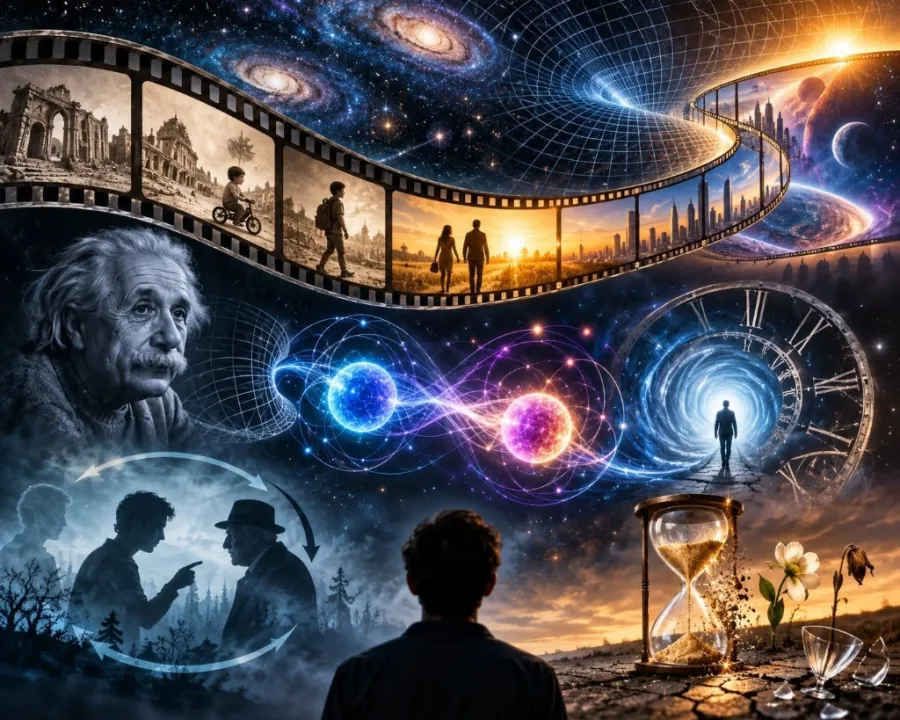
Think of the universe as a movie. On screen, we watch scene after scene unfold in sequence. Yet every frame of that movie is already stored together on the disc. According to the block universe model, time works in much the same way. The past, present, and future are all coexisting parts of a four-dimensional cosmic structure. We simply experience it one slice at a time. For now, however, this remains a theoretical model to explain time’s nature, rather than a proven fact.
The Quantum Mystery
In 2023, a team of researchers leveraged peculiar quantum properties to publish a novel theoretical paper. They designed a thought experiment where future information appears to influence past events.
To grasp how this works, consider one of quantum physics’ strangest traits. Two particles can become entangled so deeply that measuring the state of one instantly reveals the state of the other—even if they are separated by vast cosmic distances. Einstein famously dubbed this phenomenon “spooky action at a distance.”
Researchers used this entanglement to model an astonishing scenario: sending information back into the past. They showed that by combining specific quantum operations with post-selection, one could achieve results that look as though measurements made at the end of the experiment had been available right at the start.
This experimental scheme simulates features of a closed timelike curve, or CTC. In theoretical physics, a CTC is a worldline in spacetime that loops back onto its own past. Traveling along such a curve could, in principle, return you to an earlier moment in time.
Crucially, the physicists did not build a physical time machine or send real signals to the past. They mathematically demonstrated that quantum correlations and measurement selection can simulate the behavior of sending information backward.
The Paradox of the Past
The greatest dilemma of time travel is altering history. Imagine traveling to the past and doing something that prevents your own birth. How could you ever have grown up to travel back in the first place? This is the famous Grandfather Paradox.
Certain theoretical models suggest that even if time travel were physically possible, one could never trigger a contradictory event. History would have to unfold in a self-consistent way, forbidding logical paradoxes. Yet to this day, physicists have found zero empirical evidence that returning to the past is possible in reality.
The True Nature of Time
If the block universe theory holds true, our entire conception of reality must change. The past is not lost to oblivion, and the future is not an unwritten void. Every single instant in cosmic history remains an enduring part of a massive four-dimensional canvas.
Einstein’s relativity makes this picture even more compelling. Because time is relative, there is no universal “now” shared across the cosmos. Two distant events that occur simultaneously for one observer may unfold at different times for an observer in motion.
Whether a block universe implies that every chapter of our lives is strictly predetermined remains an entirely separate question.
The Arrow of Time
In everyday life, time flows in only one direction: moving steadily from the past, through the present, and forward into the future. Physicists call this the arrow of time.
Children grow into adults, and childhood never returns. Flowers bloom, wither, and never reassemble into fresh buds. A shattered drinking glass never spontaneously glues itself back together. This irreversible, one-way progression is tied intimately to the growth of entropy. In simple terms, entropy measures how widely energy is dispersed throughout a system. Over time, energy tends to spread out, and this relentless increase helps explain why time moves forward rather than backward.
Yet why do our minds only experience the present moment? Why can we remember the past, but not perceive the future? Science still seeks definitive answers to these profound questions.
Endless Questions
Quantum experiments offer fresh ways to think about temporal mechanics. Yet these studies do not prove that time travel or block universes are concrete realities.
Perhaps time genuinely flows like a river. Or perhaps past, present, and future are all timeless fragments of a single cosmic whole, and we are merely drifting from one second to the next. The ultimate question endures: is time truly moving forward, or are we the ones gliding through time?