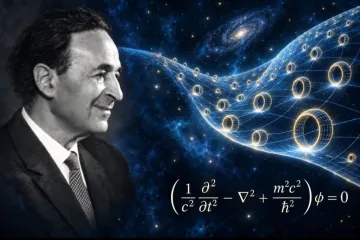
Twenty Scientists Who Transformed 20th-Century Physics
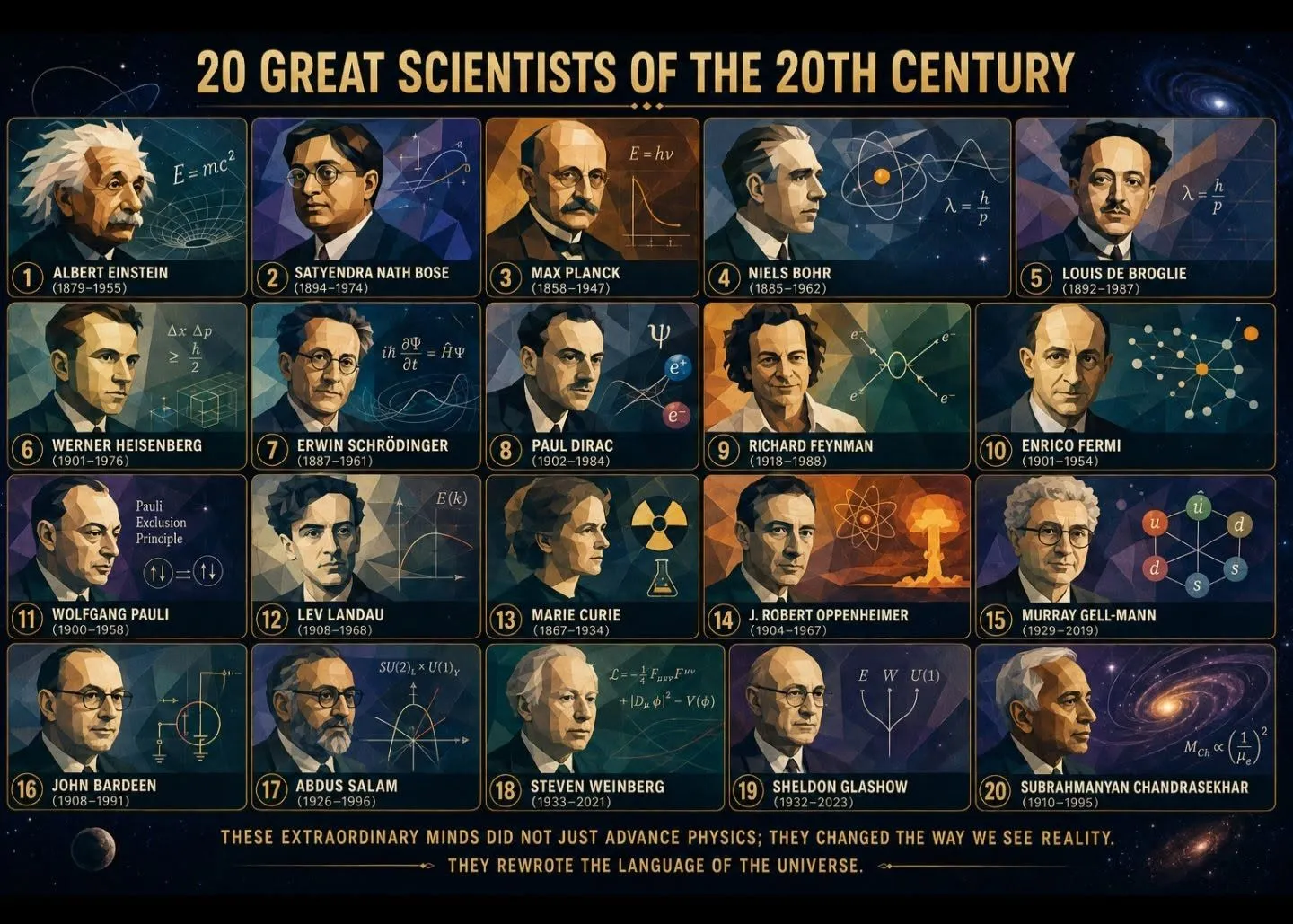
The twentieth century was not merely an era of technological acceleration; it was an epoch that fundamentally redefined physical reality. A handful of visionary physicists revolutionized our understanding of nature, giving humanity a brand-new vocabulary to decipher existence from subatomic dimensions to cosmic scales.
At the center of this revolution stood Albert Einstein. He demonstrated that space and time are not independent absolutes, but interwoven into a dynamic four-dimensional continuum called spacetime. His general theory of relativity superseded centuries of Newtonian physics, while his analysis of the photoelectric effect ignited the quantum revolution.
A quiet co-architect of that quantum dawn was Indian physicist Satyendra Nath Bose. Bose recognized that light quanta must be treated as indistinguishable entities obeying novel statistical laws, originating the concept of “bosons.” Einstein recognized the genius of Bose’s derivation and extended it. Today, lasers, superfluidity, Bose-Einstein condensates, and the Higgs boson all trace their lineage to Bose’s profound mathematical insight.
Remarkably, a prominent British journal initially rejected Bose’s seminal paper. Bose sent his manuscript directly to Albert Einstein in Berlin, who translated it into German and ensured its publication. Few scientific ideas have achieved recognition through such dramatic turns.
Earlier, at the turn of the century, Max Planck and Niels Bohr unlocked the quantum threshold. Planck showed that energy is exchanged in discrete packets called quanta, while Bohr demonstrated that atomic electrons occupy quantized orbitals rather than following classical mechanics.
They were followed by Louis de Broglie, Werner Heisenberg, and Erwin Schrödinger. De Broglie proposed matter waves, establishing wave-particle duality. Heisenberg formulated the uncertainty principle, revealing fundamental limits to deterministic measurement. Schrödinger introduced his wave equation, translating quantum kinematics into the language of probability amplitudes. Together, their work erected modern quantum mechanics.
This quantum reality was so counterintuitive that it provoked fierce philosophical debates among its founders.
Even Einstein resisted aspects of quantum indeterminacy, yet experiment after experiment upheld the predictions of quantum mechanics.
Paul Dirac synthesized quantum mechanics with special relativity, predicting the existence of antimatter. Dirac was a man of few words, yet his elegant relativistic equation mathematically required an antiparticle—the positron—which experimentalists discovered within years.
Richard Feynman reformulated quantum electrodynamics with intuitive visual elegance. His Feynman diagrams provided theoretical physics with an indispensable diagrammatic language to compute particle interactions.
Enrico Fermi and Wolfgang Pauli laid down principles governing atomic stability. Pauli’s exclusion principle established that no two fermions can occupy the same quantum state, explaining chemical periodicity and the structural stability of solid matter.
Fermi-Dirac statistics illuminated the collective behavior of fermions, clarifying electron transport in metals, semiconductors, and the degenerate matter of white dwarf stars.
Marie Curie was a titan of experimental science. Her pioneering investigations into radioactivity inaugurated nuclear physics, making her the only scientist in history awarded Nobel Prizes in both Physics and Chemistry.
Mid-century luminaries such as J. Robert Oppenheimer, Murray Gell-Mann, and Lev Landau expanded the frontiers further. Oppenheimer made foundational contributions to quantum theory and astrophysics while serving as scientific director of the Manhattan Project. Gell-Mann introduced the quark model to organize the chaotic subatomic “particle zoo.” Landau advanced condensed matter physics and established the legendary Soviet school of theoretical physics.
John Bardeen remains the only physicist awarded two Nobel Prizes in Physics: first for co-inventing the transistor, which underpins modern computing, and second for BCS theory explaining superconductivity. Despite these monumental achievements, he remained exceptionally modest throughout his life.
In the late twentieth century, Abdus Salam, Steven Weinberg, and Sheldon Glashow achieved a profound theoretical synthesis, proving that electromagnetism and the weak nuclear force are manifestations of a unified electroweak interaction—a cornerstone of the Standard Model.
Earlier, young Indian astrophysicist Subrahmanyan Chandrasekhar demonstrated mathematically that dying stars have an upper mass threshold. Above this Chandrasekhar limit, a stellar core cannot support itself against gravitational collapse as a white dwarf, collapsing into a neutron star or black hole.
Though his conclusions faced early skepticism from established contemporaries, Chandrasekhar persevered. Decades later, observational astronomy vindicated his mathematics, recognizing his work as a foundation of modern relativistic astrophysics.
These twenty remarkable scientists did not simply advance physics; they transformed how humanity perceives reality. Modern semiconductors, lasers, nuclear medicine, telecommunications, and quantum computation all rest upon the intellectual legacy they left behind.
These 20th-century physicists rewrote the language of the universe. In the 21st century, we continue to read that language to probe deeper cosmic mysteries, carrying forward the tireless journey of modern science.