The World of Quarks: Nature's Building Blocks
Everything in the visible world—mountains, oceans, forests, and human bodies—is composed of atoms. Scientists once believed the atom was matter’s indivisible building block. Later discoveries revealed that atomic nuclei harbor protons and neutrons. Yet the story does not end there. Deep inside protons and neutrons lies a far more mysterious subatomic realm: the world of quarks.
Quarks are fundamental elementary particles. As far as modern physics can measure, they cannot be broken into smaller constituents. Physicists have identified six distinct “flavors” of quarks: up, down, strange, charm, top, and bottom.
Unconventional as their names sound, these six particles constitute the physical foundation of all tangible matter.
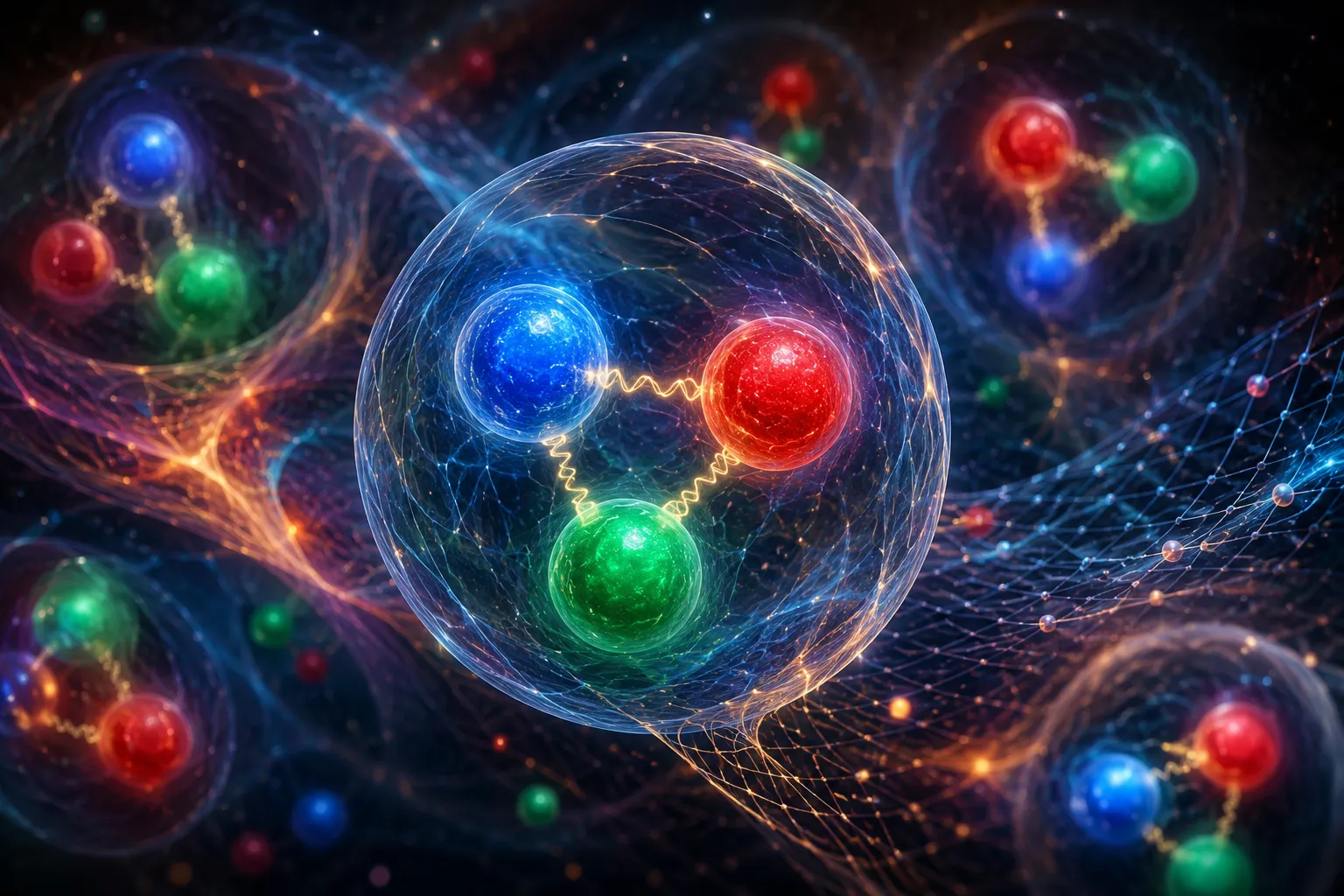
Protons and neutrons are bound composite systems composed of three valence quarks each. A proton contains two up quarks and one down quark, whereas a neutron comprises two down quarks and one up quark. These subatomic particles ultimately build the planets, stars, and life across the universe.
Yet the most astonishing property of quarks is that they are never observed in isolation. Nature enforces an unbreakable law: no matter how much kinetic energy is pumped into a collision, a quark cannot be isolated from its partners. This phenomenon is known as color confinement.
Binding them together are gauge bosons called gluons. The name is literal: gluons act as the subatomic “glue” that binds quarks into hadrons. But unlike everyday adhesives, the strong nuclear force behaves counterintuitively.
As quarks are pulled apart, the attractive force between them does not fade; it intensifies. They behave like a cosmic rubber band: the farther you stretch it, the harder it pulls back, until the energy stored in the field creates a new quark-antiquark pair rather than snapping open.
Quarks also carry a quantum charge termed “color.” This does not denote visual pigment like red, blue, or green; in quantum chromodynamics, color charge governs interactions under the strong nuclear force, stabilizing atomic nuclei across the cosmos.
No laboratory on Earth has ever captured a lone, isolated quark. Yet experimental evidence for their existence is incontrovertible, validated through deep inelastic scattering in world-leading particle colliders.
Remarkably, most of the mass of ordinary matter does not originate in the bare rest masses of quarks themselves. Instead, the frantic kinetic energy of quarks and the binding energy of gluons churning within protons and neutrons account for nearly 99 percent of hadronic mass. In accordance with Einstein’s \(E = mc^2\), tangible matter is essentially congealed kinetic energy.
Looking deep into the heart of matter, the grand tapestry of our universe rests upon the subatomic world of quarks. Invisible to direct vision, they are so indispensable that without them, stars, planets, and humans could never exist. Bound in perpetual embrace, quarks sustain the architecture of physical reality.