Two Full Moons: Why the Moon Flips Upside Down
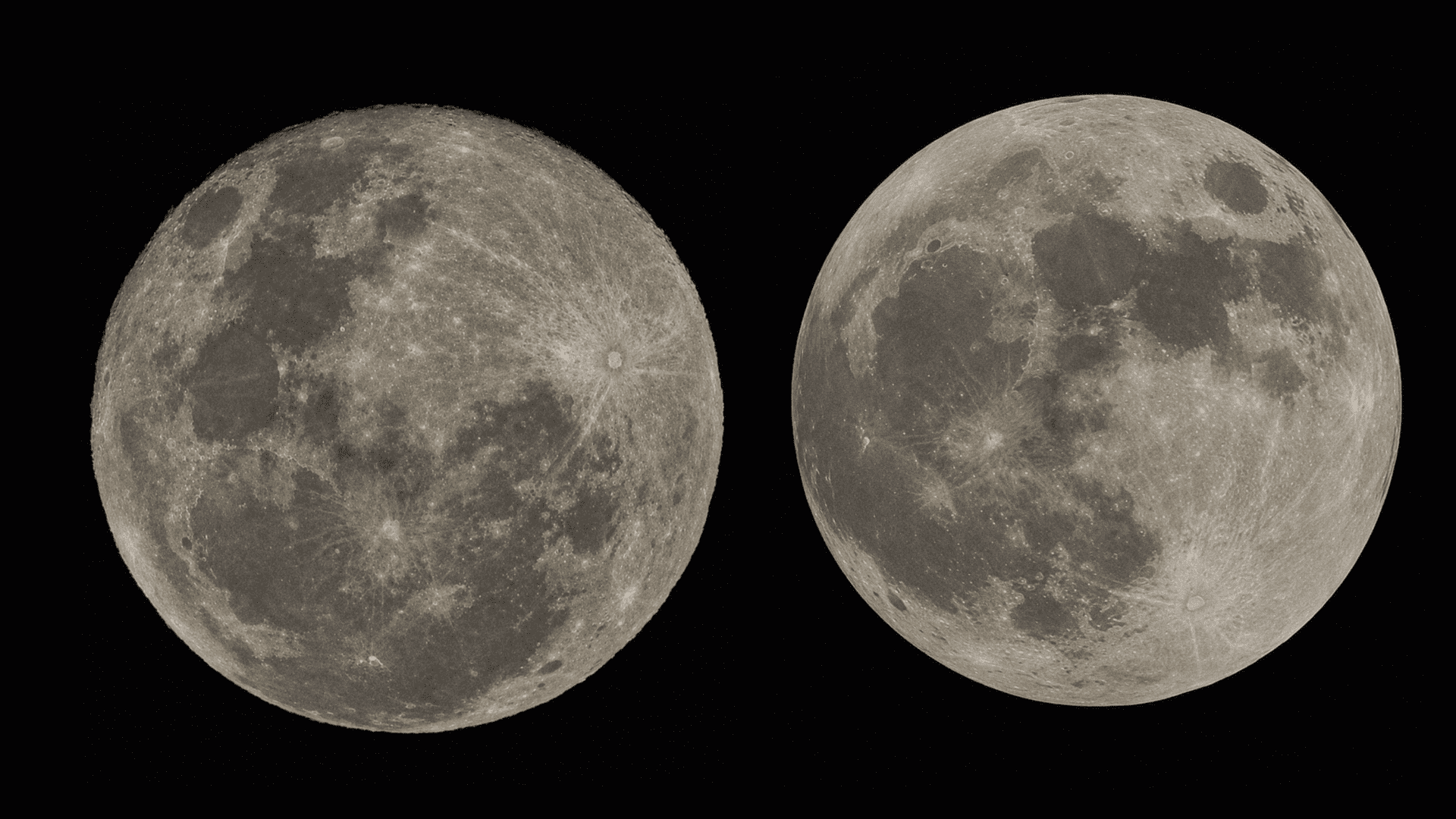
The first photograph was taken under the night skies of Canberra, Australia; the second under the skies of Dhaka, Bangladesh. Both are original photographs of the full moon—showing identical craters, ancient basaltic lava plains, and radiant ejecta rays. Yet placing the two images side by side creates the uncanny impression that someone has rotated the Moon. In reality, the Moon has not turned; it is our viewing perspective that has shifted.
Canberra is situated in the Southern Hemisphere at approximately 35° South latitude. Dhaka lies in the Northern Hemisphere at roughly 24° North latitude. That represents a latitudinal separation of nearly fifty-nine degrees between the two observers. This substantial difference in geographic latitude causes the lunar disc to appear in strikingly different orientations in the night sky.
Looking at the full moon from Dhaka, what an observer perceives as “up” is inverted from Canberra. Because the observers stand on opposite hemispheres of a curved planet, their local horizons and zenith directions are tilted relative to one another.
Gazing into deep space from opposing hemispheres, we are standing on different sides of a terrestrial sphere looking outward at the same celestial object.
Consequently, familiar lunar maria such as Mare Imbrium and Oceanus Procellarum appear in inverted positions in the Canberra photo compared to Dhaka. The bright ejecta rays emanating from crater Tycho appear rotated as well. None of the lunar geology has changed; only the orientation of the observer has flipped.
This is analogous to turning a world map upside down. The continents and coastlines remain identical, but rotating the map by sixty degrees completely alters where northern and southern landmarks appear. Exactly the same geometric phenomenon occurs when observing the Moon from different hemispheres.
Astronomers explain this as a consequence of lunar orientation and parallactic angle rotation. Northern and Southern Hemisphere observers face opposite directions when gazing toward the celestial equator. As a result, the full moon viewed from Australia appears dramatically inverted relative to the moon seen from Bangladesh.
These twin photographs are not merely curious portraits of the Moon; they offer direct visual evidence of Earth’s spherical geometry. One celestial sphere, viewed from two different latitudes, appears to wear two different faces. The Moon remains constant—it is our terrestrial vantage point that shifts, transforming our perspective on the cosmos.