The Rise of Space Startups
There was a time when space exploration belonged only to superpowers. Building a rocket or a spacecraft took thousands of engineers, massive government budgets, and years of preparation.
That picture is changing rapidly.
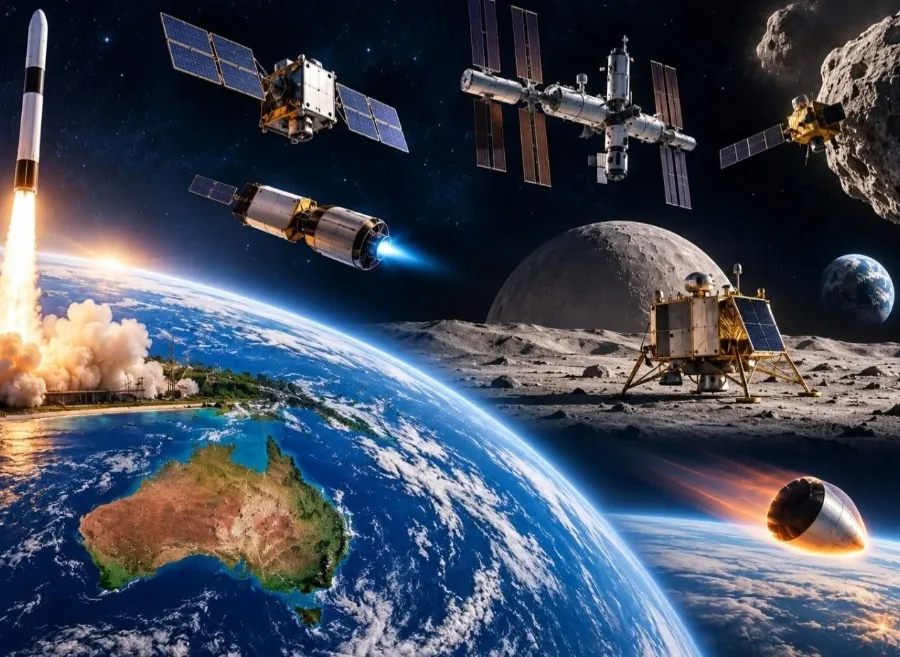
Today, numerous private space companies have emerged across different countries. Some are building rockets, some are sending landers to the Moon, others are attempting to build space factories. Still others are chasing asteroids.
Space is no longer just the domain of government agencies like NASA and the European Space Agency, or aerospace giants like SpaceX and Lockheed Martin. Numerous small startup companies are now working across diverse areas of space technology.
A New Era
Behind this transformation are small satellites, advanced electronics, 3D printing, reusable rockets, and relatively low-cost launch systems.
As a result, tasks once feasible only for major national space agencies are now within reach of small companies.
Yet the lion’s share of private investment still flows to American aerospace firms, making the United States the largest hub for new space startups.
Small Rockets
A familiar example of this emerging industry is Rocket Lab. Founded in New Zealand in 2006, the company is now headquartered in Long Beach, California.
To launch small satellites, the company developed the Electron rocket. Now they are developing the larger Neutron rocket. At the same time, they build various spacecraft and satellite components in-house.
In other words, the company is not just building rockets, but gradually assembling an entire space infrastructure.
Headed for the Moon
Another group of companies has set its sights on the Moon.
In 2024, Houston-based Intuitive Machines landed their Nova-C class Odysseus lander on the lunar surface. It marked the first American moon landing since Apollo 17, and the first soft lunar landing by a commercial company. However, the lander tipped onto its side upon landing, limiting its operational capabilities.
Then, in 2025, the Blue Ghost lander from Cedar Park, Texas-based Firefly Aerospace successfully touched down on the Moon, carrying ten scientific and technological instruments for NASA.
Several other companies, including Pittsburgh-based Astrobotic, are also working on lunar spacecraft.
Here, NASA’s role has been pivotal. Rather than building every lunar vehicle itself, NASA is now purchasing services from private companies to deliver scientific instruments and other payloads to the Moon.
Orbital Factories
California-based Varda Space Industries is taking a distinct approach. Their goal is to harness the microgravity environment of space to manufacture pharmaceuticals and specialised materials. On Earth, gravity makes certain crystals and compounds difficult to produce; in orbit, the conditions are fundamentally different.
Varda’s spacecraft manufactures in orbit, after which the materials are returned to Earth inside a reentry capsule. The spacecraft is therefore not merely a laboratory, but a miniature factory in space.
Space Taxis
Meanwhile, California’s Impulse Space is tackling a different challenge.
Delivering a satellite to orbit does not always complete the mission. Often, the satellite needs to reach a specific higher orbit or journey to a farther destination.
Impulse Space is building spacecraft capable of transporting satellites and other payloads from one orbital location to another—much like a taxi for space.
Space Stations
An even more ambitious vision comes from Vast in California. They are building private space stations, aiming to launch their first station, Haven-1, in 2027.
As the era of the International Space Station draws to a close, a private market may emerge in low Earth orbit for research, astronaut training, and commercial ventures. Future space stations may thus gradually shift from government installations to commercial infrastructure.
Mining Asteroids
One of the boldest concepts in this new space economy is being pursued by California’s AstroForge.
Their long-term goal is to extract valuable platinum-group metals from asteroids.
Actual mining remains far off. First, they must prove that a relatively small commercial spacecraft can reliably reach a distant metallic asteroid and operate there.
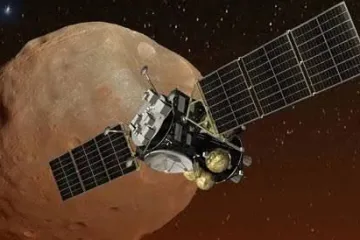
To that end, they are developing their DeepSpace-2 spacecraft, currently slated for launch in the final quarter of 2026. Its objective is to reach a near-Earth asteroid, observe it up close, and attempt an onboard landing.
AstroForge previously dispatched a deep-space probe named Odin. Launched in 2025, Odin travelled nearly 300,000 kilometres into deep space but was unable to complete its planned asteroid rendezvous.
Those hard-won lessons are now being poured into DeepSpace-2. Realising the dream of mining in space requires first learning how to reliably get there.
NASA’s Evolving Role
The rise of the commercial space industry does not diminish NASA’s importance; rather, its role is evolving. In earlier decades, NASA was intimately involved in virtually every phase of spacecraft construction and operation. Today, it increasingly buys turnkey services from private vendors.
Multiple US companies participate in NASA’s Commercial Lunar Payload Services (CLPS) program to deliver science instruments to the Moon.
The concept is simple: NASA says, “deliver our scientific instruments to the Moon.” How the company designs the spacecraft and navigates the journey is largely up to the company itself.
This procurement model has unlocked an entirely new marketplace for smaller space ventures.
Australia Joins the Race
Australia is keeping pace in this emerging space economy. A cluster of private space enterprises has taken root across the country, building orbital rockets, applying artificial intelligence in orbit, and developing mineral exploration technologies for Earth and the Moon.
Queensland-based Gilmour Space Technologies has developed Australia’s homegrown orbital rocket, Eris. The company manufactures rockets and satellites on the Gold Coast and established its own orbital spaceport at Bowen in North Queensland.
In July 2025, Eris made its inaugural test launch from Bowen. While the rocket failed, it marked a historic milestone in the effort to launch Australian-built rockets into orbit from sovereign soil.
Spiral Blue
Sydney-based Spiral Blue is pioneering artificial intelligence and edge computing in orbit.
Their Space Edge Computers process satellite data on-orbit before transmitting it to ground stations. By filtering out unneeded data, they drastically reduce downlink bandwidth.
The company is also developing space-based LiDAR technology, using lasers to capture high-precision three-dimensional geospatial data from orbit.
Hunting for Minerals
In Adelaide, South Australia, Fleet Space Technologies is deploying space technology for terrestrial mineral exploration.
Their ExoSphere platform unites satellite communications, seismic sensors, and artificial intelligence to map underground mineral deposits in three dimensions.
The company plans to adapt the same core technology beyond Earth as well.
Techniques perfected for subterranean surveying on Earth could one day uncover resources beneath the crust of the Moon or Mars.
Gilmour, Spiral Blue, and Fleet Space represent three distinct frontiers of Australia’s flourishing commercial space industry.
The Inherent Risks
Yet commercial space is fraught with peril. A single launch failure can derail years of work. A minor communications glitch can turn a multimillion-dollar spacecraft into space debris, as demonstrated by AstroForge’s Odin mission.
Not all space startups will survive. Developing technology is not enough; each venture must prove there is a genuine, sustainable market for its services in space.
A New Frontier
Even so, the momentum is undeniable. In 2025, there were 325 orbital launches worldwide, with roughly 87 percent conducted by commercial operators. That same year, 4,544 spacecraft were lofted into orbit, approximately 98 percent of which weighed under 1,200 kilograms. Spacecraft are not just turning private; they are becoming lighter and smaller.
Centuries ago, private merchant shipping opened up global sea lanes. Later, private enterprise propelled the expansion of railways and commercial aviation.
We are likely witnessing the dawn of a similar revolution in space. What was once the exclusive pursuit of nation-states is rapidly becoming a vibrant commercial economy.