Signals from an Alien World
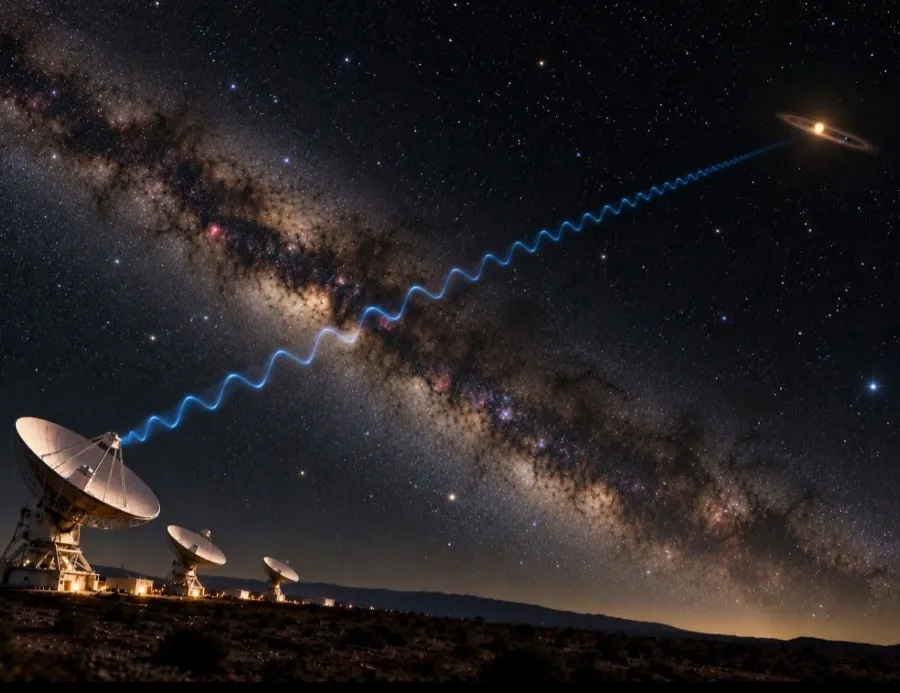
Sixty-three light-years from Earth lies an enormous planet named Beta Pictoris b. Now, radio waves emanating from that distant world have been picked up by telescopes on Earth.
No, this is not an alien transmission. It is an entirely natural emission of radio radiation. Yet the discovery is extraordinary nonetheless.
Astronomers were observing the planet using South Africa’s MeerKAT radio telescope when they detected faint, repeating radio waves.
Then began the real investigation. Were the waves coming from the host star or the planet itself? Precise astrometric measurements revealed the source was not the star; it aligned perfectly with the position of Beta Pictoris b.
Researchers believe the radio emissions are driven by the planet’s immensely powerful magnetic field. Interactions between charged particles and this magnetic field generate auroras, which unleash radio waves—a phenomenon that also occurs on Jupiter.
Analysing the radio waves yielded an even more striking revelation: in the region where the emission originates, the magnetic field strength reaches at least 1,250 Gauss—many times stronger than Jupiter’s.
If the researchers’ interpretation holds true, this marks the very first direct measurement of an exoplanet’s magnetic field strength beyond our solar system.
A final conclusion remains premature, however. The study has yet to undergo peer review and has been published as a preprint on arXiv.
Even so, a brand-new door has opened in astrophysics. For decades, we studied distant planets solely by observing their light. Now, by tuning in to their natural radio waves, we may listen to the secrets of unfamiliar worlds. We will no longer just look at distant exoplanets; we will hear them as well.