The Universe Through James Webb
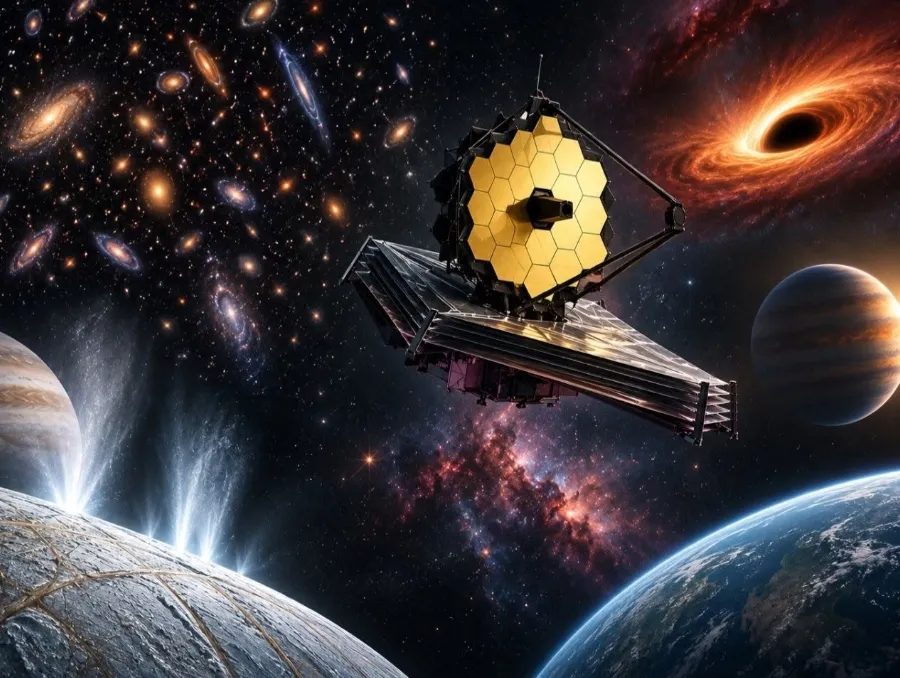
Prior to its launch, astrophysicists promised that the James Webb Space Telescope would revolutionize our comprehension of cosmic history. Few, however, anticipated just how swiftly that grand promise would be realized.
Since commencing scientific operations in 2022, the observatory has returned breathtaking data that has compelled astronomers to fundamentally rethink established models of galaxy formation, primordial black hole growth, stellar lifecycles, and extrasolar planetary systems.
James Webb is far more than a cosmic camera. Its decisive advantage lies in infrared sensitivity and high-resolution spectroscopy. By dispersing the faint infrared light from remote objects into constituent wavelengths, Webb deciphers their temperature, orbital velocity, and chemical fingerprint. Across its initial three years of science, approximately three-quarters of Webb’s observational schedule was dedicated to spectroscopy, with direct imaging accounting for the remainder.
What groundbreaking revelations has the observatory delivered so far?
Peering into the Cosmic Dawn
Because light travels at a finite speed, looking across immense cosmic distances means peering deep into the past. Webb now reveals the universe when it was merely a few hundred million years old — an infant stage in a cosmic history spanning 13.8 billion years.
Among Webb’s crowning triumphs is the discovery of MoM-z14. Possessing a confirmed spectroscopic redshift of 14.44, this galaxy is observed as it existed roughly 280 million years after the Big Bang, establishing it as the most distant spectroscopically verified galaxy known to science.
The surprise extends far beyond mere distance. Despite its extreme youth, MoM-z14 is remarkably luminous, dense, and enriched with chemical elements heavier than hydrogen and helium. Its existence indicates that star formation and galactic assembly occurred far more rapidly than orthodox cosmological models predicted.
A Cosmic Population of Overachieving Galaxies
MoM-z14 is not an isolated anomaly.
Webb has uncovered a surprisingly dense population of luminous, highly structured galaxies thriving in the early universe, many dating to just a few hundred million years after the Big Bang.
This poses a profound cosmological riddle: how did such luminous and evolved galactic structures assemble so rapidly in the cosmic dawn? Webb’s spectroscopic data indicates that primordial star formation was exceptionally efficient and energetic during that epoch.
The Enigma of the “Little Red Dots”
One of Webb’s most bewildering discoveries is the identification of the so-called “Little Red Dots”.
These compact, intensely red, and luminous sources populate the infant universe in surprising numbers during the first billion years, before vanishing rapidly in later epochs.
What are these mysterious objects?
Initially, researchers debated whether they were ultra-compact dwarf galaxies packed with dense stellar populations, or cocooned supermassive black holes accreting mass at voracious rates.
Recent observations strongly favor the black hole hypothesis.
In 2026, deep spectroscopic analysis of a Little Red Dot revealed unequivocal signatures of an enormous black hole actively gorging on surrounding matter, swaddled in dense, superheated gas. Some astrophysicists describe these configurations as hypothetical “black hole stars”, though whether all Little Red Dots represent identical systems remains an active investigation.
The Supermassive Black Hole Dilemma
Webb has magnified the enduring paradox of primordial supermassive black holes.
Conventional astrophysics posited that supermassive monsters grew gradually over billions of years from the stellar-mass remnants of the first generation of stars.
Yet Webb has detected gargantuan black holes flourishing so early in cosmic history that simple accretion over cosmic epochs cannot easily account for their mass, reigniting interest in direct-collapse black hole theories.
Probing Alien Atmospheres
Webb has achieved historic breakthroughs in the study of exoplanets orbiting distant stars.
Analyzing transmission spectra from the gas giant WASP-39b, the telescope conclusively detected atmospheric carbon dioxide, sulfur dioxide, and water vapor.
Across various exoplanets, Webb has identified the distinct spectroscopic fingerprints of methane, carbon monoxide, ammonia, and hydrogen sulfide. These atmospheric characterization techniques pave the way toward eventually analyzing the atmospheres of rocky, terrestrial worlds in search of biosignatures.
Rocky Exoplanets Under the Microscope
Located roughly 41 light-years away, 55 Cancri e is an ultra-hot rocky super-Earth whose surface is believed to be partially molten lava.
Webb observations detected indications of a thick carbon monoxide- or carbon dioxide-rich secondary atmosphere, likely outgassed continually from magma oceans beneath. Deciphering such harsh regimes helps scientists understand how rocky worlds retain or replenish atmospheres under intense stellar radiation.
Unveiling Hidden Worlds
In 2026, Webb added another jewel to its observational crown in the Beta Pictoris planetary system.
While two giant exoplanets were already cataloged around Beta Pictoris, Webb identified a previously hidden third planet: Beta Pictoris d.
Remarkably, the discovery did not rely on standard imaging; Webb’s high-resolution spectroscopy detected the distinctive absorption lines of carbon monoxide, water, and methane in the planet’s atmosphere, confirming its presence dynamically.
Oceans Beneath Europa’s Ice
Closer to home, Webb is unearthing vital insights across our own solar system.
On Jupiter’s ice-crusted moon Europa, Webb identified carbon dioxide deposits on the surface. Crucially, the isotopic and chemical context suggests this carbon originated from the vast subsurface saltwater ocean beneath Europa’s icy shell.
The Giant Plumes of Enceladus
Saturn’s small moon Enceladus is equally astonishing. Cryovolcanic geysers erupt through fissures in its southern ice crust, spraying water vapor and organic molecules into space.
Webb revealed that this plume extends more than 10,000 kilometers into space — over twenty times the diameter of Enceladus itself — and continuously feeds Saturn’s sprawling E-ring.
Worlds on the Boundary: Planets or Stars?
Webb is also discovering ultra-low-mass substellar objects that blur the boundary between gas giant planets and stars.
These brown dwarfs form like stars through gravitational collapse, yet lack sufficient mass to sustain core hydrogen fusion. Webb has cataloged free-floating brown dwarfs with masses barely three to four times that of Jupiter.
Rewriting Cosmic History
The greatest discovery of the James Webb Space Telescope is not an individual galaxy, planet, or black hole.
It is the transformation of our narrative of cosmic evolution. By revealing that galaxies, stars, and black holes developed far earlier and with greater vigor than previously thought, Webb is prompting astrophysicists to rewrite textbooks.
According to NASA data published in July 2025, across its initial three years of science operations, Webb executed over 860 distinct scientific programs, collected 550 terabytes of data, and facilitated more than 1,600 peer-reviewed scientific publications.
With more than a decade of fuel remaining, the voyage of discovery has only just begun.