Pi Day March 14: Unlocking the Cosmic Mysteries of Pi
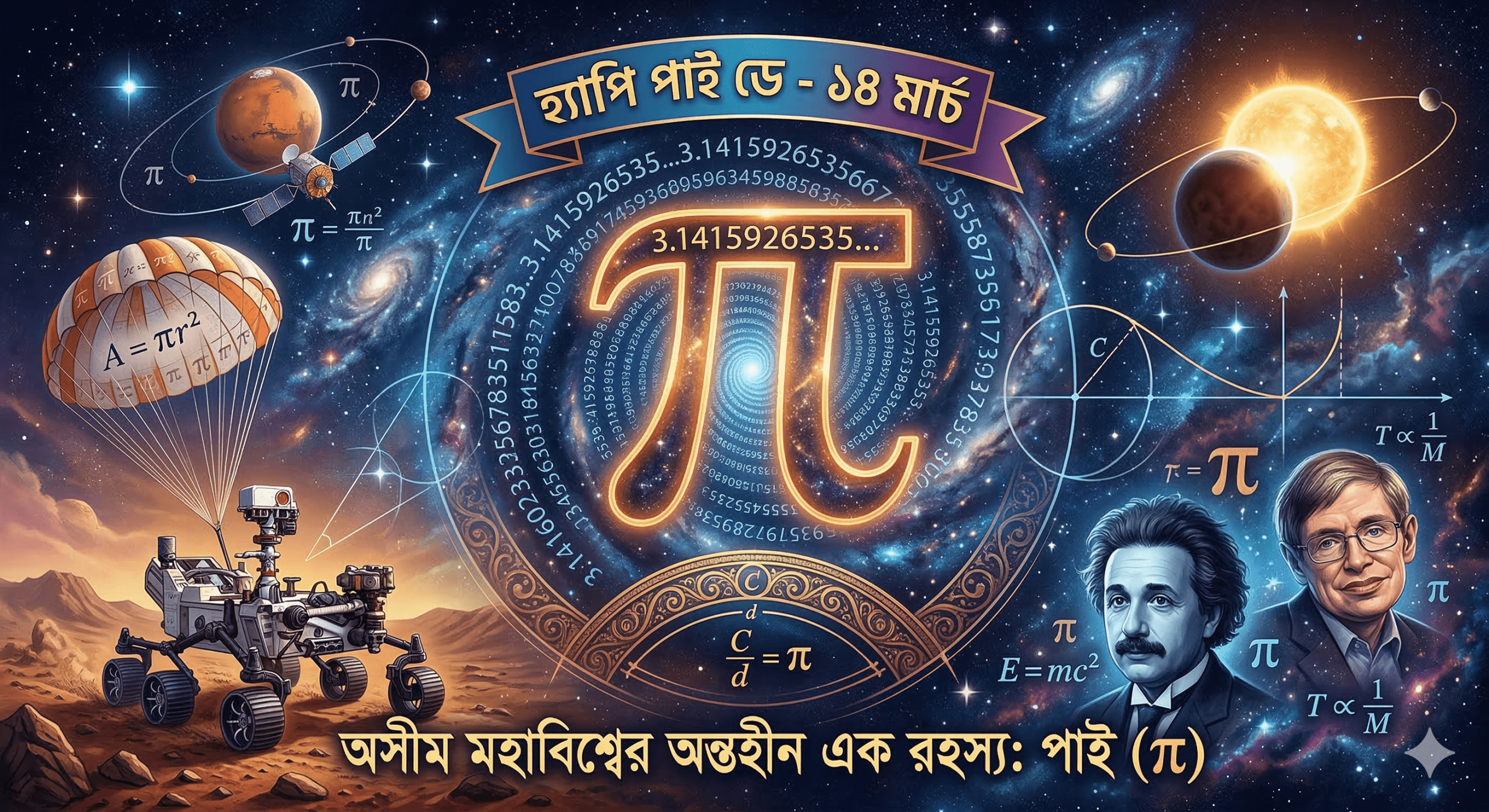
March 14 is celebrated around the world by mathematicians, scientists, and curious thinkers as Pi Day.
Why this particular date?
Written in the month/day date format (3/14), it mirrors the opening digits of mathematics’ most celebrated constant: π ≈ 3.1415926535…
Fundamentally, pi is the ratio of a circle’s circumference to its diameter. Yet this ubiquitous constant transcends elementary geometry, weaving through the foundational equations that describe our universe.
An Endless Numerical Ocean
Pi is an irrational number: its decimal expansion continues forever without repeating or terminating. Modern supercomputers have calculated pi to beyond 100 trillion decimal digits, finding no repeating pattern. Memorizing its digits is a celebrated test of human memory: in 2015, Rajveer Meena set a Guinness World Record by reciting 70,000 decimal places of pi while blindfolded across nearly ten hours.
Pi Across Astronomy and Deep Space Exploration
From orbital trajectories to stellar structures, astrophysicists rely on pi across every domain of cosmic exploration:
- Precision Navigation at NASA: While supercomputers compute trillions of digits, NASA’s Jet Propulsion Laboratory requires only fifteen decimal places (3.141592653589793) for interplanetary spacecraft navigation. To calculate the circumference of the entire observable universe with precision down to the diameter of a single hydrogen atom, just thirty-nine to forty digits of pi are necessary.
- Atmospheric Entry on Mars: When rovers like Curiosity and Perseverance plunge into the Martian atmosphere, massive supersonic parachutes decelerate their descent. Calculating parachute surface area using circular aerodynamics (A = πr²) is critical for mission survival.
- Detecting Exoplanets: When distant exoplanets transit their parent stars, they eclipse a fraction of starlight proportional to their cross-sectional area. Applying pi-dependent geometric formulas allows astronomers to calculate planetary radii light-years away with precision.
A Cosmic Calendar Coincidence
March 14 carries remarkable historical resonance in physics: Albert Einstein, whose field equations of general relativity are steeped in pi, was born on Pi Day in 1879. Fittingly, renowned theoretical physicist Stephen Hawking passed away on Pi Day in 2018.
History also records amusing legislative brushes with the constant. In 1897, the Indiana State Legislature debated the infamous “Indiana Pi Bill,” which attempted to establish a mathematically flawed geometric proof that implicitly defined pi as 3.2. Fortunately, Purdue University mathematician C.A. Waldo intervened to halt the bill’s passage.
Pi connects the simplest hand-drawn circle to the orbital dance of galaxies across the cosmos. It is an endless number that helps us measure an infinite universe.
Happy Pi Day!