Einstein vs Bohr Debate: The Epic Clash Over Reality
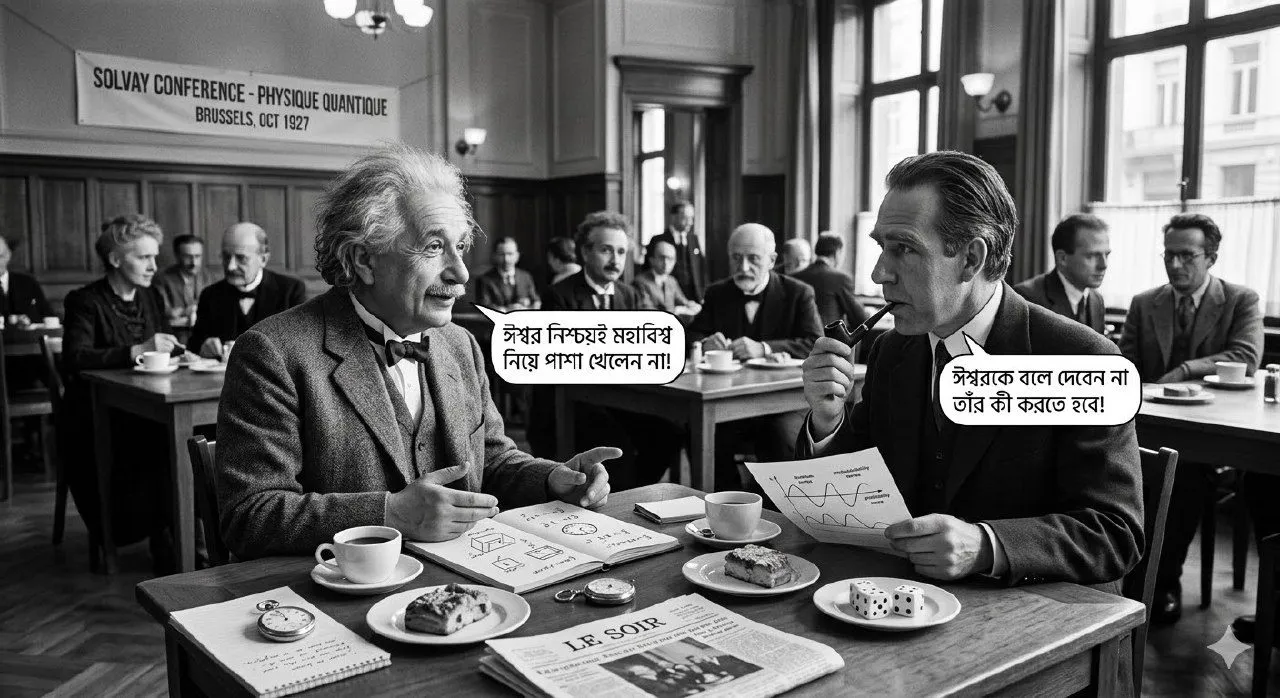
In October 1927, Brussels was charged with intellectual electricity. Gathering for the Fifth Solvay International Conference on Physics, twenty-nine of the world’s most brilliant minds assembled to deliberate the nature of matter and energy. Among attendees including Marie Curie, Max Planck, Erwin Schrödinger, and Werner Heisenberg, the conference centered upon an epic intellectual duel between two towering giants of modern science: Albert Einstein and Niels Bohr.
Their clash was not personal or political; it was a profound philosophical confrontation over the ultimate character of physical reality.
Clockwork Determinism vs. Quantum Probability
To Albert Einstein, the architect of general relativity, the universe was an orderly, deterministic cosmos governed by strict causality. Einstein believed that every physical event has an exact preceding cause. If one could measure the position and momentum of every particle at a single instant, the entire future of the universe could in principle be calculated with total certainty. Nature held no room for capricious chance.
Conversely, Niels Bohr and the Copenhagen school presented a radical worldview born from the atomic domain. In quantum mechanics, an unobserved electron does not possess a definite position or trajectory; it exists as a cloud of probabilities, spread across space in a wave function until an act of measurement collapses it into reality. Bohr argued that uncertainty is not a limitation of our measuring tools, but an intrinsic, fundamental feature of nature itself.
Einstein refused to accept that reality dissolves into rolls of the dice, famously declaring: “God does not play dice with the universe!”
To which Bohr famously countered: “Einstein, stop telling God what to do!”
Breakfast Table Intellectual Duels
Throughout the Solvay Conference, the hotel dining room served as their intellectual arena. Each morning at breakfast, Einstein presented a clever thought experiment designed to expose a contradiction in Heisenberg’s uncertainty principle or the Copenhagen interpretation.
Bohr would listen with intense concentration, muttering and pacing while dissecting the challenge throughout the day. By dinner that evening, Bohr would return with a rigorous mathematical rebuttal—often using Einstein’s own general relativity to prove that the uncertainty principle held firm. The next morning, Einstein would arrive with yet another ingenious puzzle, only for Bohr to resolve it once again.
1935: The EPR Paradox and “Spooky Action”
The debate culminated eight years later. Working at the Institute for Advanced Study in Princeton alongside Boris Podolsky and Nathan Rosen, Einstein published the 1935 EPR paradox. They demonstrated that if quantum mechanics were complete, two entangled particles could be created such that measuring a property of one would instantaneously determine the state of the other—even if separated by light-years across the universe.
Because special relativity dictates that no physical signal or information can travel faster than the speed of light, Einstein dismissed this instantaneous correlation as an absurd impossibility: “spooky action at a distance.” He concluded that quantum mechanics must be incomplete, possessing hidden variables that predetermine particle states from the outset.
Bohr remained unmoved, insisting that entangled particles form an inseparable quantum system whose non-local correlations do not violate relativity because no classical signal or message is transmitted.
The Verdict of Deep Time
Einstein passed away in 1955 and Bohr in 1962, neither living to see their debate empirically resolved. In 1964, Northern Irish physicist John Stewart Bell formulated Bell’s Theorem, devising a mathematical test to determine whether hidden variables could explain quantum correlations.
Beginning with Alain Aspect’s landmark experiments in 1982 and culminating in the 2022 Nobel Prize awarded to Aspect, John Clauser, and Anton Zeilinger, definitive loophole-free experiments proved that quantum entanglement is an undeniable empirical reality. Nature is indeed non-local; Bell’s inequalities are violated, and Bohr’s quantum model was vindicated.
The Foundations of Modern Civilization
Yet the true triumph of the Einstein-Bohr debates lies in how their rivalry forged modern technology:
- Quantum mechanics underpins the semiconductor physics inside every modern microprocessor, smartphone, and computer.
- Medical MRI scanners, fiber-optic lasers, and photovoltaic solar cells operate entirely on quantum principles.
- The very “spooky action at a distance” that Einstein questioned now powers quantum cryptography, unhackable satellite networks, and next-generation quantum computers.
Einstein and Bohr were intellectual adversaries united by deep mutual respect and an unquenchable passion for truth. From their relentless debate emerged the scientific bedrock of our modern technological civilization.