Aging Research Killifish Model: Unlocking Longevity Clues
The African Turquoise Killifish as a Model for Longevity
Aging is an inevitable, intricate biological process that has engaged clinicians and evolutionary biologists for centuries. Because human lifespans span many decades, directly investigating the molecular and behavioral mechanisms of aging in humans is extraordinarily time-consuming. To accelerate discoveries, scientists turn to short-lived vertebrate models whose aging processes closely parallel our own.
The African turquoise killifish (Nothobranchius furzeri) has emerged as an premier model organism. Inhabiting ephemeral rainwater pools in Mozambique and Zimbabwe that desiccate annually, the killifish evolved an ultra-condensed lifecycle: maturing and aging completely within four to eight months. This compressed lifespan allows researchers to track an entire vertebrate life trajectory within a single semester.
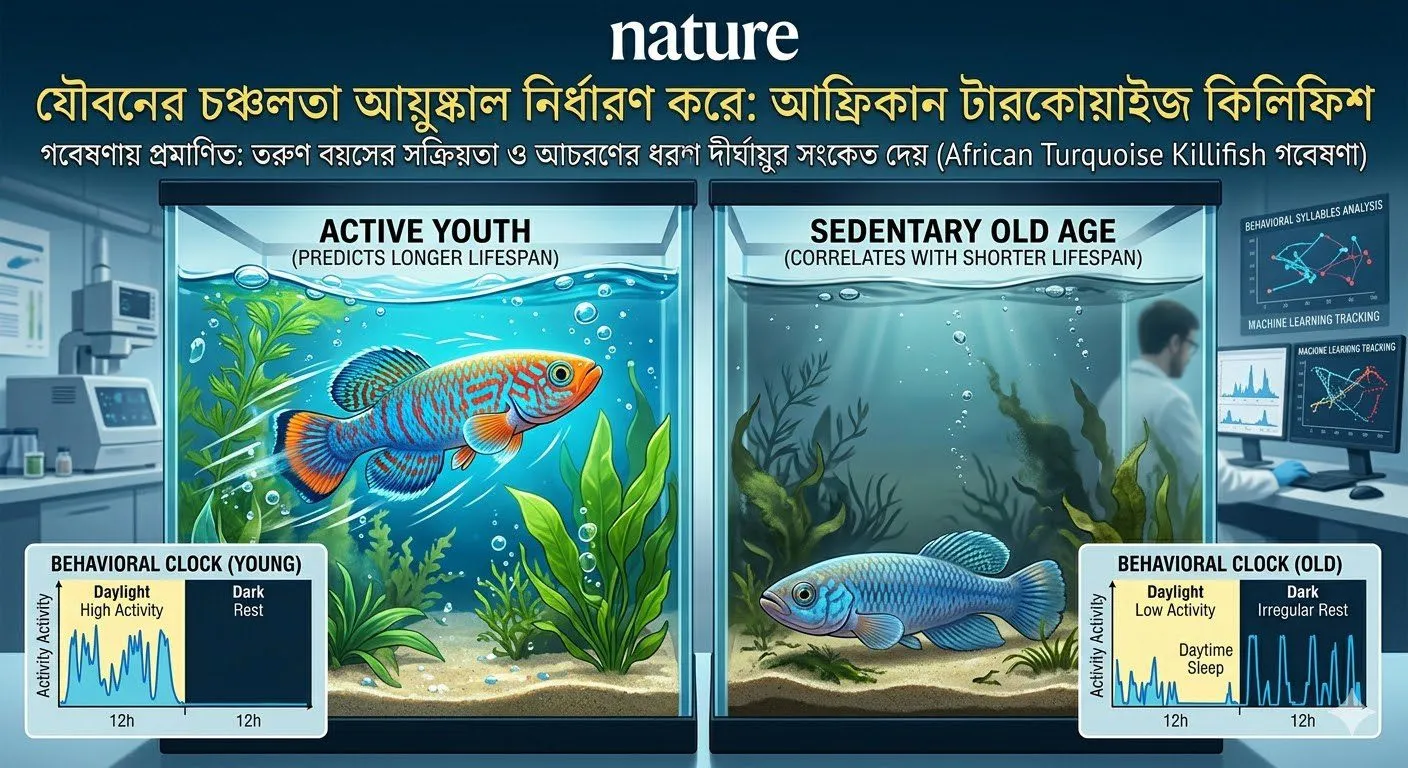
Crucially, recent research demonstrates that a killifish’s youthful activity patterns and movement dynamics accurately forecast its eventual lifespan. Youthful vigor is far more than a marker of fitness—it serves as a profound biological harbinger of longevity.
Automated Behavioral Tracking and Machine Learning
At Stanford University, researchers Claire Bedbrook and Ravi Nath spearheaded an exhaustive study monitoring eighty-one killifish throughout their entire lives. To achieve objective, continuous observation without human bias, the scientists deployed high-resolution computer vision and machine learning frameworks that monitored each fish around the clock.
The algorithm classified continuous swimming into roughly one hundred discrete behavioral motifs termed “behavioral syllables”—the foundational building blocks of the fish’s behavioral repertoire. By quantifying the frequency and sequencing of these syllables, researchers discovered that early-life behavioral metrics accurately predicted how long each fish would live.
Key Discoveries: Physical Vigor and the Stepped Nature of Aging
The study yielded several transformative insights into vertebrate aging:
- Youthful Activity Correlates with Longevity: Fish that exhibited higher swim velocities and sustained active exploration during their youthful weeks lived significantly longer than more sedentary peers, demonstrating that early physical vigor strongly correlates with extended vitality.
- Circadian Sleep Integrity: Resilient, long-lived killifish maintained clean circadian rhythms: active during daytime light cycles and restful during dark cycles. Conversely, short-lived fish showed disrupted diurnal patterns and excessive daytime lethargy—a parallel seen in aging humans where daytime drowsiness often signals systemic frailty.
- The Behavioral Clock: The team built a predictive mathematical model dubbed the “behavioral clock.” By processing behavioral syllable data, this algorithm determined a fish’s biological age and predicted its remaining lifespan with remarkable accuracy, identifying onset risks for senescence before visible pathology arose.
- Aging as a Stepped Transition: Rather than a continuous, linear decline, killifish aged in distinct “step-wise” transitions. Across their lives, fish underwent two to six abrupt behavioral shifts lasting only a few days, after which their baseline activity settled into a more advanced stage of senescence.
Implications for Human Longevity Research
While uncovered in Nothobranchius furzeri, these principles carry direct relevance for human gerontology:
- Discrete Transitions in Human Aging: The step-wise aging observed in killifish mirrors recent human multi-omics studies, which revealed that human molecular profiles undergo dramatic inflection points at specific ages—most prominently around ages 44 and 60.
- Behavioral Biomarkers and Early Intervention: Digital behavioral phenotyping—using consumer smartwatches and wearable accelerometers—could adapt these machine learning models to detect subtle early shifts in human gait, mobility, and circadian rhythms, alerting clinicians to accelerated biological aging years before chronic disease manifests.
Future Frontiers in Gerontology
Translating these findings into personalized medicine represents an exciting frontier. Future investigations aim to correlate specific behavioral syllables with cellular senescence markers, mitochondrial decay, and epigenetic methylation clocks. The tiny turquoise killifish has illuminated an enduring biological principle: across vertebrates, youthful vitality and structured diurnal rhythms are deeply woven into the architecture of a long and healthy life.