The History of Earth: A 4.5-Billion-Year Epic Journey
Our home planet Earth is approximately 4.54 billion years old—a span of time so vast that human intuition struggles to grasp it. If we were to compress Earth’s colossal biography into a thousand-page volume, the entire recorded history of human civilization would occupy mere words in the corner of the very last page. Scientifically calculated, human existence accounts for barely 0.0004 percent of Earth’s total lifespan—a vanishingly thin sliver of deep time.
A Fiery and Turbulent Genesis
The epic of our planet began in a world unrecognizable from the peaceful blue haven we inhabit today. Approximately 4.54 billion years ago, amidst the violent birth of the solar system, swirling clouds of primordial dust, interstellar gas, and rocky debris coalesced around the young Sun. Relentless gravitational accretion and catastrophic asteroid collisions forged the nascent Earth.
At its dawn, Earth was a molten hellscape—a churning sphere of searing lava bombarded by meteors, choked by poisonous volcanic gases, and swept by extreme turbulence. Gradually, around 4.4 billion years ago, the planet’s surface cooled enough for a solid crust to form. Atmospheric water vapor condensed into dense storm clouds, unleashing torrents of rain that fell across millennia, filling the basins to create Earth’s primeval oceans—the cradle of terrestrial life.
The First Spark of Life
Between 3.5 and 3.8 billion years ago, deep within primordial hydrothermal vents, the first microscopic single-celled organisms emerged. Though simple in structure, these ancient microbes would fundamentally transform the global environment.
Certain lineages of cyanobacteria evolved the miraculous mechanism of oxygenic photosynthesis, capturing sunlight to split water molecules and releasing free oxygen as a byproduct. Over hundreds of millions of years, this steady biological exhalation fundamentally altered the atmosphere—a transformative epoch known as the Great Oxidation Event.
The accumulation of atmospheric oxygen birthed the stratospheric ozone layer, shielding the planet from lethal solar ultraviolet radiation and creating the environmental prerequisites for complex multicellular life to evolve.
The Explosion of Multicellular Complexity
The next major evolutionary leap unfolded nearly three billion years later. Around 600 million years ago, macroscopic multicellular organisms flourished across the oceans. Then, approximately 540 million years ago, a burst of evolutionary radiation known as the Cambrian Explosion ignited the fossil record, producing virtually all major animal body plans in a geological blink of an eye. Armored trilobites and predatory marine invertebrates filled the seas, followed by the pioneering colonization of land by plants, insects, amphibians, and reptiles.
The Reign of the Dinosaurs
Approximately 230 million years ago, during the Mesozoic Era, dinosaurs rose to evolutionary dominance. For roughly 160 million years, these magnificent reptiles ruled terrestrial ecosystems across Pangaea and its fragmented continents. In their shadows, early mammals scurried as small, nocturnal creatures, while the earliest feathers evolved into the ancestors of modern birds.
Cataclysm and the Age of Mammals
Sixty-six million years ago, an asteroid roughly ten kilometers in diameter slammed into the Yucatán Peninsula near Chicxulub, Mexico. The impact unleashed apocalyptic firestorms, global mega-tsunamis, and a pervasive particulate winter that plunged the planet into freezing darkness for years, eradicating the non-avian dinosaurs. In the wake of this planetary devastation, surviving mammals diversified rapidly, colonizing vacant ecological niches across land, sea, and air.
The Late Arrival of Humanity
Long after the dinosaurs vanished, roughly 200,000 to 300,000 years ago in the African savannas, anatomically modern humans—Homo sapiens—made their quiet entrance. In geological terms, this occurred only a fraction of a second ago.
Agriculture was invented a mere 10,000 years ago. The industrial revolution sparked barely two centuries ago. And human footsteps touched the lunar surface only half a century ago. The entire technological explosion of human society has unfolded in the final heartbeat of planetary time.
Earth’s Timeline as a Single Calendar Year
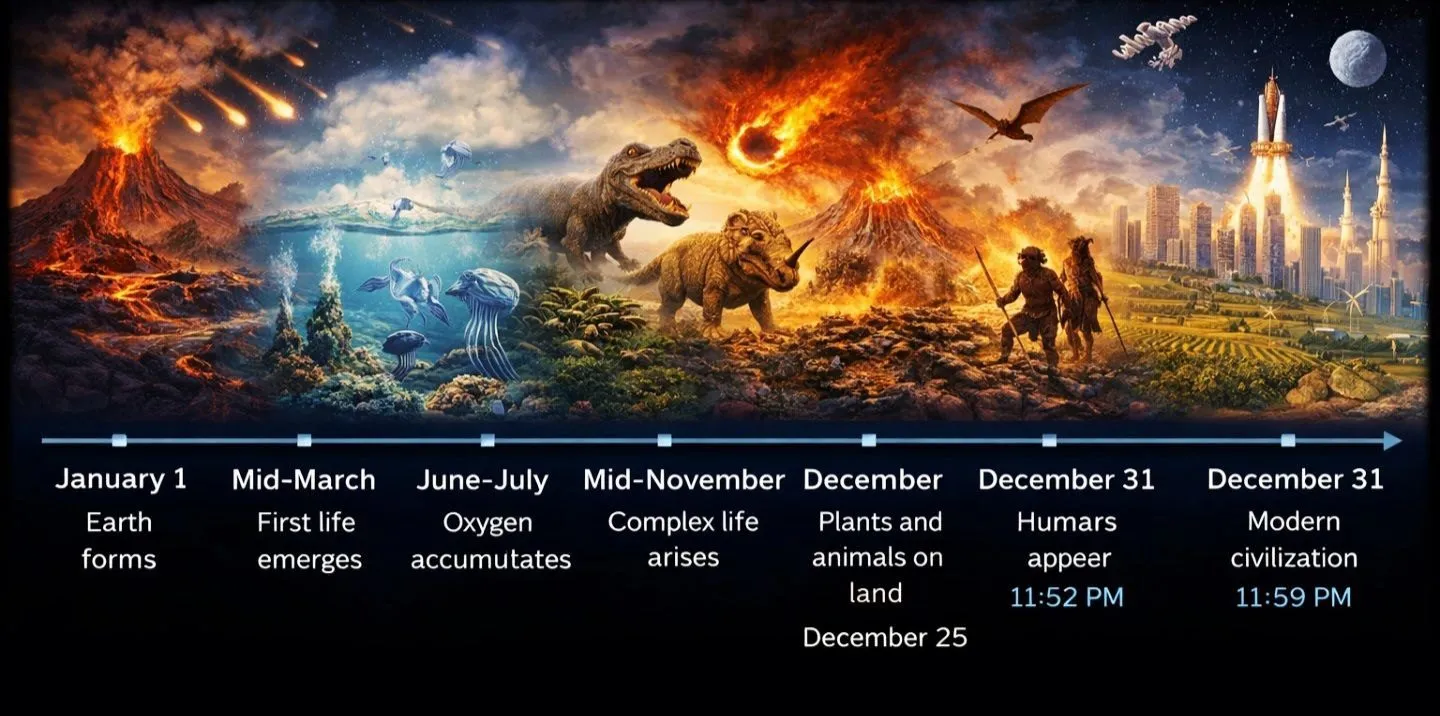
To visualize this staggering chronology, imagine condensing Earth’s 4.54-billion-year timeline into a single calendar year, where January 1 marks the planet’s formation and midnight on December 31 represents the present:
- January 1: Formation of the Earth
- Mid-March: First single-celled life appears
- June–July: Oxygen begins accumulating in the atmosphere
- Mid-November: Complex multicellular life proliferates
- Early December: Plants and animals colonize dry land
- Mid-December: Dinosaurs emerge
- December 25: Asteroid impact extinguishes the dinosaurs
- December 31, 11:52 PM: Modern humans appear
- December 31, 11:59:45 PM: Recorded human history, agriculture, and civilization unfold
In this cosmic calendar, humanity has existed for mere minutes, and our industrial civilization for barely fifteen seconds.
Transient Guests with Monumental Influence
Across Earth’s grand timeline, we are fleeting newcomers. Yet in this brief tenure, human intelligence and collective enterprise have reshaped the biosphere on a scale unmatched by any preceding organism. We have mapped continents, traversed the ocean floor, placed satellites in orbit, and landed robotic rovers on neighboring worlds. Concurrently, human activity is altering global climate, transforming landscapes, and driving biodiversity loss.
Compared to the billions of years that preceded us, our stay is momentary. Yet that fleeting presence now holds the stewardship of Earth’s living future—making humanity’s arrival the most consequential chapter in this planetary epic.