Quantum Battery Technology: Charging at Light Speed
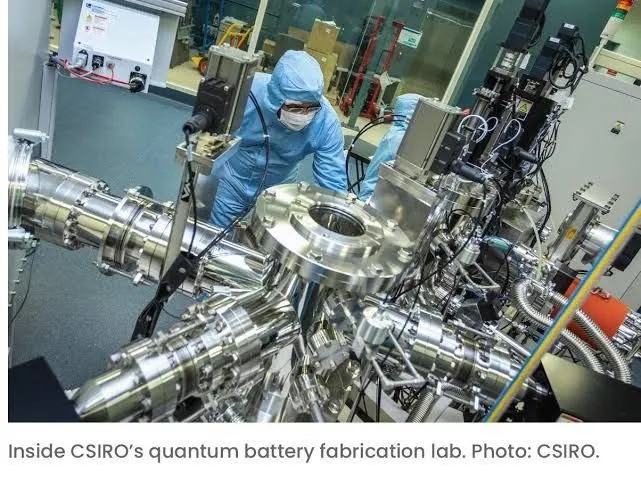
For over a century, energy storage has followed a universal empirical rule: small batteries charge relatively quickly, while large battery packs take significantly longer. Charging a smartphone requires an hour, while recharging a long-range electric vehicle demands an extended wait. This trade-off is so deeply ingrained in consumer electronics that we accept it as an inevitable law of physics.
An Unprecedented Discovery in Canberra
Yet in the research laboratories of Australia’s national science agency, the Commonwealth Scientific and Industrial Research Organisation (CSIRO) in Canberra, a team of physicists has upended this conventional wisdom. They demonstrated an astonishing inversion of normal thermodynamics: a battery that charges progressively faster the larger it becomes. While counterintuitive, their experimental prototype achieves precisely this quantum marvel.
What Is a Quantum Battery?
This radical energy storage architecture is known as a quantum battery. Unlike traditional electrochemical batteries that rely on chemical redox reactions and lithium-ion migration through an electrolyte, a quantum battery operates on the principles of quantum mechanics—harnessing quantum entanglement, superposition, and collective quantum behavior.
In an electrochemical battery, individual storage units charge independently in parallel, causing the total charge time to scale linearly with energy capacity. In a quantum battery, the energy-storing quantum elements enter an entangled, coherent state. Rather than charging individually, they absorb energy collectively through a phenomenon analogous to superradiance. Consequently, as more quantum units are coupled together, the collective charging rate accelerates dramatically, allowing the system to absorb energy in a synchronized quantum leap.
Most remarkably, this collective absorption takes place on the femtosecond timescale—one quadrillionth of a second (10⁻¹⁵ seconds). This rate of energy transfer is so astronomically swift that it defies everyday human perception, yet once charged, the device can retain its stored energy across comparatively extended durations, opening revolutionary frontiers in applied physics.
Entering Deeper Realms of Physics
While such behavior appears to challenge standard physical intuition, no fundamental laws are broken; rather, the system leverages the deeper rules of quantum thermodynamics. Currently, quantum batteries remain in the foundational proof-of-concept phase. Laboratory prototypes are microscopic in scale, hold minuscule amounts of energy, and retain their charge for limited durations before decoherence sets in. Practical consumer applications—such as powering smartphones or electric cars—remain years away.
However, the paramount achievement lies in the experimental verification itself: proving that quantum super-charging is physically achievable outside theoretical mathematical models. Validating this mechanism establishes a crucial technological milestone that could transform future engineering.
A Revolution in Clean Energy and Computing
Looking to the future, the implications of scalable quantum energy storage are profound. The day may arrive when electric vehicles recharge completely in mere seconds rather than hours, or where ultra-fast quantum batteries power next-generation quantum computers and facilitate directed wireless energy transfer without thermal losses. The breakthrough reminds us that the technological boundaries we perceive are often merely the limits of our current understanding. The quantum domain continues to reveal that physical reality is far more wondrous and capable than classical mechanics ever suggested.