Human Evolution Bottlenecks: Surviving Near Extinction
The chronicle of planet Earth is not merely a serene tapestry of lush forests and tranquil oceans. Beneath the surface lie epic chapters of fire, crushing ice sheets, devastating megadroughts, and lethal contagions. Across evolutionary time, the threat of extinction has knocked repeatedly at life’s door.
Today, human beings number over eight billion strong. We construct soaring cities, explore the ocean depths, and send robotic emissaries into interstellar space. Yet our presence at the pinnacle of the biosphere was never guaranteed. Our evolutionary history is primarily a saga of sheer survival—a journey during which our ancestral lineage repeatedly teetered on the brink of total annihilation.
Understanding Population Bottlenecks
In evolutionary biology, an abrupt, catastrophic collapse in the census of a species is termed a population bottleneck. Like liquid constricted through the narrow neck of a bottle, the vast majority of the population perishes, leaving only a handful of survivors to carry the species forward. When a bottleneck occurs, massive genetic diversity is permanently lost, and genetic drift reshapes the surviving gene pool. Yet a bottleneck is also a powerful evolutionary sieve: those who endure pass on physiological, cognitive, and behavioral adaptations that define the future trajectory of the species.
Teetering on the Brink of Extinction
Anthropological and genomic research reveals multiple instances where early humans nearly vanished. Genomic modeling published in recent years indicates that between 900,000 and 800,000 years ago during the Early to Middle Pleistocene transition, our ancestral lineage suffered a catastrophic collapse. The global breeding population plummeted to roughly 1,280 individuals—scarcely the population of a modest village—and remained suppressed for over a hundred thousand years. Severe glacial cycles, persistent megadroughts, and ecological collapse drove hominin populations to the edge of extinction.
Chromosomal Evolution and Genetic Legacy
This prolonged crisis left an indelible mark on our genome. Some geneticists theorize that around this period, the distinctive fusion of two ancestral ape chromosomes into modern human chromosome 2 may have become fixed within this tiny surviving breeding group—a defining cytogenetic hallmark separating humans from our great ape cousins. While scientists debate the exact chronology, it is undeniable that Pleistocene environmental stress profoundly shaped human biological evolution.
The Toba Super-Eruption
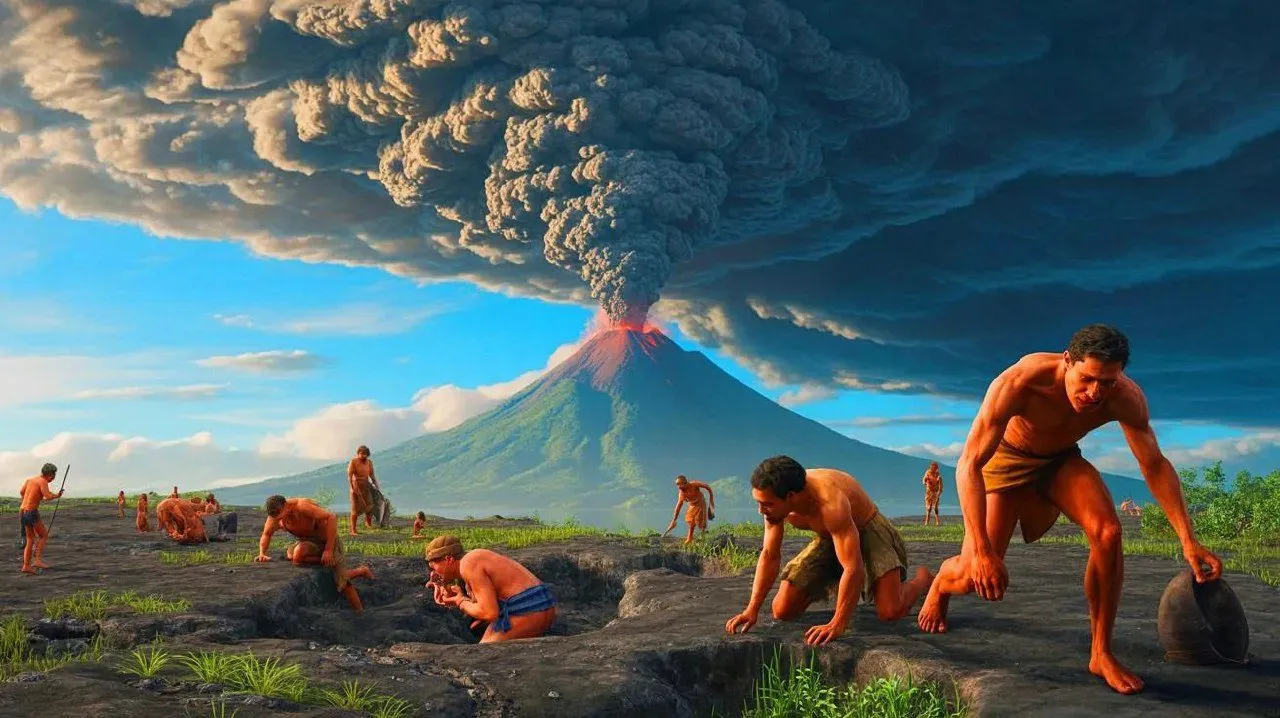
Approximately 74,000 years ago, the colossal Toba supervolcano erupted on the island of Sumatra, ejecting thousands of cubic kilometers of ash and sulfur aerosols into the stratosphere. The resulting volcanic winter severely disrupted global climate. While early proponents of the Toba catastrophe theory suggested human populations were decimated to a few thousand individuals, modern archaeological excavations across India and Africa reveal that some human populations demonstrated remarkable resilience, surviving the climatic fallout through behavioral flexibility and resourcefulness.
The Ice Age and Glacial Refugia
During the Last Glacial Maximum roughly 25,000 years ago, massive continental ice sheets locked up vast swaths of Europe and North America. Human populations were squeezed into temperate microclimates known as refugia across Iberia, Italy, and the Balkans. Survival during these harsh epochs depended on more than individual physical endurance: it demanded complex social cooperation, technological innovation like sewn clothing and thermal shelters, and the intergenerational transmission of hunting strategies.
The Younger Dryas and the Dawn of Agriculture
Around 12,800 years ago, Earth was abruptly plunged back into glacial conditions during the Younger Dryas cold period, lasting roughly 1,200 years. This environmental disruption altered vegetation zones and megafauna distributions. In response, hunter-gatherer communities in the Fertile Crescent began managing wild grains and establishing permanent settlements, accelerating the emergence of agriculture. Adversity did not halt humanity; it inspired revolutionary cultural adaptations.
Social Shocks and the Neolithic Bottleneck
Not all bottlenecks were caused by raw environmental catastrophe. Between 7,000 and 5,000 years ago during the Neolithic period, human genetic diversity experienced a bizarre crash specifically on the male Y-chromosome, where effective male breeding populations collapsed by up to seventeen-fold while female mitochondrial diversity remained stable. Anthropologists attribute this to the rise of patriarchal social structures, inter-clan warfare, and wealth concentration following the agricultural revolution—proving that human social dynamics can directly reshape the genome.
The Black Death and Immune Selection
In the fourteenth century, the Black Death swept across Afro-Eurasia. The bubonic plague decimated an estimated 30 to 60 percent of Europe’s population. Recent ancient DNA studies demonstrate that individuals carrying protective variants of immune genes, such as ERAP2, enjoyed a significant survival advantage, rapidly increasing the frequency of these alleles in surviving populations. Yet evolutionary adaptations carry trade-offs: today, those same gene variants are associated with increased susceptibility to autoimmune disorders like Crohn’s disease.
Indomitable Resilience
Synthesizing these historical trials illuminates a foundational truth: human beings survived not merely through brute biology, but through intense sociality, collaborative intelligence, technological mastery, and nomadic adaptability. From fire and stone points to farming and sanitation, culture has always been our primary evolutionary shield.
As our civilization faces modern perils—from climate disruption to global pandemics—the deep history of human evolution offers perspective and hope. We are the descendants of survivors who traversed the darkest corridors of deep time. The defining hallmark of our species is an unyielding capacity to adapt, endure, and rebuild.