The Evolutionary Origin of Sexes
Look across the living world and a familiar pattern emerges: humans, birds, fish, insects, and even flowering plants feature distinct female and male roles. Producing offspring typically requires the joining of two distinct sexes. Yet at the dawn of life on Earth, reproduction looked very different.
The origin of sexes evolution represents one of the most fascinating transitions in natural history, trading simple cellular division for genetic diversity.
When One Was Enough
Earth’s earliest unicellular organisms had no concept of sex. A parent cell grew, replicated its DNA, and divided into two daughter cells. Billions of bacteria and protists still reproduce this way today. Why, then, did female and male sexes emerge? Asexual reproduction was vastly simpler and energetically cheaper.
Sexual reproduction appears wildly inefficient by comparison: an individual must seek a mate, court them, and combine genetic material, expending immense energy and effort.
Asexual organisms avoid all that overhead. Why would natural selection favor the complex, costly route of two sexes? The answer lies in generating genetic diversity.
Shuffling the Genetic Deck
The supreme advantage of sexual reproduction is dual ancestry. Offspring inherit alleles from two distinct parents. During gamete formation, homologous chromosomes cross over, recombining genetic sequences into novel arrangements.
It is like shuffling a deck of cards: the cards remain the same, but every shuffle yields a unique hand. This ongoing genetic variation provides the raw fuel for natural selection.
When climates shift, new pathogens invade, or ecological pressures arise, a genetically diverse population is far more likely to possess individuals with advantageous survival traits. Moreover, sexual recombination helps purge deleterious mutations that would otherwise accumulate across asexual lineages.
The Emergence of Two Sexes
Sex did not begin with the male and female forms we recognize today. In early eukaryotes, mating gametes were identical in size and shape – a state called isogamy. Across evolutionary epochs, divergent reproductive strategies emerged: one strategy favored producing large, nutrient-rich, but scarce gametes; the opposing strategy favored producing tiny, motile, and abundant gametes.
The large, sessile gametes became proto-eggs, while the tiny, motile gametes became proto-sperm. From this anisogamous divergence arose separate female and male sexes. Evolution did not start with fixed genders; rather, two distinct gamete strategies evolved over eons.
Beyond the Binary
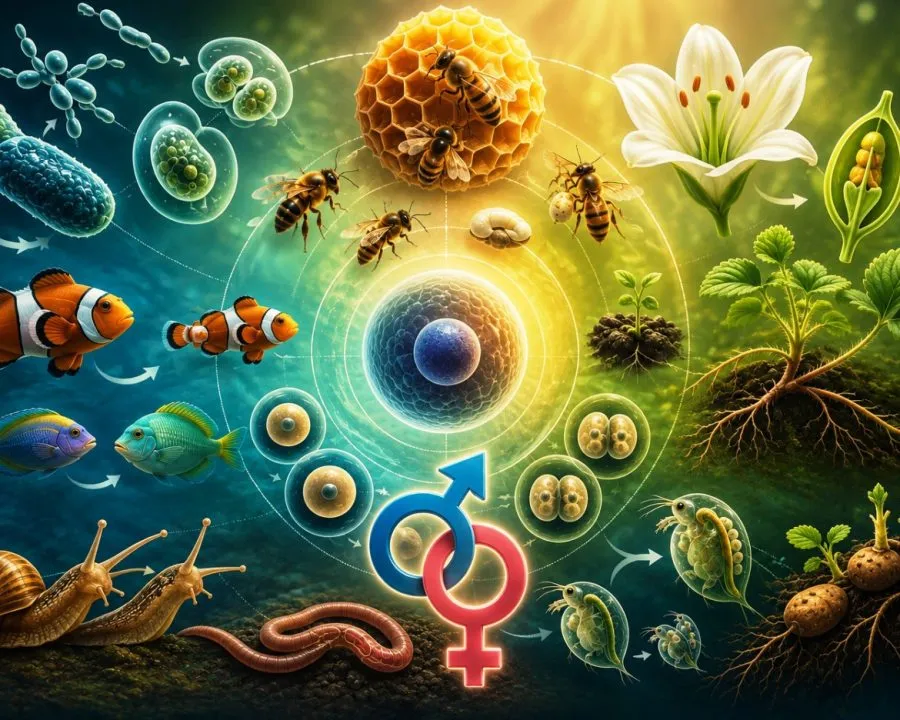
The living world is far richer than a rigid binary. Many flowering plants bear perfect flowers possessing both stamens and pistils, including rice, mustard, hibiscus, and tomatoes.
Hermaphroditic animals like earthworms and garden snails possess both male and female reproductive systems within a single body. In addition, various reef fish undergo sequential hermaphroditism, changing biological sex during adulthood in response to social dynamics.
Generations Without Males
While sexual reproduction fosters diversity, nature never relies exclusively on a single method. Many species retain the ability for females to produce viable offspring without male fertilization.
In animals, this is known as parthenogenesis. Unfertilized eggs develop directly into embryos in insects like aphids and honeybees, as well as certain fish, whiptail lizards, and snakes.
Honeybees present a classic example: unfertilized eggs develop into haploid male drones, while fertilized eggs produce female workers and queens.
Apomixis in the Plant Kingdom
Flowering plants feature an equally remarkable asexual process known as apomixis. Normally, seed production requires fertilization between an ovule and a pollen grain. In apomixis, embryos develop entirely from maternal tissue without fertilization.
Apomictic seeds yield exact genetic clones of the mother plant. This allows elite agricultural traits to be preserved faithfully across generations, which is why agronomists have worked for decades to engineer synthetic apomixis into staple crops like hybrid rice.
Alternative Survival Strategies
Asexual propagation extends well beyond parthenogenesis and apomixis. Freshwater Hydra reproduce by budding, sea stars regenerate whole bodies from severed arms, and countless plants multiply via rhizomes, runners, and tubers. Many organisms switch between sexual and asexual modes depending on environmental conditions.
Which Strategy Wins?
There is no single superior method. Asexual reproduction is rapid, inexpensive, and requires no mate. When an environment is stable and a genome is well-adapted, cloning that successful blueprint is highly advantageous.
Yet our planet is constantly shifting: climates change, parasites evolve, and ecosystems transform. In this volatile world, the ability to continually recombine genes gives sexual reproduction an unmatched evolutionary advantage. Both strategies have survived for billions of years, creating the extraordinary diversity of life on Earth.