The Maternal Legacy of Mitochondrial DNA
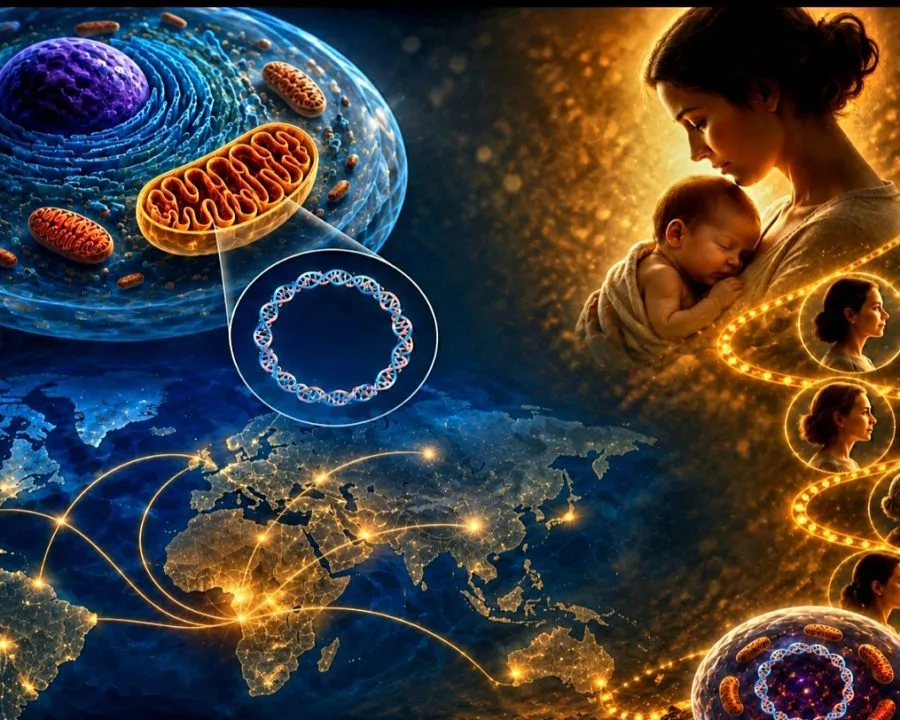
Most of our genome resides within the nucleus of our cells. Yet a tiny fraction of our genetic heritage sits outside the nucleus, tucked inside miniature organelles called mitochondria. This independent code is mitochondrial DNA, or mtDNA.
Mitochondria are the cellular power plants responsible for generating adenosine triphosphate (ATP) from the food we eat. Astonishingly, each mitochondrion contains its own circular chromosome. In humans, this genome contains 16,569 base pairs and 37 genes essential for energy synthesis. While modest compared to the 3.2 billion base pairs in our nuclear genome, the story of our mitochondrial DNA maternal lineage is extraordinary.
Echoes of an Ancient Microbe
Why do mitochondria carry their own DNA? The answer dates back roughly two billion years. According to the endosymbiotic theory, modern mitochondria descend from free-living proteobacteria.
In the ancient oceans, an ancestral eukaryotic host cell engulfed one of these aerobic bacteria. Instead of digesting it, the two organisms forged an enduring mutualistic symbiosis. The bacterium generated abundant ATP, while the host cell provided shelter and nutrients.
Over evolutionary eons, the guest bacterium evolved into the cellular organelle we rely on today, retaining a circular plasmid-like chromosome as living testimony to its free-living past.
The Mother’s Inheritance
Mitochondrial DNA exhibits a unique inheritance pattern: while nuclear DNA is inherited equally from both biological parents, mitochondrial DNA is passed down almost exclusively through mothers. During fertilization, the egg cell provides all organelles, while paternal mitochondria in the sperm flagellum are degraded.
Consequently, both sons and daughters inherit their mother’s mtDNA, but only daughters transmit it to the subsequent generation. Tracing mitochondrial sequences therefore unspools an unbroken maternal lineage back through human history.
Walking Backward Through Generations
Because mtDNA does not undergo meiotic recombination with paternal genes, it passes down essentially intact, altered only by occasional spontaneous mutations. With an average generation span of twenty-five to thirty years, one thousand generations represent roughly thirty thousand years of human prehistory.
By comparing sequence variations across modern populations, population geneticists can build phylogenetic maternal lineages, reconstructing human migrations across the globe.
A Molecular Clock
These steady mutations serve as a biological molecular clock. By measuring mutational divergence in mtDNA across global ethnic groups, researchers can estimate when ancestral groups diverged and how early humans journeyed out of Africa.
This research yielded the famous concept of Mitochondrial Eve. She was not the first woman on Earth, nor the only woman alive in her era. She was simply the most recent common matrilineal ancestor of all living humans.
Genomic data indicates she lived in Africa roughly 100,000 to 200,000 years ago. Many other women lived alongside her, but over thousands of generations, their maternal lines eventually produced sons rather than daughters, ending their direct matrilineal lines. Through mathematical probability and generations, one unbroken maternal line persisted to the present day.
A Tiny Genome with a Vast History
Though microscopic alongside our nuclear chromosomes, mitochondrial DNA encapsulates two foundational epics of life on Earth.
First, it tells how an ancient free-swimming bacterium became the indispensable powerhouse of animal life. Second, it provides an enduring genetic tape recording our species’ maternal journey across thousands of generations.
Mitochondria are far more than energy furnaces; they are living libraries of deep evolutionary history.