Venki Ramakrishnan's Scientific Journey
He began his academic career studying physics, earning a doctorate in theoretical physics. Yet he ultimately received the Nobel Prize in Chemistry for unveiling the atomic architecture of one of biology’s most intricate molecular machines. The life of scientist Venki Ramakrishnan is an inspiring testament to leaving conventional boundaries behind to follow curiosity.
Decades of dedication culminated in the Venki Ramakrishnan ribosome Nobel accolade, opening up new frontiers in antibiotic pharmacology and structural biology.
From Theoretical Physics to Molecular Biology
Born in 1952 in Chidambaram, Tamil Nadu, Venki Ramakrishnan grew up in a household where both parents were active scientists. While consistently performing well academically, he was drawn more toward deep understanding than rote curricula.
After graduating with a degree in physics from the Maharaja Sayajirao University of Baroda, he moved to the United States at just nineteen, completing his PhD in theoretical physics at Ohio University.
Then he made an unexpected choice. Leaving behind the familiar world of theoretical physics, he pivoted entirely toward biology. Enrolling as a graduate student at the University of California, San Diego, he embarked on learning biology from scratch, effectively returning to student life.
Genetics, biochemistry, and molecular biology were largely unfamiliar territories. Yet the rigorous analytical thinking forged during his physics training would later prove decisive in cracking one of molecular biology’s most daunting enigmas.
The Cell’s Protein Factory
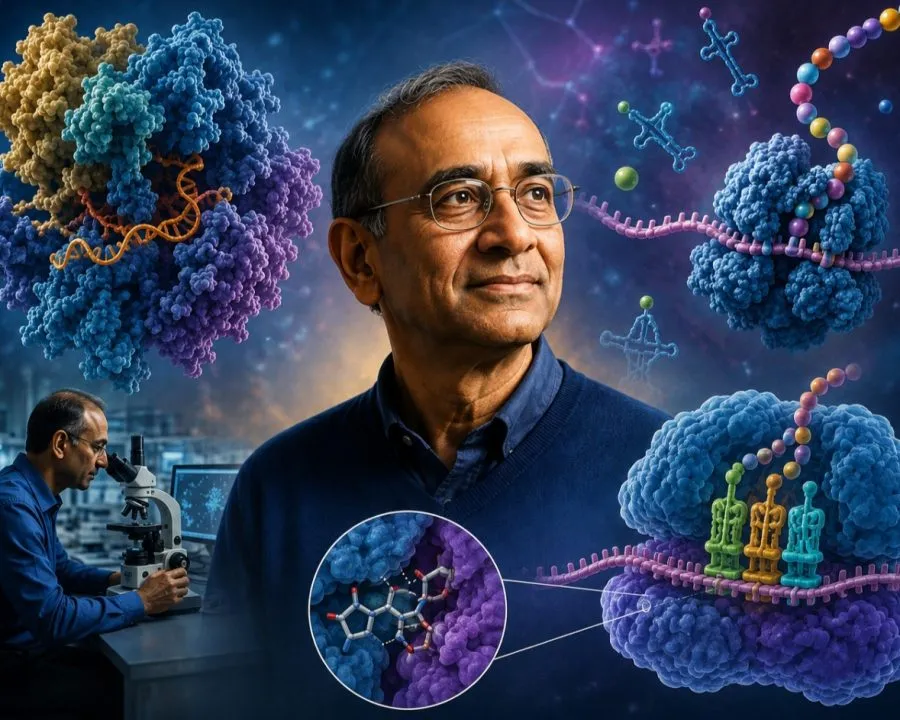
His scientific fascination centered on the ribosome: the molecular engine of the living cell. Genetic instructions archived in nuclear DNA are transcribed into messenger RNA (mRNA). The ribosome reads that genetic tape, stringing together amino acids in precise sequence to assemble proteins. Without proteins, biological life is impossible.
Yet solving the ribosome’s structure was considered nearly impossible. The ribosome is not a single protein; it is an enormous ribonucleoprotein complex comprising ribosomal RNA strands and scores of distinct proteins. Deciphering how each atomic component assembled and operated was a towering scientific challenge.
Visualizing the Invisible
Ramakrishnan took on that monumental task. Employing X-ray crystallography, he and his team at the MRC Laboratory of Molecular Biology in Cambridge mapped the atomic coordinates of the bacterial 30S small ribosomal subunit. Concurrently, several international teams were resolving complementary components. This breakthrough opened the hood on the engine of life, revealing how the ribosome decodes mRNA codons with astonishing fidelity and coordinates peptide bond synthesis.
The clinical implications were immediate. Many frontline antibiotics fight bacterial infections by binding to specific pockets within bacterial ribosomes, stalling their protein production without harming human ribosomes. Knowing the ribosome’s 3D atomic structure illuminated exactly how antibiotics work and enabled the rational design of new therapies against drug-resistant superbugs.
The Nobel Prize in Chemistry
Global recognition arrived in 2009. Venki Ramakrishnan, Ada Yonath, and Thomas Steitz jointly received the Nobel Prize in Chemistry “for studies of the structure and function of the ribosome.”
The young physicist who pivoted to biology had unraveled one of life’s deepest secrets, earning the highest honour in chemistry. That cross-disciplinary journey captures the true spirit of science.
At the Helm of the Royal Society
His public leadership continued to flourish. From 2015 to 2020, Ramakrishnan served as President of Britain’s Royal Society, one of the world’s oldest and most prestigious scientific academies.
For an immigrant scientist to lead the historic institution once presided over by Isaac Newton and associated with figures like Charles Darwin and Michael Faraday was an inspiring milestone.
The Story Behind the Science
In his candid memoir, Gene Machine: The Race to Decipher the Secrets of the Ribosome, Ramakrishnan offers an unvarnished window into scientific life.
It is far more than an academic history. The book reveals laboratory rivalries, bitter setbacks, funding anxieties, and the raw human ambition that drives discoveries.
Science is rarely the orderly, linear progression depicted in textbooks. It involves false starts, strategic pivots, and years of patient persistence, where a single breakthrough can suddenly illuminate an entire field.
Science Without Artificial Boundaries
Venki Ramakrishnan’s journey demonstrates that the rigid boundaries separating scientific disciplines exist in academic departments, not in nature.
Trained in physics, he applied chemical methodologies to decipher a biological engine. His career teaches us that curiosity has no borders; stepping off comfortable paths into the unknown can lead to humanity’s greatest discoveries.