Bar-Tailed Godwit Flight: A Record 8,400-Mile Odyssey
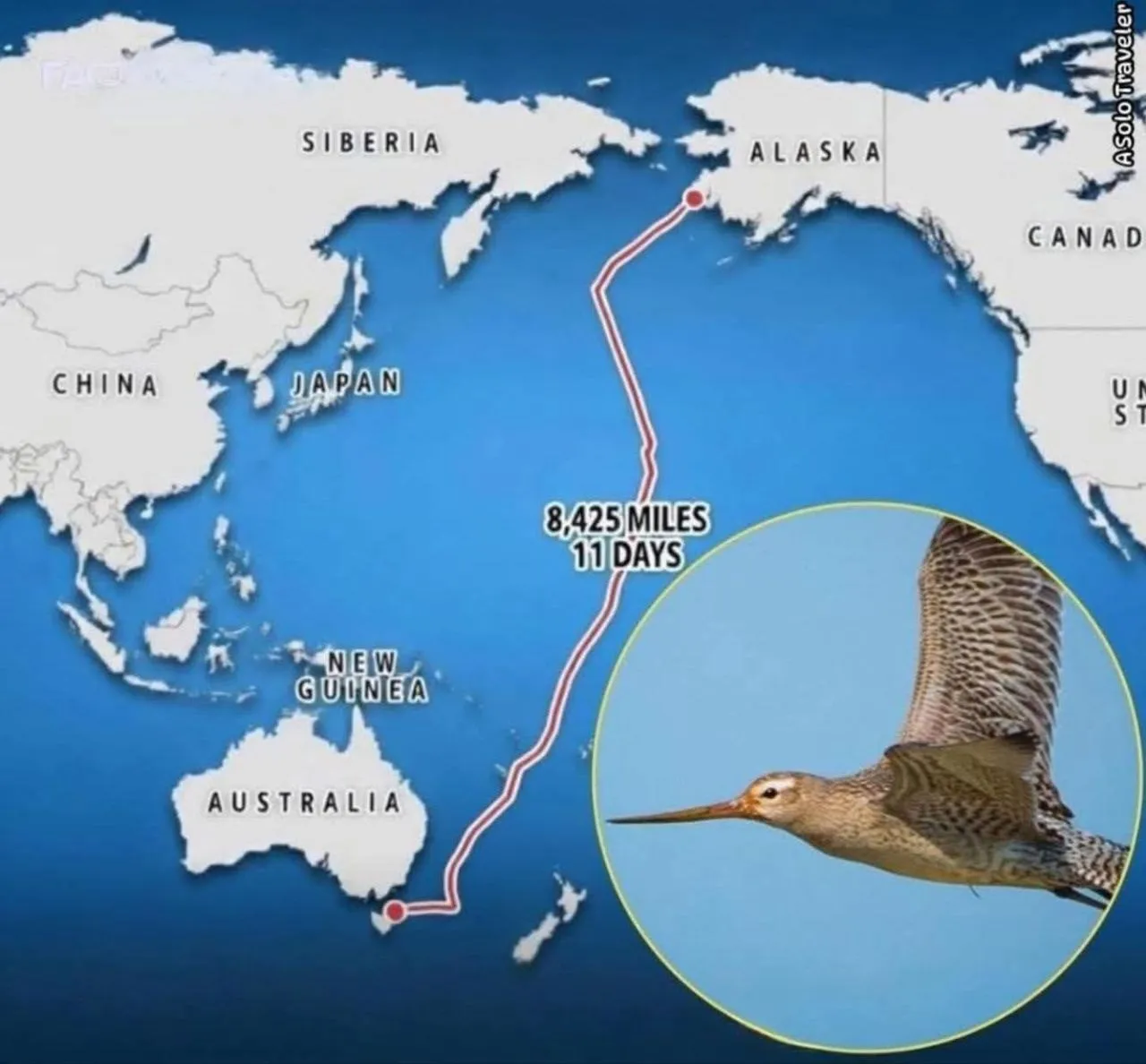
Ornithologists and wildlife biologists have recently witnessed one of the most astonishing navigational feats in the history of biology: tracking the relentless transoceanic migration of a juvenile migratory wader. The bar-tailed godwit (Limosa lapponica) has long reigned as the world champion of endurance aviation, but a recent tracked flight has shattered all prior records.
A young bar-tailed godwit, just five months old and tagged with satellite transmitter number 234684, took off from the coastal tundra of Alaska, North America, and landed safely on the southern shores of Tasmania, Australia. The bird accomplished this journey without a single intermediate stop: no resting on remote Pacific atolls, no hitchhiking on cargo ships, and no pausing on open water.
This unbroken marathon spanned eleven days and one hour, covering an astounding distance of roughly 8,425 miles (13,500 kilometers). Throughout this entire voyage, the young bird had neither a drop of fresh water, nor a morsel of food, nor a single second of sleep on solid ground.
Staggering Physiological Metamorphosis
Prior to embarking on this transoceanic marathon, the godwit undergoes an extraordinary physiological transformation. In the weeks preceding migration, it hyperphages on marine invertebrates, accumulating dense fat reserves until lipids constitute nearly fifty-five percent of its total body mass. This dense fuel depot is metabolized during flight to provide energy and metabolic water.
Even more astonishing, the bird temporarily atrophies non-essential internal organs—such as its gizzard, stomach, liver, and kidneys—to minimize aerodynamic drag and save precious energy during flight, rebuilding them upon arrival at its feeding grounds.
Relentless Flapping Across the Pacific
Unlike soaring ocean birds such as albatrosses that rely on dynamic wind soaring to conserve energy, the bar-tailed godwit cannot glide. It must flap its wings continuously, maintaining an unrelenting rhythm day and night across the vast expanse of the open Pacific Ocean.
Confronted with shifting headwinds, tropical squalls, and severe atmospheric turbulence, the young bird navigated flawlessly across the equator. What makes this feat utterly mind-boggling is that this was the juvenile’s very first migratory flight, flying independently without adult guidance.
The Enigma of Avian Navigation
Tracked by researchers at the Pūkorokoro Miranda Shorebird Centre in New Zealand, the godwit’s flawless orientation across thousands of miles of featureless ocean highlights one of biology’s greatest unsolved mysteries. Scientists believe that migratory birds integrate multiple sensory systems: reading the polarized light of the setting sun, memorizing celestial constellations, feeling atmospheric pressure variations, and utilizing quantum-level cryptochromes in their eyes to perceive Earth’s geomagnetic field lines.
Nature’s Living Masterpiece
Humanity rightfully takes pride in advanced aerospace achievements—commercial airliners, orbital satellites, and GPS networks. Yet a five-month-old shorebird weighing just a few hundred grams navigates across half the globe without instruments, radar, or engines, driven solely by evolutionary engineering. This tiny aviator serves as a humbling reminder of the astounding wonders woven quietly into the natural world.