New Particle at CERN: Doubly Charmed Baryon Mystery
The visible world we inhabit is merely the surface layer of physical reality. If we look deep inside everyday matter—tables, trees, oceans, and human bodies—we discover molecules, atoms, and within atomic nuclei, protons and neutrons. Yet nature’s story goes deeper still. Bound tightly inside protons and neutrons lies the subatomic world of quarks. Quarks exist in six fundamental flavors: up, down, charm, strange, top, and bottom. From this microscopic domain, an exciting new discovery has emerged from the frontier of particle physics.
A Groundbreaking Experiment at the Large Hadron Collider
Deep beneath the Franco-Swiss border, researchers at CERN’s Large Hadron Collider (LHC) conduct experiments that probe the foundational architecture of matter. Within the 27-kilometer subterranean ring, bunches of protons are accelerated to 99.999999 percent of the speed of light and smashed together in violent collisions. These collisions briefly recreate conditions that existed a trillionth of a second after the Big Bang—producing an ultra-hot, dense soup of short-lived exotic particles. From this high-energy cauldron, physicists have identified an extraordinary new subatomic particle.
A Heavy Doubly Charmed Baryon
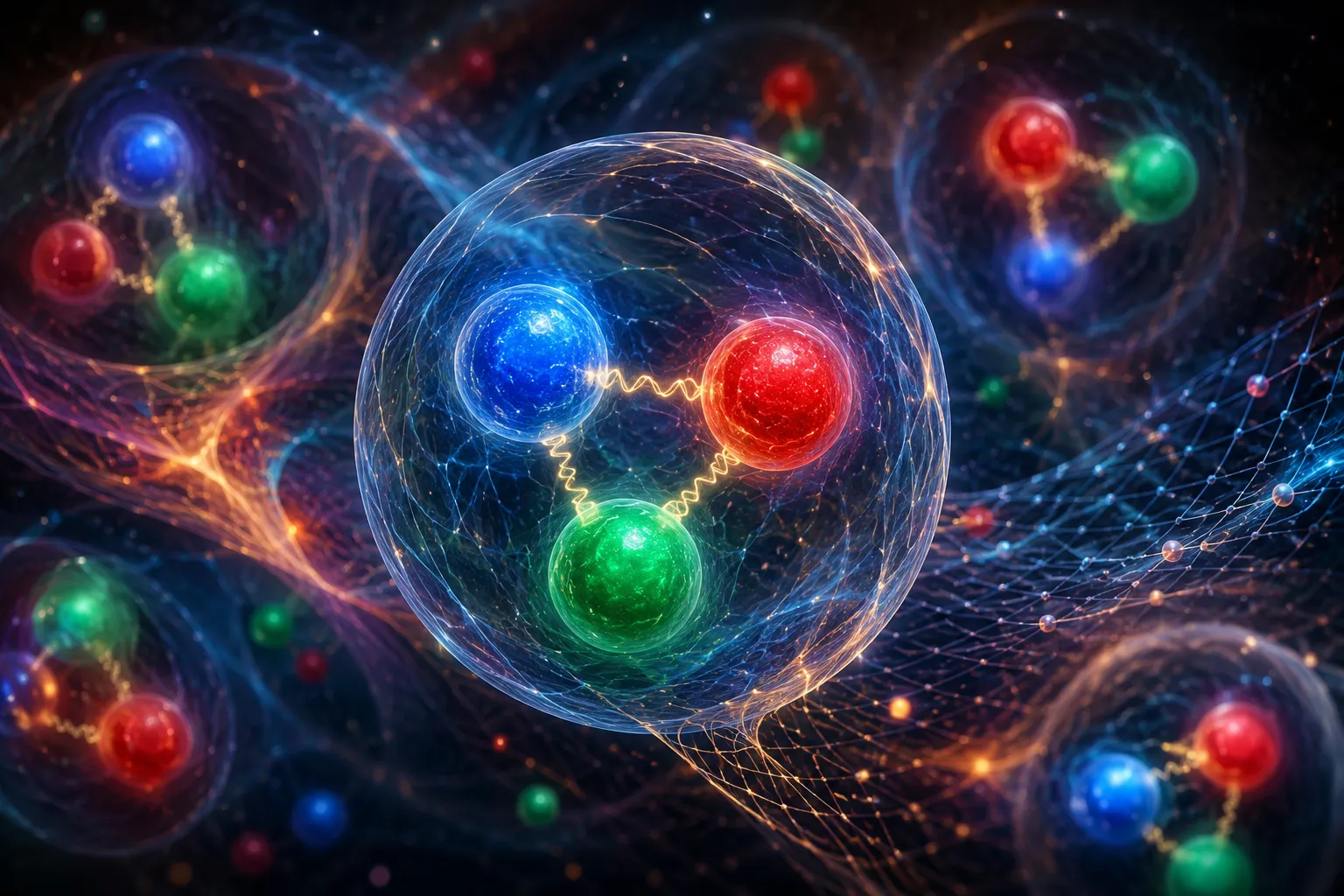
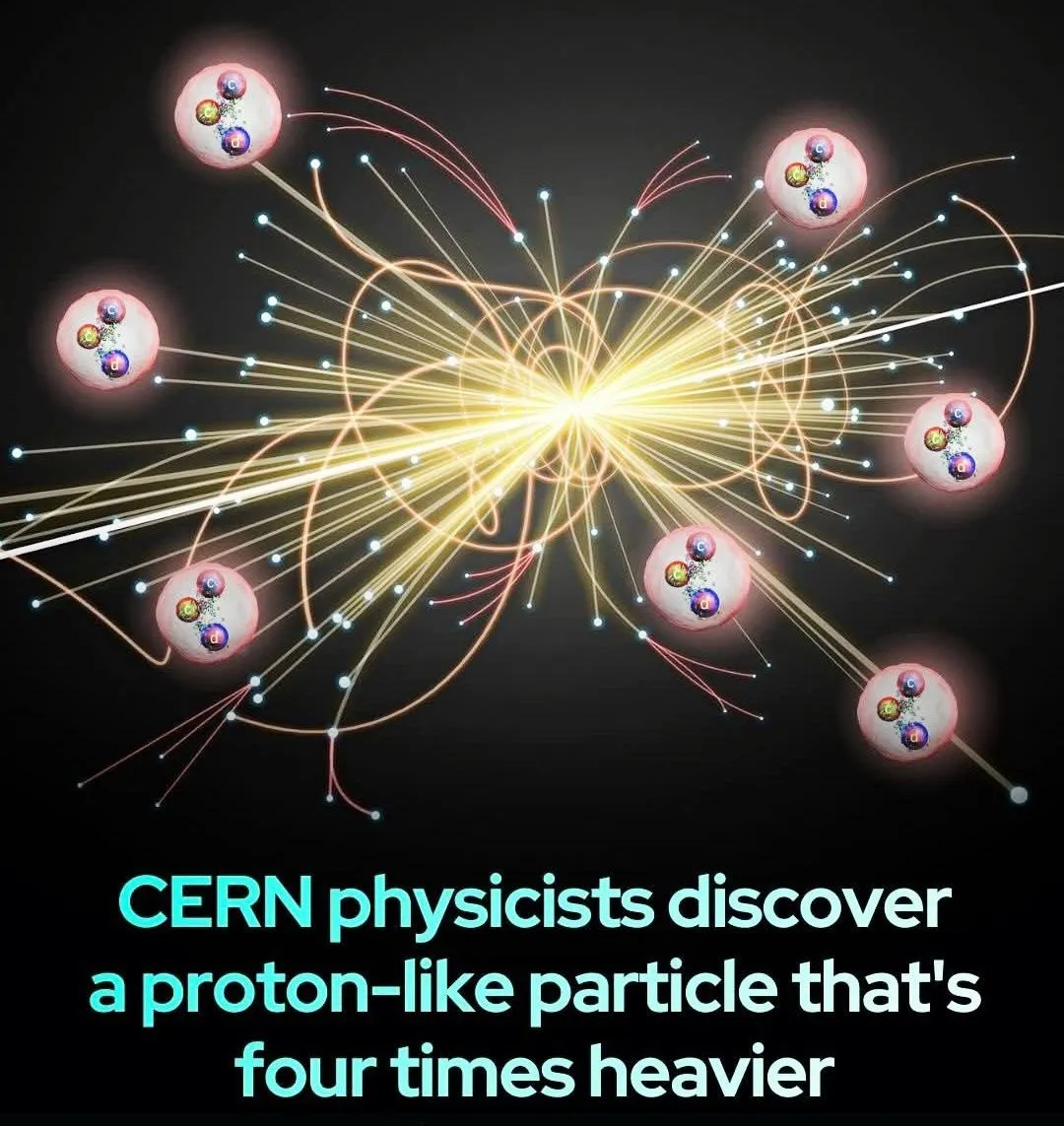
At first glance, the new particle resembles familiar matter: it is composed of three quarks, classifying it as a baryon, the same broad family as protons and neutrons. However, its internal composition is radically different. A common proton contains two up quarks and one down quark, all exceptionally light. In contrast, this newly discovered particle contains two heavy charm quarks and one down quark.
Replacing light quarks with massive charm quarks dramatically inflates the particle’s inertia, endowing it with a mass roughly four times greater than that of a standard proton. Such doubly heavy baryons are extraordinarily rare and inherently unstable: they materialize for mere fractions of a picosecond before decaying into cascades of lighter subatomic particles, making direct visual detection impossible.
Reconstructing the Ghostly Signal
To detect such ephemeral entities, experimental physicists employ sophisticated decay-chain reconstruction algorithms. By tracking the trajectory, kinetic energy, charge, and momentum of secondary particles emerging from the collision point, detectors reconstruct the invariant mass of the parent state—much like reconstructing the geometry of a shattered crystal glass from its scattered fragments.
The statistical significance of this discovery exceeded seven sigma (7σ). In experimental physics, a threshold of five sigma (5σ)—representing a one-in-3.5-million probability of being a statistical fluke—is required to claim a definitive discovery. Achieving seven sigma elevates the finding to unassailable empirical certainty.
Probing the Strong Force and Quantum Chromodynamics
Why are physicists thrilled by this fleeting exotic particle? Heavily charmed baryons serve as ideal natural laboratories for studying the strong nuclear force—the most powerful fundamental force in nature, mediated by gluons, which binds quarks into hadrons and holds atomic nuclei together.
This breakthrough provides crucial empirical testbeds for Quantum Chromodynamics (QCD), the quantum field theory governing the strong interaction. Modeling how two heavy, sluggish charm quarks interact with a light, relativistic down quark tests theoretical calculations under extreme physical conditions. This transient particle whispers profound secrets about the deep structure of matter, proving that the subatomic universe still holds captivating wonders waiting to be unveiled.