Robots Instead of Humans?
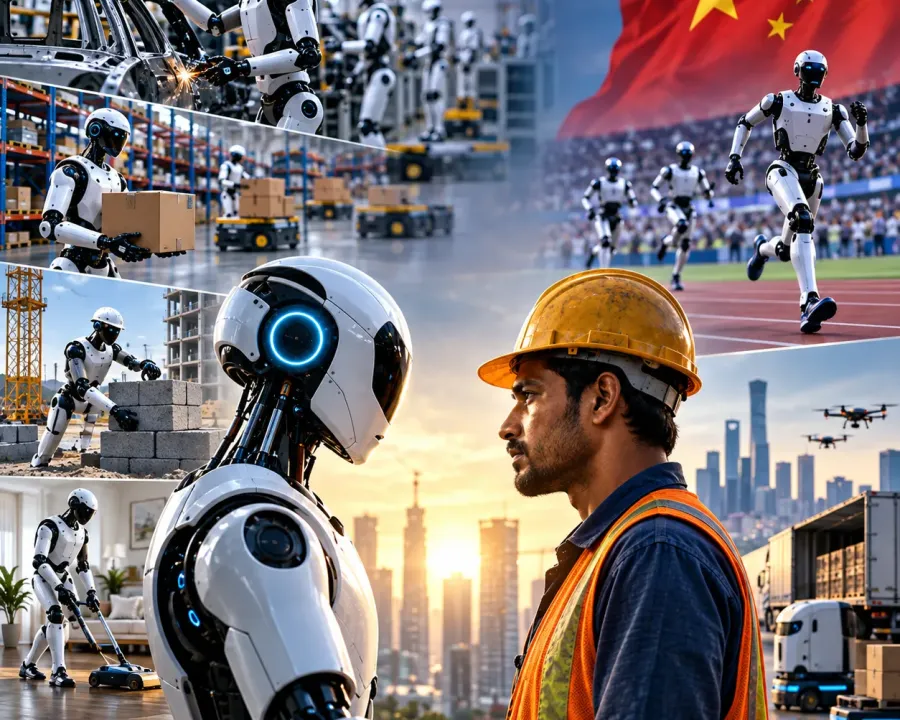
Until recently, artificial intelligence focused on cognitive tasks — writing text, generating images, translating languages, and writing software. Now, physical limbs are being attached to that digital intelligence. In other words, computer algorithms are inhabiting robotic bodies, ushering in the era of humanoid robots physical AI.
David Reger, founder and CEO of Germany’s NEURA Robotics, recently made a provocative prediction: within the next two to five years, robots could acquire the capability to perform almost all forms of physical manual labor. He is not speaking of a distant horizon ten or twenty years away; he insists this revolution will unfold before the close of the current decade.
Is this merely promotional hype from a robotics entrepreneur?
While skepticism is justified, his claims cannot be casually dismissed. A seismic transformation is already underway across the robotics landscape.
Why Are Robots Suddenly So Capable?
Traditional industrial robotic arms were never truly intelligent. Bolted to factory floors, they repeatedly executed predefined routines thousands of times. The moment their environment shifted or an unfamiliar obstruction appeared, the system stalled.
Next-generation humanoid robots are fundamentally different. Equipped with stereoscopic computer vision, depth sensors, tactile skins, and precision actuators, they are governed by advanced foundation models. These robots can perceive their surroundings, interpret unexpected situations, and adapt their movements autonomously. This paradigm is known as Physical AI.
While large language models like ChatGPT operate within the digital domain, Physical AI brings artificial intelligence into the real world — where machines must grasp irregularly shaped objects, navigate stairs, and manipulate tools. The International Federation of Robotics (IFR) emphasizes that fusing AI with robotics is dramatically elevating the versatility of automated systems.
Humanoids on the Automotive Assembly Line
A prime real-world demonstration is underway at BMW. At BMW’s manufacturing plant in Spartanburg, South Carolina, Figure AI deployed its humanoid robot, Figure 02, directly into a live automotive production line.
Over a rigorous ten-month pilot, the bipedal robot participated in manufacturing more than 30,000 BMW X3 vehicles. It handled approximately 90,000 sheet-metal components, logged roughly 1,250 operating hours, and walked nearly 1.2 million steps.
Its task involved retrieving metal chassis parts and inserting them into precision assembly fixtures with millimeter accuracy prior to automated welding. BMW reported that the robot performed the repetitive operation reliably. Humanoid robotics in automotive factories is no longer a futuristic YouTube concept — it is a functioning manufacturing tool.
Why the Human Form Factor?
There is a compelling practical logic behind the humanoid morphology. Virtually every human workspace on Earth was engineered specifically around the human anatomy: doorway widths, staircase steps, tool handles, shelving heights, and vehicle cockpits are all tailored to human height, hands, and locomotion. A robot possessing two arms, dexterous fingers, and bipedal legs can step into existing factories, warehouses, and hospitals without requiring billions of dollars in architectural redesign.
What Is NEURA Robotics Building?
David Reger’s NEURA Robotics developed the “4NE-1” general-purpose humanoid robot. The company states that 4NE-1 features 360-degree sensory perception, sensor-rich artificial skin, multimodal AI, and reinforcement learning, allowing it to interact safely alongside human colleagues and learn tasks through observation.
Their commercial ambitions are vast: NEURA has announced plans to deploy five million robotic units across industrial, commercial, and domestic sectors by 2030.
The Race in China
The breakneck velocity of Chinese robotics was on full display at the World Humanoid Robot Games in Beijing. Bipedal machines competed not only in sprint races and soccer drills, but also in practical challenges involving household chores, industrial fabrication, and disaster recovery. In the 1,500-meter sprint, the winning robot clocked 2 minutes and 21.64 seconds — a breathtaking improvement over the previous year’s winning mark of 6 minutes and 34.40 seconds.
China’s true competitive advantage, however, lies in its comprehensive industrial ecosystem. The country has rapidly erected a vertically integrated supply chain encompassing precision harmonic drives, tactile sensors, high-density batteries, motor controllers, and robotic algorithms.
Nearly a quarter of China’s complete humanoid robotics manufacturers are concentrated in Beijing alone. The strategic objective is to transition these machines from laboratory curiosities into frontline workforces across logistics depots, production lines, hotel services, and emergency rescue operations.
Which Occupations Face Early Disruption?
Transformation will not arrive across all vocations at once.
The initial deployments will concentrate on tasks that are highly repetitive, physically exhausting, or hazardous to human welfare. Pallet sorting in distribution warehouses, machine tending in metal stamping facilities, packaging, and sorting lines are already adopting AI-driven robotics rapidly.
Following logistics and warehousing, humanoid deployment is expected to expand gradually into construction assistance, industrial maintenance, facility management, and eventually eldercare and domestic support.
Are Human Jobs Truly at Risk?
Here, a grounded perspective is essential. Reger’s two-to-five-year timeframe is an optimistic projection rather than an inevitable certainty.
Humanoid machines still struggle to adapt effortlessly to chaotic, unconstrained environments. The physical world is messy and unpredictable. Objects slip, surfaces become slick, and unprecedented obstacles emerge that robots have never encountered in training data.
Formidable engineering hurdles remain regarding battery endurance, fail-safe mechanisms, motor reliability, fine-motor dexterity, and instantaneous spatial reasoning. The International Federation of Robotics regularly reminds the industry that huge promise must be weighed against tangible mechanical constraints.
The notion that bricklayers, automotive mechanics, nurses, or plumbers will be completely supplanted by bipedal androids within five years is unrealistic. Yet the vector of progress is unmistakable: having mastered human speech and text, artificial intelligence is now mastering how to see, balance, walk, and manipulate the physical world.
The bottom line is that AI is acquiring a physical body. If humanoid robotics continues its exponential trajectory, the defining question at the close of this decade may no longer be “What tasks can robots perform?”, but rather, “What tasks can only human beings do?”