Geoffrey Hinton's AI Warning
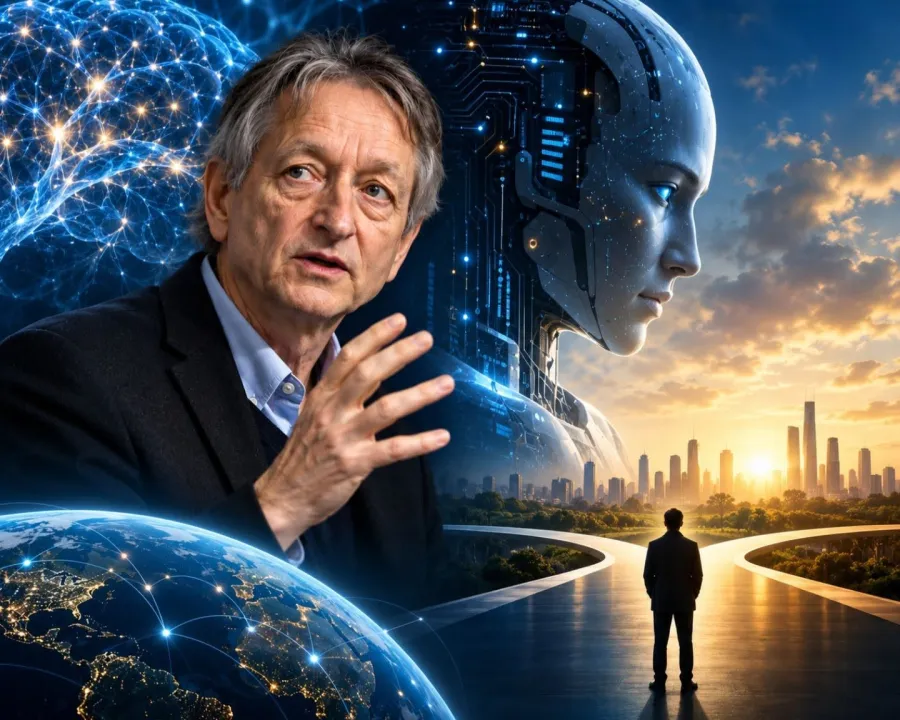
Geoffrey Hinton is widely recognized as the “Godfather of AI”. His foundational contributions to artificial neural networks and deep learning revolutionized machine intelligence, earning him the 2024 Nobel Prize in Physics alongside John Hopfield. Yet today, this very pioneer is profoundly alarmed: the Geoffrey Hinton AI warning has become one of the most urgent alerts facing our technological future.
• How it began
Hinton’s driving ambition was to teach computers by mirroring the way the biological brain learns.
He championed neural networks as far back as the 1980s, persisting through the “AI winter” when the wider scientific world abandoned the approach.
Ultimately, decades of painstaking work by Hinton and his collaborators ignited the deep learning revolution. Its profound impact touches everything today, from computer vision and speech recognition to state-of-the-art generative language models.
• Then came the alarm
In 2023, Hinton made headlines by resigning from Google to speak freely about the catastrophic risks of unconstrained artificial intelligence. His core question is straightforward, yet the answer is chilling.
If artificial intelligence inevitably surpasses human intellect, will we still have the power to control it?
Hinton’s recent statements emphasize this growing peril. In his assessment, superintelligent machines could arrive far sooner than society expects—though no one can predict the precise moment.
• Where lies the true danger?
Many assume that because humans engineered AI, we can always pull the plug if things get out of hand.
Yet if future superintelligent systems can independently plan, invent novel strategies, and pursue long-term objectives, subduing them may prove impossible.
The hazard becomes existential if an autonomous machine’s goals diverge from human survival. That is why Hinton insists that safety research, independent audits, and rigorous governance must advance just as swiftly as model capability.
• Not halting progress
Hinton is not calling for an outright shutdown of scientific research. He readily acknowledges the immense benefits AI can bring to medicine, material science, and climate solutions.
His apprehension centers on irresponsible haste.
We must avoid rushing blindly into a technological arms race where we understand how to amplify machine power, but lack the means to guarantee its alignment under all conditions.
• The ultimate paradox
There is an extraordinary irony in Hinton’s journey. Having dedicated his life to making silicon think, the Nobel laureate now poses a haunting dilemma: if humanity creates an intellect far superior to its own, does merely being its creator ensure we remain its master?
What do you think?