Designing New Gene Editors with AI
What if, instead of searching through nature for enzymes to edit DNA, computer models could generate brand-new molecular scissors that never existed in billions of years of biological evolution?
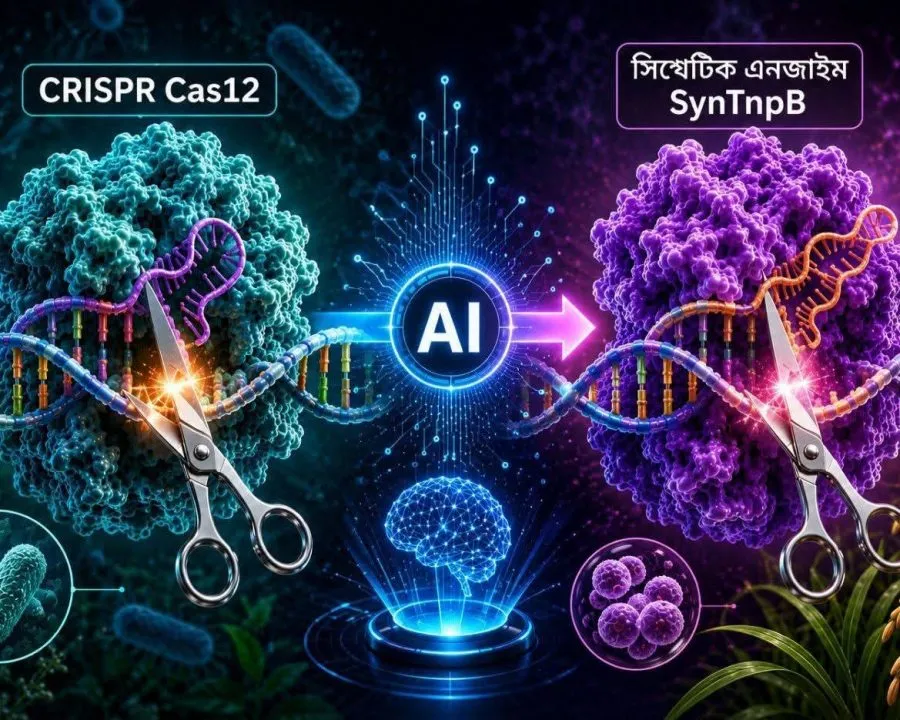
What sounded like science fiction is now reality. Using generative deep learning models, researchers have designed synthetic AI gene editing enzymes from the ground up. These are not merely digital blueprints; in laboratory trials on living cells, these synthetic proteins successfully edited target DNA with high precision.
Nature’s Molecular Scissors
Over the past decade, CRISPR revolutionized molecular genetics. CRISPR acts as a programmable targeting system: a short guide RNA directs a nuclease enzyme to an exact nucleotide sequence within a genome, where the enzyme makes a precise cut. The cell’s innate DNA repair mechanisms can then disable a faulty gene or insert new genetic code. That is why CRISPR enzymes are widely celebrated as molecular scissors.
Yet these enzymes were not engineered by human hands. They originated as bacterial immune defenses evolved to fend off bacteriophages. Scientists merely borrowed nature’s tools.
Now, researchers asked an ambitious question: why limit ourselves to enzymes produced by natural evolution? Can we engineer bespoke molecular cutters tailored precisely to our medical needs?
Artificial Intelligence Designing Molecular Tools
A research team connected with the laboratory of CRISPR pioneer and Nobel laureate Jennifer Doudna focused on TnpB, a compact ancestral predecessor of the CRISPR-Cas12 enzyme family. Like its modern descendants, TnpB uses an RNA guide to locate and cleave complementary double-stranded DNA.
How the Model Works
Enzymes are complex proteins made from linear chains of amino acids that fold into intricate three-dimensional conformations. Their catalytic activity depends entirely on this physical geometry.
Researchers inverted the traditional discovery workflow: instead of analyzing an existing protein, they specified the structural coordinates they wanted and tasked deep generative algorithms with designing amino acid sequences that would fold into that exact shape.
Crucially, the AI was not left unguided. Researchers trained the algorithms on evolutionary datasets of natural TnpB variants, preserving catalytic active sites while granting the model freedom to redesign surrounding scaffolds. The result combines billions of years of evolutionary wisdom with modern machine learning.
Forging Novel Molecular Cutters
After generating and screening thousands of candidate designs in silico, the team selected nine promising synthetic variants, designated SynTnpB.
Generating a plausible protein structure on a computer screen is only half the battle. The true test is whether these artificial molecules can fold, bind, and cleave genomes inside living biological systems.
Remarkable Laboratory Results
The synthetic SynTnpB enzymes successfully performed targeted genome editing inside bacterial, plant, and human cells. Even more impressively, several synthetic variants exhibited higher editing efficiencies than their wild-type natural counterparts, while preserving strict target specificity.
Cryo-electron microscopy confirmed that the AI introduced novel structural motifs that optimize how the enzyme docks onto RNA and DNA targets. The algorithms did not merely imitate nature; they innovated upon it.
Why This Breakthrough Matters
Historically, discovering new gene editors required bioprospecting through strange bacteria and archaea. That discovery paradigm is fundamentally transforming.
In the near future, scientists will specify the parameters of the exact molecular tool they require – a miniature enzyme capable of fitting into adeno-associated virus vectors, an enzyme with minimal off-target cleavage, or one tailored for high-fidelity base editing.
Generative algorithms will output custom protein sequences on demand, which laboratories can synthesize and validate within weeks.
Vast Possibilities Ahead
From curing monogenic hereditary diseases to breeding drought-resilient crops, the applications are immense. While therapeutic human applications still require years of safety validation, this milestone proves that computational protein design has arrived.
Writing New Words in the Language of Life
The proteins of the living world were forged across eons of trial and error. For centuries, humans could only catalog and repurpose the tools nature provided.
Generative intelligence is opening a daring new chapter. We are no longer limited to the molecular tools evolution handed us. By deciphering the fundamental physics of protein folding, humanity is learning to write entirely new words in the ancient vocabulary of life.