Red Blood and Green Leaves: The Porphyrin Link
The Astonishing Chemistry of Blood and Plant Leaves
Human blood is vibrant red, while plant leaves are radiant green. At first glance, one might assume these two fluids share nothing in common. Yet when viewed through the lens of biochemistry, the molecules responsible for these colors reveal an astonishing structural twinship, differing primarily by a single central metal atom.
The Porphyrin Ring: A Shared Molecular Architecture
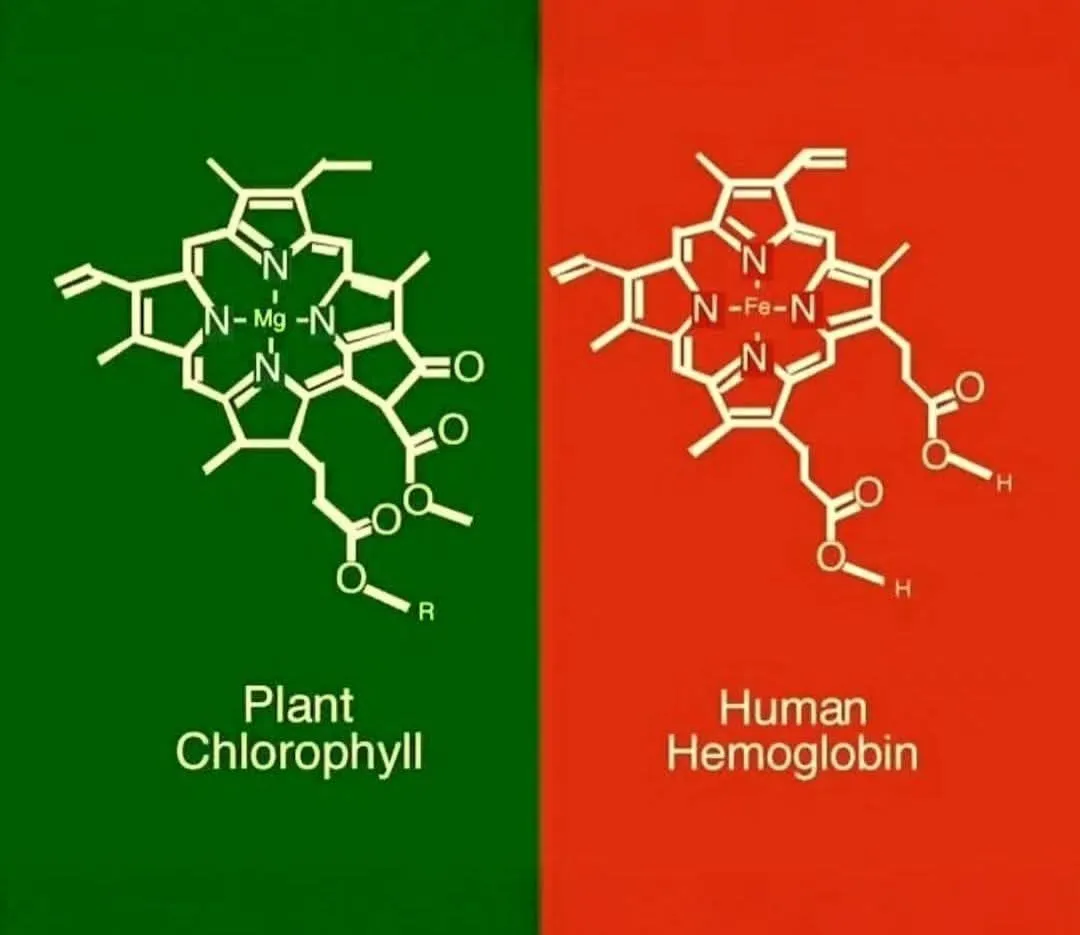
Comparing the molecular structures of plant chlorophyll and human hemoglobin reveals a striking symmetry. Both molecules are built around a heterocyclic macrocycle called a porphyrin ring, where four nitrogen atoms hold a central metal ion. In chlorophyll, that central ion is magnesium ($Mg^{2+}$). In hemoglobin’s heme group, that central ion is iron ($Fe^{2+}$).
Distinct Roles Built on a Common Foundation
This single substitution of iron for magnesium alters the molecule’s electronic properties to serve two completely different biological purposes. Chlorophyll absorbs blue and red wavelengths of solar radiation to drive photosynthesis, synthesizing glucose and oxygen from carbon dioxide and water. Hemoglobin, by contrast, binds oxygen in the lungs and transports it through the circulatory system to fuel cellular respiration throughout the body.
Ecological Interdependence and Natural Symmetry
Nature has deployed the same core chemical architecture to sustain two complementary life cycles. Green plants use their magnesium-centered porphyrin rings to generate life-sustaining oxygen, while animals use their iron-centered porphyrin rings to distribute that oxygen to living cells.
The Unity of Terrestrial Life
This shared molecular heritage is not a coincidence; it reflects the deep evolutionary interconnectedness of all life on Earth. Every breath we draw links our blood directly to the green canopy of the plant world—a timeless bond forged in the chemistry of porphyrin rings.