The Language of Plants: From Jagadish Chandra Bose to Modern Botany
Acharya Jagadish Chandra Bose and the Invention of the Crescograph
In 1901, the visionary polymath Acharya Jagadish Chandra Bose astonished the scientific world with an extraordinary apparatus of his own invention: the crescograph. Using high-magnification optical levers, Bose demonstrated that plants are exquisitely sensitive to their environment, responding actively to mechanical, electrical, thermal, and chemical stimuli. When subjected to electrical currents, temperature shifts, or toxic gases, plants exhibited distinct physiological reactions that Bose recorded with remarkable precision. While Victorian science greeted his claims with skepticism, modern botany has comprehensively vindicated his pioneering vision. Recently, researchers at Cornell University uncovered groundbreaking details of plant internal signaling that represent a direct modern continuation of Bose’s historic research.
Hydraulic Signaling and Mechanical Information Networks
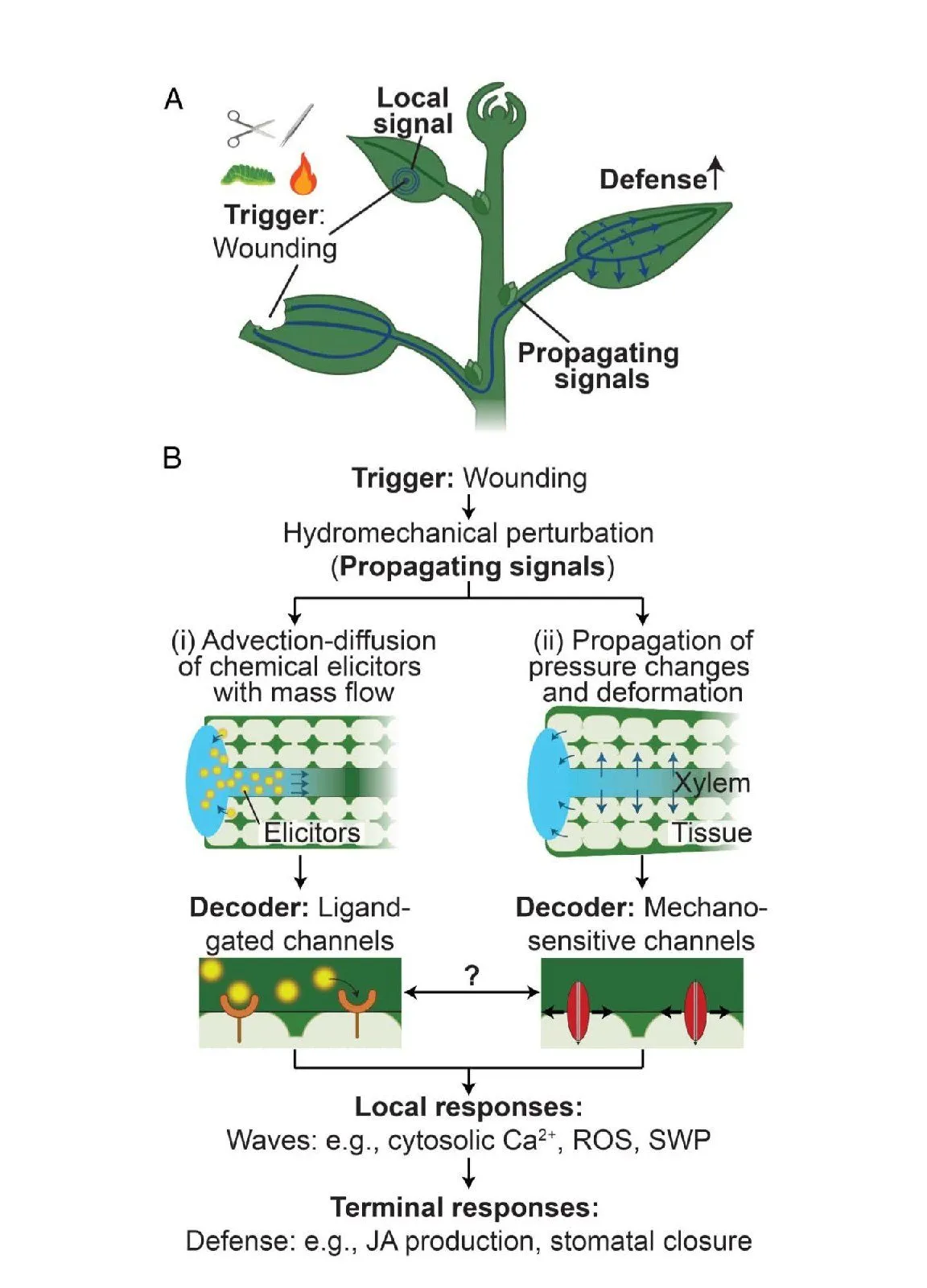
The Cornell study revealed that plants possess a sophisticated internal communication network operating through the negative pressure (tension) inherent in their vascular system. The plant’s vascular plumbing—consisting of xylem and phloem tissues—does far more than transport water and carbohydrates; it functions as a rapid mechanical information highway. When a plant faces localized stress such as drought, extreme heat, or insect predation, abrupt shifts in xylem hydraulic tension generate rapid acoustic and pressure waves propagating throughout the entire organism. Simultaneously, damaged tissues synthesize chemical defense hormones like jasmonic acid. Carried along the vascular network, these hormonal signals trigger defense responses in distant leaves, stems, and roots. Unlike animal nervous systems that transmit electrical nerve impulses, plants utilize an elegant hydraulic-chemical information stream.
Smart Agriculture and Biosensor Frontiers
Published in the prestigious journal PNAS in April 2025, this research opens remarkable frontiers for precision agriculture. By developing nano-sensors capable of listening to xylem tension fluctuations and chemical waves, agronomists can create “smart crops” that wirelessly notify farmers the moment they experience dehydration, nutrient stress, or pest attacks—long before visible wilting occurs.
Deciphering the Silent Symphony of Nature
Over a century ago, Acharya Jagadish Chandra Bose proved that plants are not inert green objects, but living beings responsive to the universe around them. Modern molecular biology and biophysics are finally learning to decode the intricate language of the plant kingdom. As science listens more closely, we discover that beneath their tranquil exterior, flora hum with an astonishing, continuous symphony of living information.