China's Artificial Sun: Nuclear Fusion and the Promise of Boundless Clean Energy
The Epochal Human Quest to Harness Energy
Human civilization is defined by the mastery of energy. From the prehistoric discovery of fire to modern industrial grids, our history has been an unbroken quest to tame powerful sources of work. Today, our species stands on the threshold of the ultimate power: bringing the celestial energy of the stars down to Earth.
The Engineering Marvel of the Artificial Sun
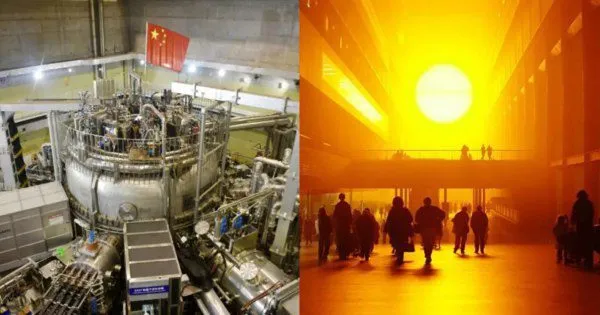
In Hefei, China, scientists have built a cutting-edge fusion reactor popularly known as the artificial sun. The nickname is literal: inside its magnetic vacuum chamber, researchers replicate the very thermonuclear processes that power the Sun itself.
The Core Mechanism of Nuclear Fusion
The Sun is a colossal sphere of incandescent hydrogen plasma. Deep within its core, titanic gravitational pressures and temperatures force hydrogen nuclei to fuse together into helium. This fusion reaction converts a minute amount of mass into enormous energy, generating all the starlight and warmth that sustains life on our planet.
Solving Civilization’s Energy Dilemma
For nearly a century, physicists have sought to harness controlled nuclear fusion. If achieved at commercial scale, fusion promises practically limitless, zero-carbon baseload energy, permanently freeing humanity from fossil fuel dependence and ecological collapse.
The Record-Breaking Success of the EAST Reactor
China’s Experimental Advanced Superconducting Tokamak (EAST) recently set a world benchmark by sustaining stable high-confinement plasma for over 1,000 seconds (nearly 17 minutes). Maintaining a stable thermonuclear plasma loop for such a prolonged duration represents one of the most critical engineering milestones in fusion history.
Hotter Than the Core of the Sun
Thermonuclear fusion on Earth requires mind-boggling heat. Because Earth cannot duplicate the Sun’s immense gravitational pressure, terrestrial reactors must compensate with extreme temperatures. EAST’s plasma core reached over 100 million degrees Celsius—more than six times hotter than the center of the Sun!
Magnetic Confinement Inside the Tokamak
No material vessel could withstand direct contact with 100-million-degree plasma. To contain this synthetic star, physicists utilize a donut-shaped magnetic chamber called a tokamak. Massive superconducting electromagnetic coils suspend the swirling plasma in a magnetic bottle. While early fusion devices could hold plasma for only milliseconds, EAST’s prolonged sustained burn proves that magnetic confinement can operate as a continuous industrial process.
Fusion vs. Fission: Safe and Inexhaustible Fuel
Unlike conventional nuclear power plants that rely on nuclear fission to split heavy uranium atoms, fusion produces no long-lived radioactive transuranic waste and carries zero risk of catastrophic meltdown. Its primary fuels are isotopes of hydrogen—deuterium, which is readily extracted from ordinary seawater, and tritium, bred from lithium. The fuel supplies are sufficient to power human civilization for millions of years.
The Dawn of a New Era in Clean Power
The milestones achieved by EAST have accelerated global fusion development. By demonstrating that steady-state plasma confinement is technologically achievable, China’s artificial sun has brought commercial fusion power closer to reality. In doing so, it illuminates the path toward an era of limitless, clean, and sustainable energy for all humankind.