Orion Spacecraft Reentry: Surviving Blazing Heat
The Perilous Journey Home from the Moon
Rounding the Moon is a historic triumph, yet the voyage home holds drama of its own. As the Orion spacecraft streaks toward Earth, it confronts the single most perilous phase of its mission: atmospheric reentry. Floating in the vacuum of space is challenging, but plunging back through Earth’s atmosphere is an ordeal of fire and immense physical forces.
Scorching Heat and Staggering Speed
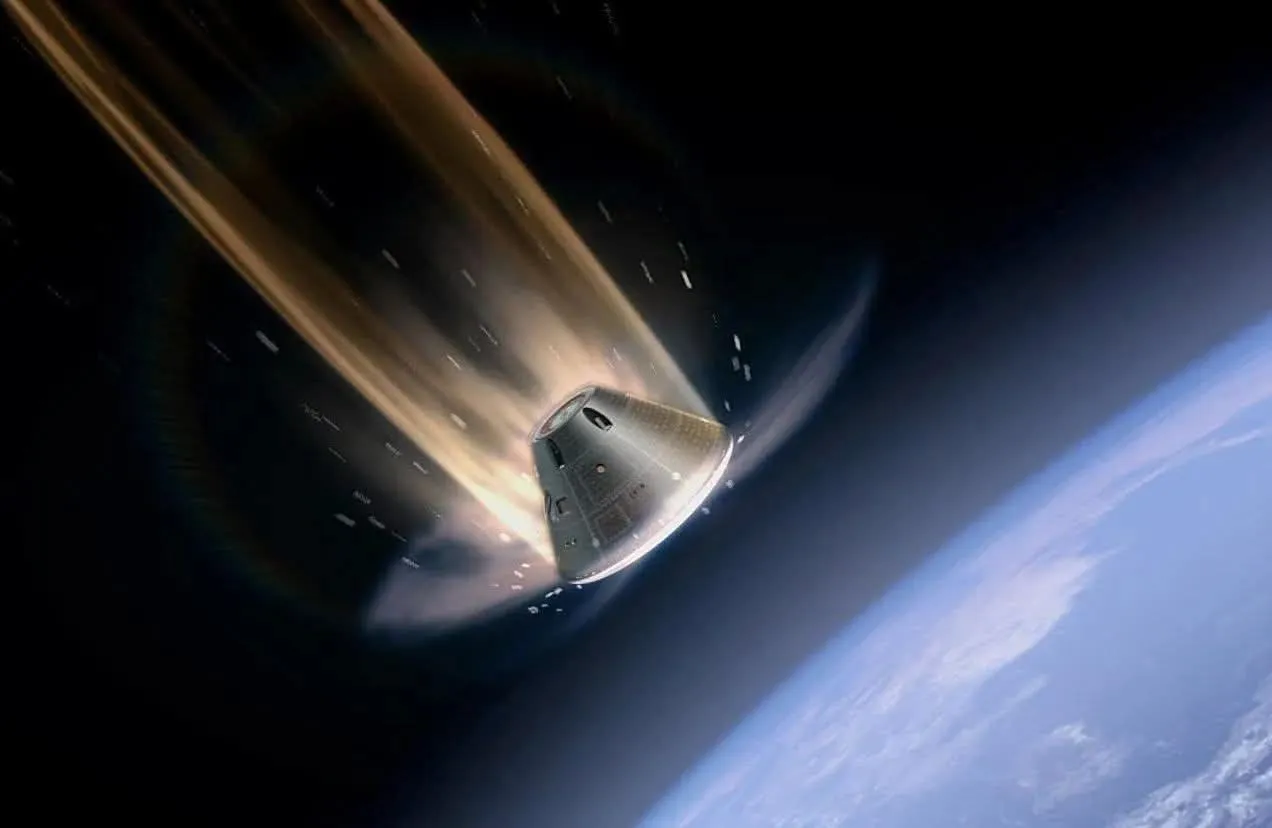
Hurling inward at nearly 40,000 kilometers per hour, Orion carries enormous kinetic energy. Slamming into the atmosphere at that velocity turns the vehicle into a blazing fireball. Earth’s atmosphere may appear soft and ethereal, but at hypersonic speeds, colliding with atmospheric molecules generates extreme thermal energy exceeding 2,700 degrees Celsius. This is not simple mechanical friction; it is violent atmospheric compression. The blunt body of the capsule compresses the air ahead into a superheated shock wave of luminous plasma, encasing the spacecraft like a streaking meteor.
Orion’s Advanced Ablative Heat Shield
Surviving this inferno requires an extraordinary thermal barrier: Orion’s heat shield. This shield is engineered from an advanced ablative composite material. Under searing heat, the ablative outer layer gradually vaporizes and outgasses, carrying the intense thermal energy away from the spacecraft. This sacrificial melting keeps the crew cabin inside safe and cool, trading microscopic layers of shielding to protect human life.
The Largest Ablative Shield Ever Built for Crewed Flight
Spanning five meters in diameter, Orion’s heat shield is the largest ever developed for a crewed spacecraft. Crafted with an advanced formulation of Avcoat—a material with roots in the Apollo program—it is tailored specifically to endure the punishing thermal and mechanical stresses of direct return from lunar velocity.
The Ingenious Skip Reentry Maneuver
Raw shielding alone is not enough; survival hinges on flight dynamics. Rather than plunging directly through the atmosphere in a single continuous descent, Orion performs an innovative “skip reentry.” The capsule dips into the upper atmosphere to bleed off excess velocity, pitches upward to briefly skip out into suborbital space like a flat stone skimming across a pond, and then executes its final descent. This two-phase profile moderates peak thermal loads and G-forces, ensuring a smoother ride for the crew.
The Tense Plasma Blackout Period
During the fiercest minutes of reentry, the envelope of ionized plasma enveloping Orion blocks radio transmissions. All communications with mission control go dark. Those silent minutes—known as the blackout period—represent the most nerve-wracking interval of the entire voyage.
Parachute Deployment and Pacific Splashdown
Once velocity bleeds off and the fireball dissipates, Orion deploys its sequence of drogues followed by three giant main parachutes. The spacecraft drifts serenely downward through the troposphere, culminating in a gentle splashdown in the Pacific Ocean off the coast of San Diego, where recovery teams stand ready.
Precision Science and Tested Heritage
Returning from lunar space requires flawless calculation and uncompromising engineering where the thinnest error margin invites disaster. Orion’s return represents the evolution of a proven legacy that began with Apollo, now refined by modern computational precision and aerospace engineering.
The Final Triumph of the Mission
Piercing through the furnace of reentry to touch down safely on Earth is the ultimate measure of mission success. May Orion always find a safe passage home.