Free-Return Trajectory: The Safe Lunar Lifeline
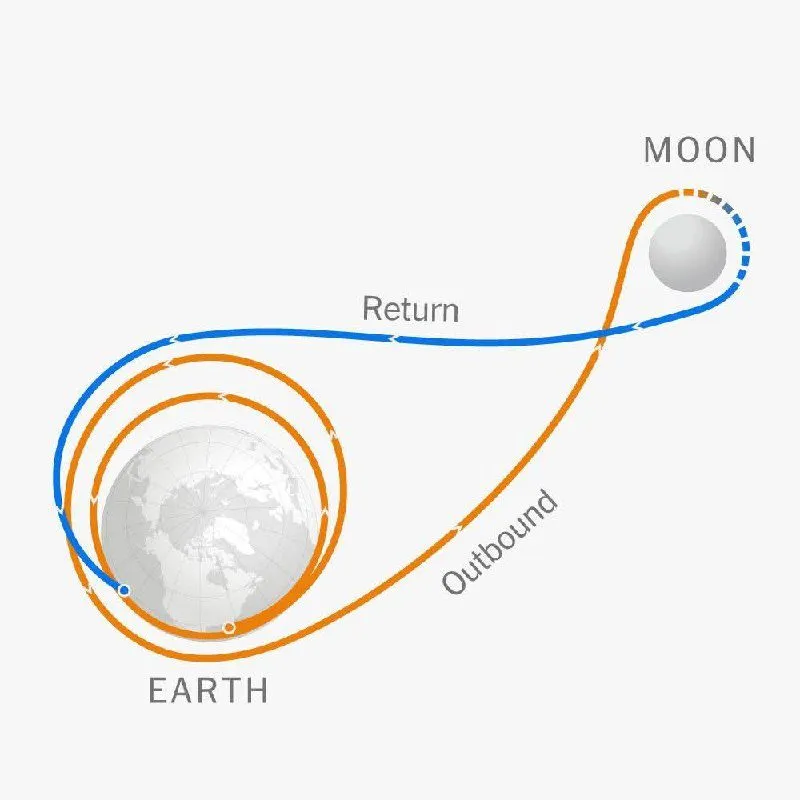
The supreme challenge of journeying to the Moon is not merely arriving there, but returning safely home. The ultimate safeguard ensuring that return lies in an elegant orbital design known as a free-return trajectory. This celestial pathway uses natural orbital mechanics to guide a spacecraft back toward Earth automatically.
A Cosmic Boomerang Across Cislunar Space
To grasp the intuition behind this trajectory, consider a familiar terrestrial object: the boomerang. Crafted by Indigenous Australians, a well-thrown boomerang curves through the air and returns directly to the thrower’s hand.
The path traversed by spacecraft like Orion mirrors this principle, acting like a cosmic boomerang hurled into the dark ocean of space. Yet unlike a wooden boomerang, no atmospheric drag or aerodynamics are at play. Here, the guiding force is pure gravity—the combined gravitational pull of Earth and the Moon.
The spacecraft is injected into a precisely calculated trajectory such that as it swings around the Moon, lunar gravity bends its flight path like a slingshot, redirecting it straight back toward Earth.
Elliptical Orbits and the Natural Path Home
While the overall flight appears as an elongated elliptical figure-eight centered on Earth, it is in truth a delicate product of the three-body gravitational dance between Earth, the Moon, and the spacecraft. As the ship rounds the lunar far side, the Moon’s gravitational pull alters its velocity vector, placing it on a direct ballistic intercept back to Earth.
Along this trajectory, the spacecraft returns home naturally without requiring any major propulsion burns. Although minor trajectory correction maneuvers consume small amounts of propellant to fine-tune atmospheric entry, the underlying flight path ensures that even in the event of total main-engine failure, the crew is guaranteed a safe return.
This passive safety architecture makes the free-return trajectory one of the most reliable principles in human spaceflight. Should primary propulsion fail or critical subsystems malfunction, the laws of orbital physics continue to serve as an invisible protective lifeline escorting the crew back to Earth.
Apollo 13: When Physics Saved Human Lives
The historic value of this trajectory was vividly proven in April 1970 during the ill-fated Apollo 13 mission. When a mid-flight oxygen tank explosion crippled the service module, Apollo 13 relied on this very free-return path to circle the Moon and return home safely. When human machinery broke down, the immutable laws of celestial mechanics saved three lives.
In modern lunar programs like NASA’s Artemis, the free-return concept remains a foundational safety pillar. While complex mission profiles may deviate to enter lunar orbit, free-return abort trajectories are meticulously designed into early mission phases as contingency lifelines.
The free-return trajectory underscores an enduring lesson of space exploration: bold ambition must always be matched by humble prudence. In the depths of the void, our safest path home is written by the timeless laws of nature.