Schrödinger's Cat: The Quantum Mechanics Thought Experiment
The Legacy of Physicist Erwin Schrödinger
Austrian physicist Erwin Schrödinger, born in Vienna in 1887, was one of the foundational architects of quantum mechanics. When explaining the behavior of subatomic particles, quantum mechanics is indispensable.
The Strange Principle of Quantum Superposition
Subatomic particles behave counter to classical physics. Under quantum laws, a particle can exist in multiple potential states simultaneously—a condition known as superposition. However, we cannot directly observe this superposition; the moment a measurement occurs, the particle appears in one definite state. Quantum reality must be described mathematically using probabilities.
The Wave Function and Schrödinger’s Nobel Prize
In 1926, Schrödinger formulated his famous wave equation, a partial differential equation that calculates the evolution of a quantum system’s wave function ($psi$). This achievement earned him the 1933 Nobel Prize in Physics.
Classical Trajectories versus Quantum Probability
Just as Isaac Newton’s equations predict the exact trajectory of a thrown ball, Schrödinger’s equation governs the probabilities of quantum particle states across time.
Applying Quantum Rules to Everyday Reality
Despite formulating wave mechanics, Schrödinger was deeply uneasy with how the Copenhagen school interpreted his mathematics. To illustrate the absurdity of applying quantum superposition to macroscopic objects, he devised his famous thought experiment: Schrödinger’s Cat.
The Architecture of the Thought Experiment
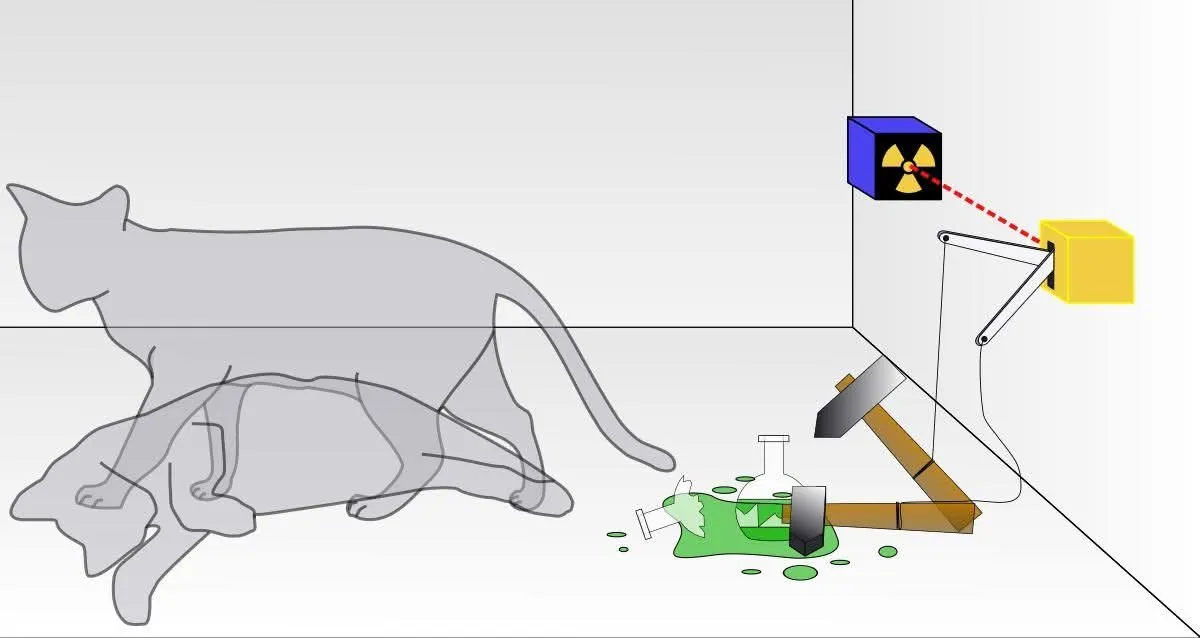
No animals were ever harmed; this was purely a theoretical thought experiment. Schrödinger imagined placing a living cat inside a sealed steel box. Alongside the cat is a tiny sample of radioactive material with a 50 percent probability of decaying within one hour. If an atom decays, a Geiger counter detects the radiation, triggering a relay that releases a hammer to shatter a vial of lethal hydrocyanic acid, instantly killing the cat. If no decay occurs, the vial remains intact and the cat lives.
The Paradox of Being Alive and Dead
Until someone opens the box after one hour, what is the state of the cat? According to the standard Copenhagen interpretation, because the radioactive atom exists in a superposition of decayed and undecayed states, the entire macroscopic apparatus—including the cat—must also exist in a superposition: simultaneously alive and dead!
Macroscopic Reality and Quantum Boundaries
Schrödinger’s goal was to demonstrate that applying micro-world quantum rules directly to everyday macroscopic objects leads to absurdities. In everyday reality, a cat is definitively either alive or dead, never both.
The Unsolved Measurement Problem
Schrödinger’s Cat highlights the “measurement problem” in quantum mechanics: where does the quantum world of superpositions end and the classical world of definite outcomes begin? Physicists continue to explore this boundary today through environmental decoherence, spontaneous collapse models, and quantum measurement theory.