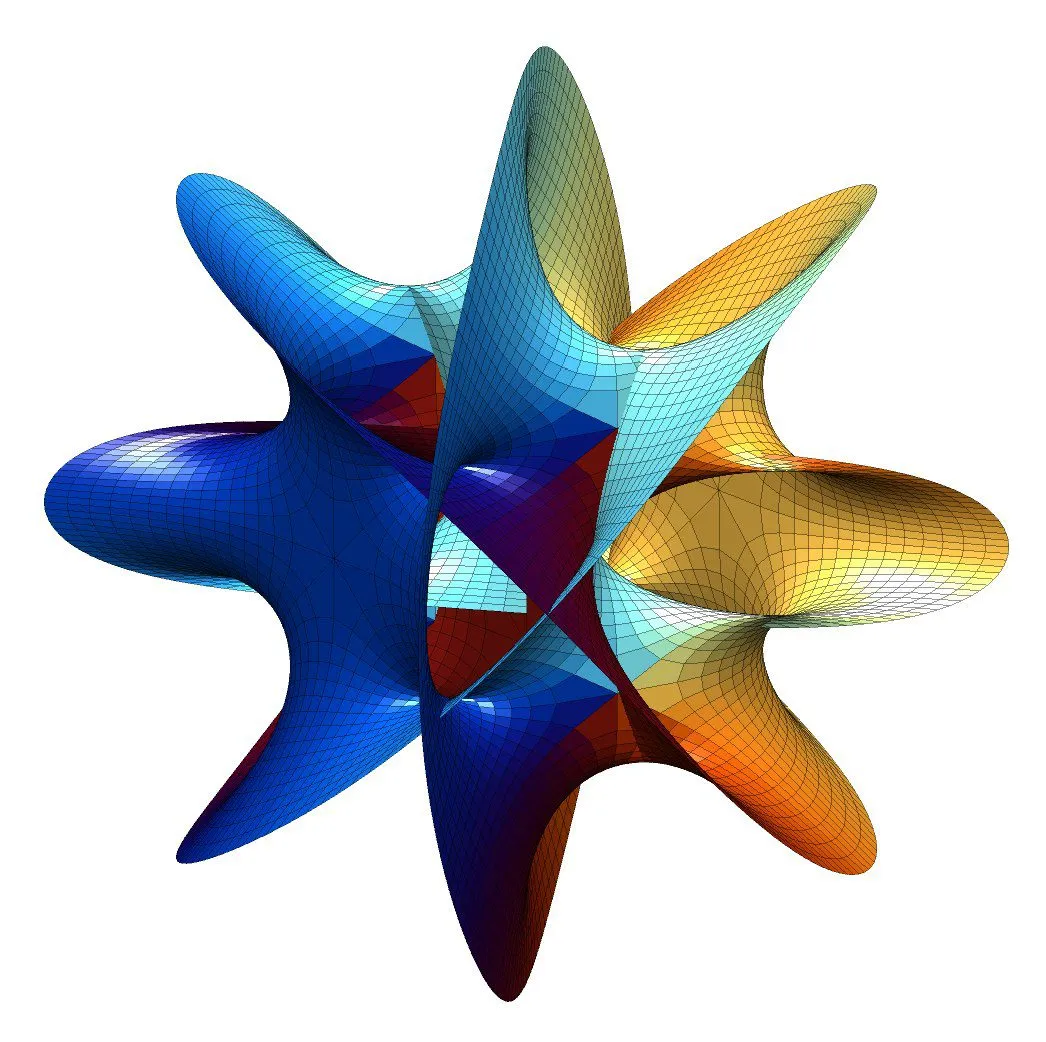
Riemannian Geometry: Unlocking the Curvature of Spacetime
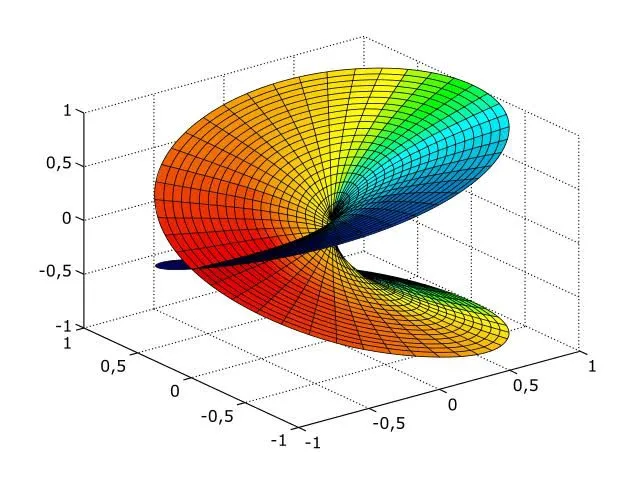
Rethinking the Shortest Distance Between Two Points
Elementary school textbooks teach us that the shortest distance between two points is a straight line. Yet in the real world, the shortest trajectory between two distant locations is frequently an arc. Long-haul commercial aviators flying from North America to Asia or Europe rarely travel along straight paths on flat navigational maps. Instead, they steer aircraft along curved, polar routes known as great-circle paths. By navigating curved geometry, flights save substantial flight time and fuel.
Euclidean Geometry and the Flat World Assumption
Does this mean elementary geometry is flawed? Not at all. Standard Euclidean geometry—codified over two millennia ago by the Greek mathematician Euclid of Alexandria—operates flawlessly on flat, two-dimensional planes. Euclid’s foundational postulates remain indispensable for daily engineering, architecture, and terrestrial surveying.
The Intrinsic Curvature of Earth
When measuring vast planetary distances, however, the planar assumptions of Euclidean geometry break down. While the Earth feels flat locally, it is a three-dimensional sphere floating through space. On short everyday walks, planetary curvature is imperceptible; on transcontinental flights and satellite orbits, it becomes decisive.
Geodesics, Riemannian Geometry, and the Metric Tensor
On curved surfaces, the shortest path between two coordinates is termed a geodesic. While a geodesic reduces to a straight line on a flat Euclidean sheet, calculating it on curved surfaces requires non-Euclidean mathematics. In the mid-nineteenth century, German mathematician Bernhard Riemann formulated the rigorous mathematical framework known as Riemannian geometry.
Riemann introduced the metric tensor, a mathematical object that quantifies the local distance, angles, and intrinsic curvature of any manifold across arbitrary dimensions. When Albert Einstein sought a mathematical language to describe how mass and energy warp four-dimensional spacetime in his general theory of relativity, he found the exact tools he needed in Riemann’s work.
The Geometry of Curved Triangles
Curved geometry produces striking mathematical counter-intuitions. In Euclidean geometry, the internal angles of any triangle strictly sum to 180 degrees. On a spherical surface, however, the sum of a triangle’s angles routinely exceeds 180 degrees.
Consider an equatorially anchored triangle on Earth: begin at the Prime Meridian (0° longitude) at the equator, traverse along the equator to 90° East longitude (passing south of Bangladesh), travel directly north to the North Pole, and then return down the Prime Meridian to the equator. Each of these three segments meets at a right angle of 90 degrees. The sum of the angles in this spherical triangle is 270 degrees! On hyperbolic or saddle-shaped surfaces, the sum falls below 180 degrees. The magnitude of this divergence directly reflects the curvature described by Riemannian geometry.