Calabi-Yau Manifold: Unlocking Hidden Dimensions
Beyond Visible Space: Four-Dimensional Spacetime
In our everyday realm, we perceive three spatial dimensions: forward-backward, left-right, and up-down. Blended with time, these form the four-dimensional spacetime continuum in which all our human experiences take place. Yet modern theoretical physics suggests that this familiar reality may not be the complete picture. Hidden behind the visible fabric of our cosmos could lie extra spatial dimensions that elude direct observation. This naturally prompts the question: where are these dimensions located, and why do our senses fail to detect them?
Consider a simple analogy. Viewed from a great distance, a long, thin wire appears like a purely one-dimensional line. Yet when inspected up close, it reveals both thickness and height—a full three-dimensional cylinder. The circular circumference wrapping around the wire is invisible from afar, tricking the eye into seeing only a line. In much the same way, extra spatial dimensions could permeate our universe, curled up at such microscopic scales that our conventional instruments cannot perceive them.
The Geometric Wonder of Calabi-Yau Manifolds
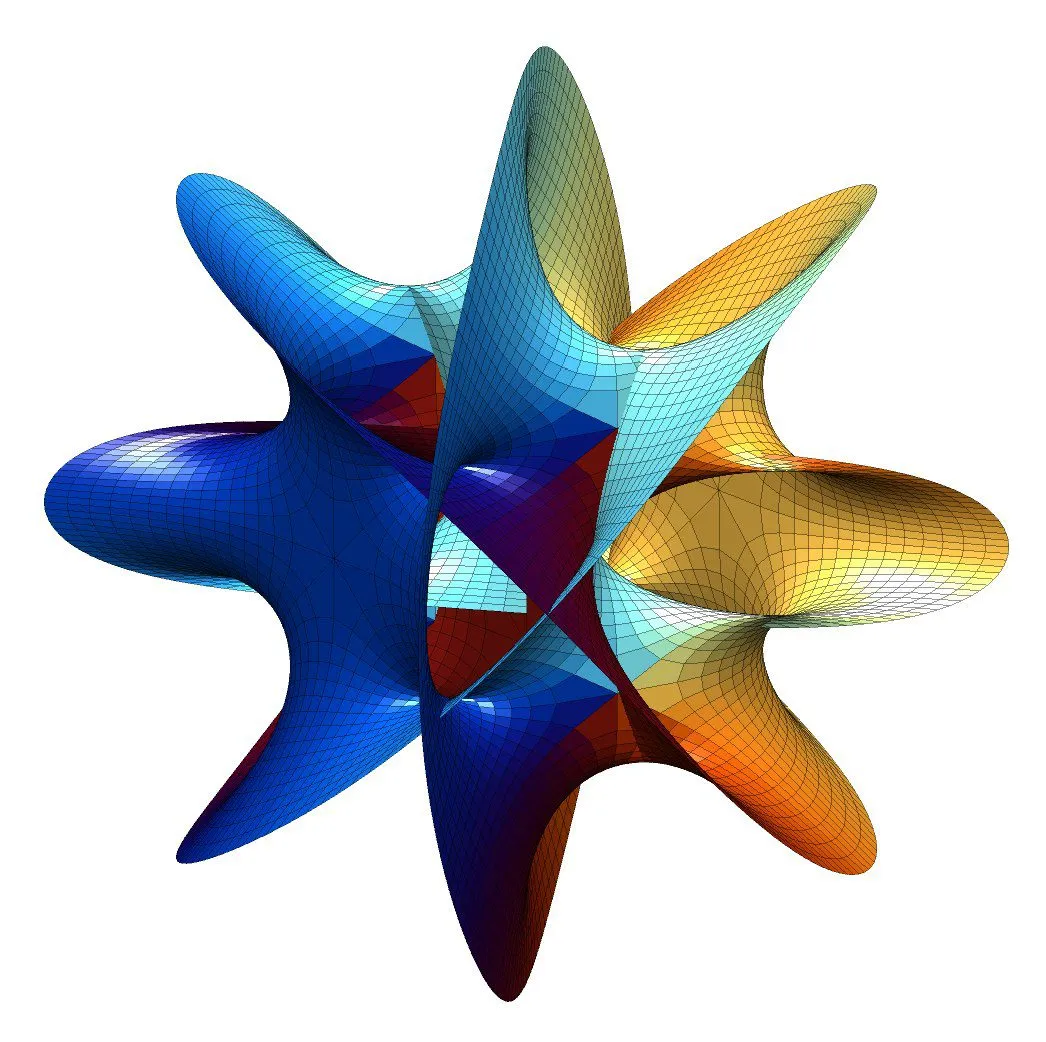
Theoretical physicists propose that these extra dimensions are not curled up at random. Instead, they compactify into exquisitely symmetrical geometric structures known as Calabi-Yau manifolds. The story behind the name is a landmark chapter in mathematical physics. In the 1950s, Italian-American mathematician Eugenio Calabi conjectured that certain compact complex manifolds could exist with zero Ricci curvature, representing a state of geometric balance. For decades, this remained an unproven hypothesis known as the Calabi conjecture. In the late 1970s, Chinese-American mathematician Shing-Tung Yau rigorously proved the conjecture, cementing the existence of what are now known worldwide as Calabi-Yau manifolds.

Demystifying Manifolds and Multidimensional Geometry
The term “manifold” is straightforward in concept. In geometry, a manifold is a space that appears flat and Euclidean in small, localized patches, even though its overall global structure may be intricately curved. The surface of Earth is a classic everyday example: it feels completely flat to someone standing on the ground, yet globally it forms a sphere. However, visualizing a Calabi-Yau manifold is far more challenging. These spaces twist, fold, and intertwine across six extra dimensions, punctured by multidimensional holes outside the bounds of sensory imagination. Yet within these enigmatic shapes, physicists believe the hidden fabric of physical reality is woven.
String Theory and the Cosmic Symphony
This is where string theory elevates geometry to the foundation of natural law. In string theory, fundamental particles are not zero-dimensional point masses, but tiny vibrating filaments of energy—strings. The frequency and modes at which these strings vibrate dictate the mass, charge, and spin of every known particle in the universe. Crucially, how a string vibrates depends directly on the geometry of the space it inhabits: the precise architecture of the Calabi-Yau manifold. Here, geometry ceases to be merely a passive background; it dictates the fundamental laws of nature. The universe becomes a grand cosmic symphony, with Calabi-Yau geometry acting as the acoustic instrument that determines the pitch of reality.
Yet this revelation brings a profound puzzle. Mathematics permits not one or two, but hundreds of thousands of distinct Calabi-Yau configurations. Why did our universe select the specific geometry that produces the physics we observe? Science does not yet know. In this unanswered question lies one of the most tantalizing frontiers in modern theoretical physics.
What we see around us is merely a glimpse of reality’s deeper architecture. Hidden within the microscopic crevices of space, dimensions, geometry, and matter entwine to generate the cosmos. Calabi-Yau manifolds remind us that nature’s true foundation is far more marvelous than our senses could ever foresee.