The Butterfly Effect Explained: Chaos Theory in Real Life
Can a Butterfly Trigger a Tornado?
Consider an intriguing thought experiment: a solitary butterfly flaps its delicate wings along the coastline of Brazil. Days or weeks later, tiny air disturbances multiply across atmospheric gradients, ultimately unleashing a ferocious tornado across Texas. While this sounds like whimsical folklore, it represents the foundational principle of a profound scientific framework: the butterfly effect.
Edward Lorenz and the Birth of Chaos Theory
The origins of this concept date back to 1961, when MIT meteorologist and mathematician Edward Lorenz was simulating atmospheric weather models on an early computer. Hoping to repeat a particular weather simulation, Lorenz restarted the program midway through, rounding an input variable from 0.506127 to 0.506. Believing a difference of less than one part in a thousand was negligible, he left the machine to run.
When he returned, the resulting weather projection bore no resemblance to the original forecast. What began as a minute rounding variation had cascaded exponentially into entirely different weather patterns. From this revelation, Lorenz recognized that complex, non-linear dynamical systems exhibit sensitive dependence on initial conditions. He had discovered modern chaos theory.
The Geometry of the Lorenz Attractor
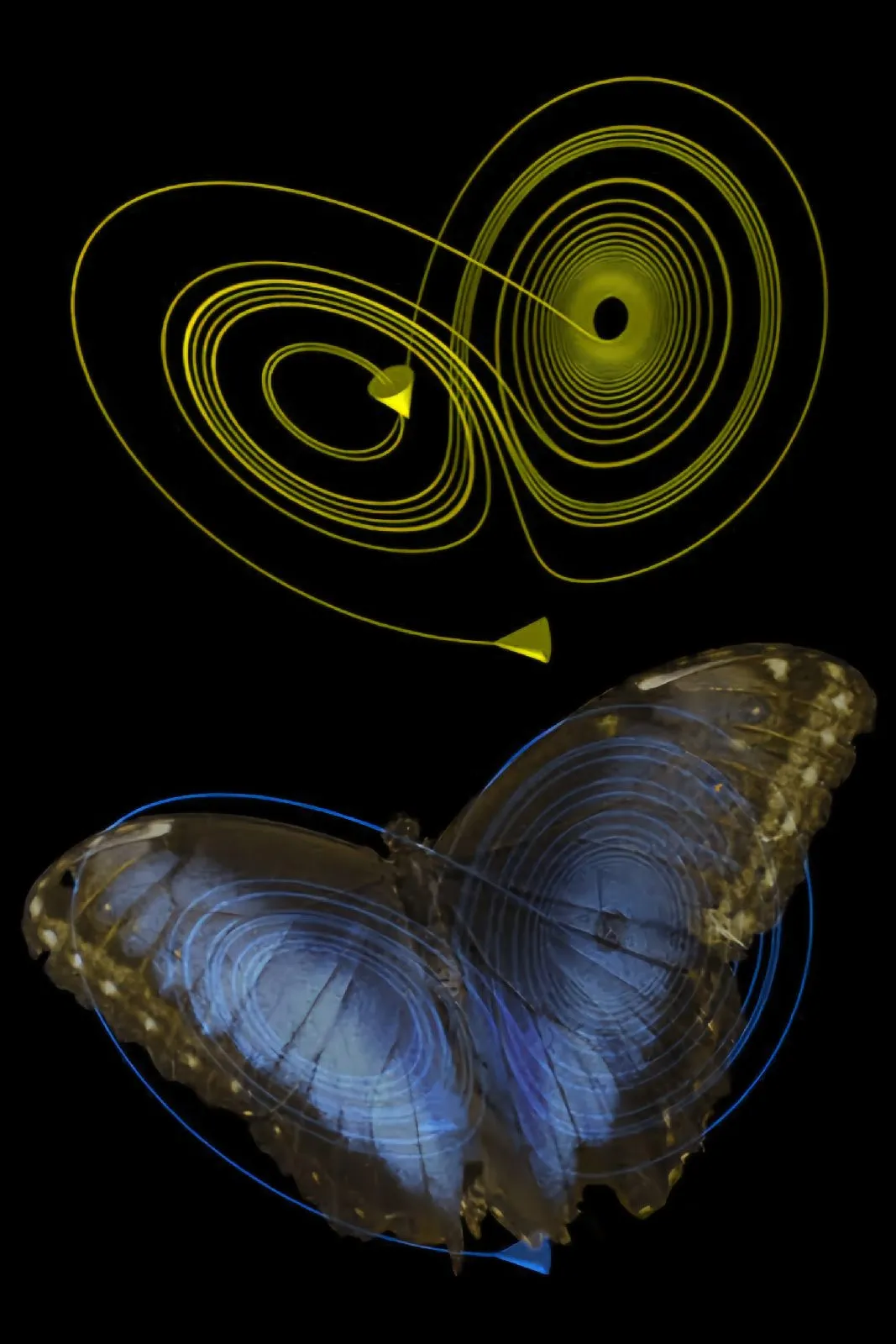
Lorenz formulated a simplified system of three coupled non-linear differential equations modeling atmospheric convection. When plotted in three-dimensional phase space, the trajectories never intersect or repeat, yet they remain bound within a deterministic fractal shape known as the Lorenz attractor. Remarkably, the visual graph resembles the spreading wings of a butterfly—a poignant mathematical symmetry for chaos theory.
Chaos Theory Across Human Experience
The implications of the butterfly effect extend well beyond atmospheric meteorology. Financial markets, macroeconomic trends, population ecologies, neurobiology, and even individual personal biographies operate as sensitive dynamical systems. A casual encounter, a delayed subway train, or a kind word spoken to a stranger can trigger cascading ripples that permanently alter human lives.
The Subtle Rhythms of Our World
Lorenz’s work shattered the classical Newtonian conceit that nature is completely predictable if given sufficient calculating power. The butterfly effect reminds us that small actions carry latent power; in a dynamic, interconnected reality, subtle choices can shape monumental outcomes.